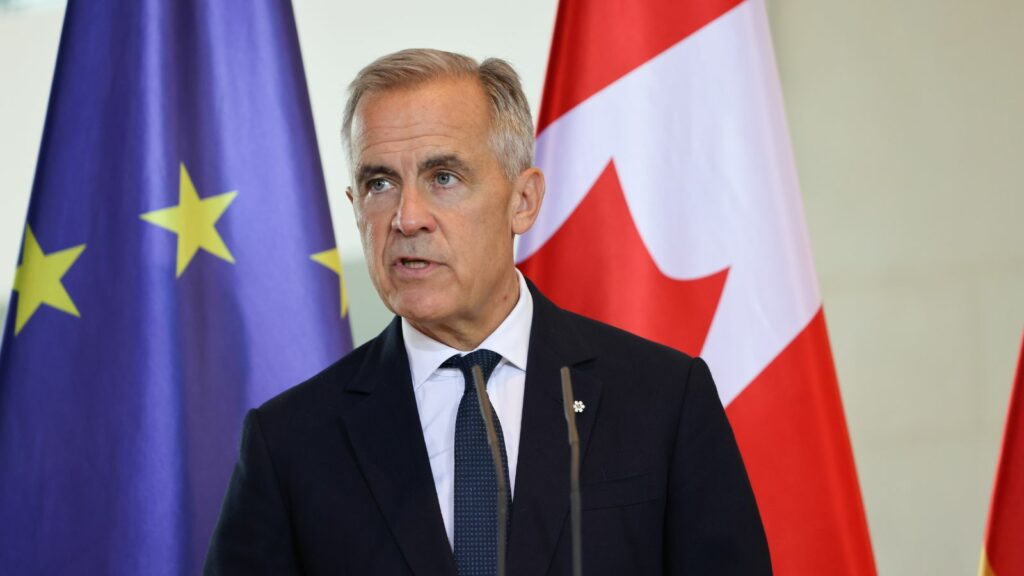
Canada’s economic relationship with Europe is entering a new chapter as Prime Minister Mark Carney moves to strengthen international trade ties amid growing tensions with the United States. At a major summit in Montreal on October 30, 2026, Canada and the European Union announced the successful conclusion of negotiations for a new Digital Trade Agreement designed to make cross-border business easier, strengthen consumer protections, and create opportunities for Canadian companies.
The development comes as U.S. President Donald Trump’s trade policies continue to raise concerns about Canada’s dependence on its largest trading partner. With Canadian businesses increasingly looking beyond the American market, the agreement represents an important step toward expanding economic opportunities across Europe. However, the negotiations’ conclusion is only the beginning, with formal approval and implementation still ahead.
Montreal Summit Delivers a Major Trade Breakthrough
The breakthrough came during the 21st Canada-European Union Summit, held in Montreal on October 29 and 30, 2026. Prime Minister Mark Carney welcomed European Commission President Ursula von der Leyen and European Council President António Costa for discussions focused on economic cooperation, security, and technological development. One of the most significant announcements was the completion of negotiations for a Digital Trade Agreement, Canada’s first international agreement dedicated entirely to digital trade. The announcement marked an important milestone in Ottawa’s efforts to strengthen commercial relationships beyond North America.
Canadian International Trade Minister Maninder Sidhu and EU Trade Commissioner Maroš Šefčovič helped advance the negotiations, which officially began in March 2026. Their discussions focused on creating a more predictable environment for businesses operating across borders. Although both governments celebrated the outcome, the agreement has not yet been formally signed or implemented. The conclusion represents a political breakthrough, with legal procedures and approvals still required before the new rules can take effect.
New Rules Could Make Online Business Much Easier
One of the agreement’s most practical objectives is reducing the administrative work involved in selling products and services internationally. The European Commission says the framework promotes electronic contracts, digital signatures, and electronic invoices, making commercial transactions more efficient. These changes could be particularly valuable for Canadian software developers, technology consultants, and businesses providing digital services to European customers. Instead of navigating unnecessary paperwork and uncertainty about electronic documentation, companies could benefit from more predictable rules governing transactions conducted across borders.
Consider a small Canadian technology company negotiating a contract with a customer in Germany. Legal uncertainty surrounding digital documents can complicate arrangements, particularly when several jurisdictions are involved. Clearer rules could make signing agreements, issuing invoices, and managing payments less cumbersome. However, the agreement will not eliminate every regulatory requirement or guarantee immediate cost reductions. Businesses must still comply with applicable consumer, tax, and commercial laws. Its principal advantage is greater certainty, which can make international expansion less intimidating.
Cross-Border Data Flows Become a Central Priority
Modern international commerce depends on information moving securely between countries. A Canadian software provider serving European clients may need to exchange customer records, process transactions, or maintain cloud-based services across multiple jurisdictions. Restrictions on these activities can introduce additional costs and operational complications. The new Digital Trade Agreement seeks to address unjustified barriers to cross-border data transfers while preserving safeguards for personal information. European officials have identified trusted data flows as one of the agreement’s central features, reflecting the growing importance of information infrastructure to international business.
The issue also emerged during Canada’s public consultations on the proposed agreement in 2025. Global Affairs Canada received 45 written submissions, with businesses and other stakeholders emphasizing the importance of secure data transfers and expressing concerns about unnecessary data-localization requirements. However, support for international data movement was not unconditional. Privacy, cybersecurity, and national regulatory authority remained important considerations. The challenge for both governments is allowing legitimate commercial information to move efficiently without weakening protections for individuals or sensitive information.
Small Canadian Businesses Could Gain Access to More European Customers
The agreement could prove especially meaningful for smaller Canadian companies that lack the resources of multinational corporations. The European Union represents a market of 27 member countries and more than 445 million consumers, creating opportunities for businesses offering software, consulting, cybersecurity, and specialized digital services. Statistics Canada reported that small and medium-sized enterprises accounted for 97.4% of Canadian businesses exporting goods in 2024, although larger firms generated most export value. Reducing regulatory uncertainty could help more of these smaller companies explore international opportunities.
For a Canadian entrepreneur operating a growing online business, Europe offers the possibility of reaching customers across multiple national markets. A cybersecurity consultancy in Ottawa, for example, could pursue contracts with European businesses seeking specialized services. Digital trade rules may simplify parts of that commercial relationship, but success will still require competitive pricing, effective marketing, and compliance with European regulations. The agreement removes neither language barriers nor the challenge of establishing customer trust. Its value lies in making expansion more manageable.
Consumer Protection Remains a Major Part of the Agreement
The negotiations were not solely focused on making international commerce faster. Both Canada and the European Union emphasized the importance of protecting consumers from misleading advertising, fraudulent transactions, and unwanted electronic communications. According to the European Commission, the agreement includes commitments addressing unsolicited commercial messages. These provisions require commercial communications to identify their sender and provide recipients with ways to stop receiving further messages. The objective is to promote trust in online transactions while maintaining a reliable environment for legitimate businesses.
Canada already has domestic protections through its anti-spam legislation, commonly known as CASL, which regulates commercial electronic communications and includes requirements concerning consent, sender identification, and unsubscribe mechanisms. The new agreement is therefore not creating consumer safeguards from nothing. Instead, it aims to establish greater consistency in expectations across the Canada-EU trading relationship. That matters when a customer purchases software from another country or subscribes to an international online service. Stronger confidence in digital transactions could encourage business activity without requiring consumers to surrender essential protections.
Canada Already Has a Multibillion-Dollar Digital Trade Relationship With Europe
The economic importance of the agreement becomes clearer when examining existing trade figures. According to the European Commission, digitally delivered services traded between Canada and the EU reached approximately €19.8 billion in 2025. Of that amount, European exports to Canada accounted for €11.2 billion, while European imports from Canada totalled €8.6 billion. These figures illustrate how extensively businesses already rely on digital services moving across the Atlantic, even before the new agreement takes effect.
Canada’s International Trade Minister Maninder Sidhu has also highlighted the sector’s potential, noting that Canadian businesses exported nearly C$15 billion in digitally deliverable services to the EU in 2024. The Canadian and European figures use different reporting years and statistical categories, so they should not be treated as directly comparable growth measurements. Nevertheless, they demonstrate an existing commercial relationship with considerable scale. Canadian technology workers, consultants, software developers, and other service providers could benefit if clearer international rules encourage additional business relationships and investment.
The Digital Deal Builds on Nearly a Decade of CETA
The new agreement does not replace the Canada-European Union Comprehensive Economic and Trade Agreement, commonly known as CETA. That agreement entered into provisional application on September 21, 2017, and dramatically reduced tariffs on merchandise moving between the two economies. By 2024, approximately 99% of tariff lines had been eliminated. CETA also provided improved market access for services and established mechanisms for regulatory cooperation. However, its original framework was negotiated before many of today’s digital commercial practices had become as economically important.
The existing agreement already contains provisions addressing electronic commerce, including restrictions on customs duties for electronic deliveries. What the new Digital Trade Agreement offers is a more specialized framework addressing data transfers, electronic documentation, and consumer confidence. The distinction matters because international trade increasingly involves services that can be delivered electronically rather than products transported through ports. European Commission figures show that bilateral trade in goods and services increased by roughly 80% between 2016 and 2025, reaching more than €130 billion. The digital agreement is intended to build on that existing relationship.
Trump’s Tariff Policies Have Made Trade Diversification More Urgent
Canada’s push toward Europe comes against the backdrop of a difficult trading relationship with Washington. President Donald Trump’s tariff measures and demands during bilateral negotiations have created uncertainty for Canadian exporters, particularly in industries such as automotive manufacturing and steel. The economic exposure is substantial. Statistics Canada reported that 71.7% of Canadian merchandise exports went to the United States in 2025, down from 75.9% in 2024. Although the share declined, the figures demonstrate how dependent Canadian businesses remain on American demand.
Carney has set a broader objective of doubling Canada’s exports to markets outside the United States over the next decade. The European agreement supports that strategy by strengthening an alternative commercial relationship. However, diversification does not mean abandoning American trade. On November 1, Carney reported a constructive conversation with Trump about a possible bilateral agreement, with further negotiations expected. Ottawa is therefore pursuing two objectives simultaneously: maintaining access to its most important export market while developing additional opportunities that could reduce its vulnerability to future trade disputes.
A Much Larger Canada-EU Alliance Is Taking Shape
The Digital Trade Agreement was only one component of the broader partnership announced in Montreal. Carney and European leaders launched an initiative called the Alliance for the Future, covering trade, technology, critical resources, financial services, security, and people-to-people cooperation. Among the announcements was Canada’s participation in the European High Performance Computing Joint Undertaking, which supports research involving powerful computing infrastructure and emerging technologies. Both sides also outlined plans for closer cooperation on artificial intelligence, cybersecurity, semiconductors, and advanced research.
Other proposals could reshape how businesses and institutions operate across the Atlantic. Canada and the EU intend to explore connections between their instant payment systems, consider new subsea communications infrastructure, and strengthen research partnerships. These initiatives remain at different stages of development and should not be mistaken for completed projects. Leaders also committed to defining a closer form of association between Canada and the EU by their 2027 summit, without pursuing full EU membership. Together, the initiatives suggest an effort to build a more comprehensive economic relationship rather than negotiate isolated trade agreements.
The Agreement Still Faces Important Steps Before Taking Effect
Despite the positive announcements, the Digital Trade Agreement has not completed the legal process required to become operational. The signing ceremony in Montreal included a political document confirming the conclusion of negotiations, rather than the final treaty itself. According to the European Commission, the next stage involves legal review and translation into the EU’s official languages. The agreement must then proceed through the relevant European institutions, including the Council of the European Union and the European Parliament. Canada must also complete its domestic procedures before the agreement can formally enter into force.
For Canadian businesses, the distinction between political agreement and implementation is important. Companies considering European expansion cannot assume that every proposed benefit is immediately available. They will need to monitor the final legal text, implementation timelines, and any resulting regulatory changes. The longer-term test will be whether businesses experience lower administrative costs, stronger customer relationships, and increased exports. For Carney, the agreement represents progress toward economic diversification, but its ultimate significance will depend on whether that political achievement translates into measurable commercial opportunities.
