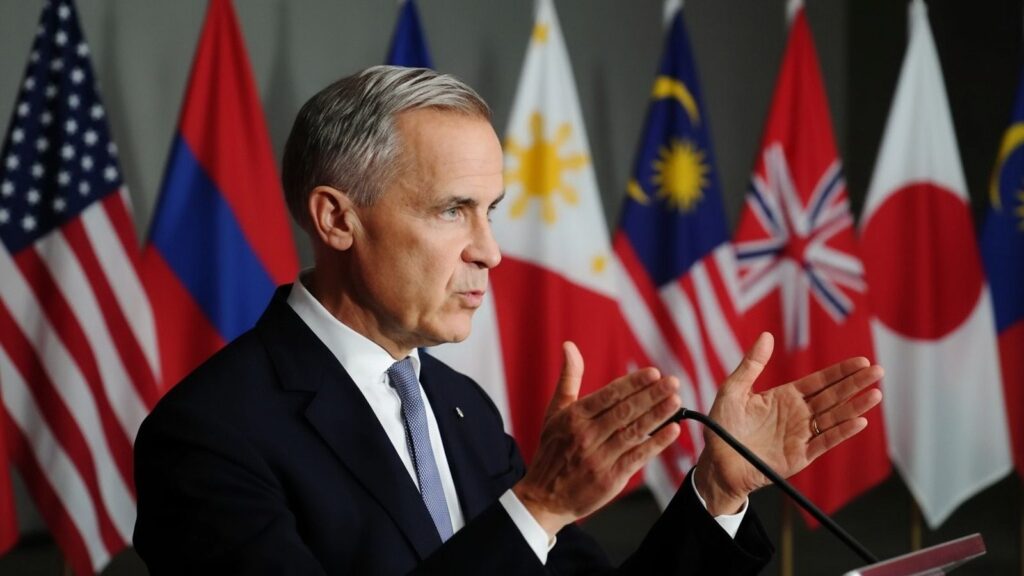
Canada’s next federal budget is arriving at a critical moment for the country’s economy, with Prime Minister Mark Carney facing pressure to protect Canadian jobs, encourage business investment and deliver meaningful relief to households struggling with everyday expenses.
Finance Minister François-Philippe Champagne is preparing to table Budget 2026 on November 5, promising new investment incentives and a stronger focus on affordability as uncertainty surrounding President Donald Trump’s trade policies continues to affect Canadian businesses.
The government is attempting to strengthen Canada’s economic independence while maintaining its most important trading relationship. With manufacturers facing tariff pressures, businesses reconsidering investment decisions and families watching household costs, the upcoming budget could become one of the defining economic tests of Carney’s government.
A Federal Budget Arriving at a Critical Moment for Canada
The federal government is preparing to present its November 5 budget against a backdrop of significant economic uncertainty, particularly surrounding Canada’s relationship with the United States. American tariffs have complicated business planning for Canadian manufacturers and exporters, while negotiations between Ottawa and Washington have yet to produce a comprehensive resolution. The timing is especially important because the budget arrives just two days after the November 3 U.S. midterm elections, which could influence the political environment surrounding future trade discussions. Although Carney and Trump recently described their conversations about a potential trade agreement as constructive, significant questions remain about tariffs affecting Canadian steel, automobiles and other industries. For businesses dependent on cross-border trade, encouraging diplomatic statements provide little certainty until concrete agreements are reached.
Champagne has characterized the government’s budget strategy as an effort to change Canada’s economic growth model, placing greater emphasis on private investment and productivity. Speaking to business leaders in Toronto on November 2, the finance minister outlined how new investment incentives could benefit companies of different sizes, from small businesses purchasing equipment to major developers pursuing infrastructure projects. The broader objective is to make Canada a more attractive place to invest while strengthening economic activity beyond traditional reliance on American markets. During its pre-budget consultations, Ottawa heard from businesses, workers, academics and community organizations about affordability, competitiveness and economic security. Those competing priorities help explain why the government is attempting to combine business-oriented tax incentives with measures intended to improve Canadians’ financial circumstances.
New Tax Incentives Could Transform Business Investment
One of the most significant components of Carney’s economic strategy is the Productivity Mega Deduction, a tax incentive announced in September that is expected to feature prominently in Budget 2026. The proposal would allow businesses to immediately deduct the full cost of a much broader range of qualifying capital investments rather than spreading those deductions over several years. Under the government’s earlier Productivity Super-Deduction, approximately 15% of capital investment was eligible for immediate expensing. The expanded approach would increase that coverage to roughly two-thirds of capital investment, including software, machinery, transportation infrastructure and other productive assets. Federal estimates suggest the change could reduce Canada’s marginal effective tax rate on new business investment from approximately 13% to 6.4%, potentially improving the country’s attractiveness compared with the United States and other advanced economies.
The expanded deduction carries a substantial fiscal cost, estimated at $36 billion over five years beginning in 2026–27. Ottawa argues that making these incentives permanent would provide businesses with greater certainty when considering expensive investments that may take years to generate returns. A manufacturer contemplating new production equipment, for example, could benefit from faster tax deductions that improve the financial case for modernizing its operations. However, a tax deduction is not the same as a direct government payment, and businesses still need sufficient financing, customers and confidence before committing to major purchases. The government’s challenge will be demonstrating that the forgone tax revenue translates into additional investment, stronger productivity and employment opportunities rather than merely rewarding projects that companies would have pursued regardless.
Small Businesses Could See a Simpler Tax System and More Innovation Support
Small and medium-sized businesses are emerging as an important focus of the government’s proposed tax reforms. During his November 2 remarks, Champagne acknowledged that Canada’s complicated tax system can make it difficult for smaller firms to take full advantage of available incentives without professional assistance. He suggested the budget would address some of those challenges by simplifying how businesses access investment opportunities and government support. The finance minister also raised the possibility of additional changes to the Scientific Research and Experimental Development program, commonly known as SR&ED. This federal program provides tax deductions and investment tax credits for eligible research and development activities conducted in Canada. For smaller technology companies, manufacturers and innovative businesses, changes to the program’s accessibility could be particularly valuable because developing new products often requires significant spending before commercial revenue arrives.
The government has already introduced several SR&ED improvements that provide a foundation for potential additional reforms. Legislative changes enacted in March 2026 increased the annual expenditure limit for the enhanced 35% investment tax credit from $3 million to $6 million for qualifying businesses. The Canada Revenue Agency also launched an optional pre-claim approval process in April, allowing eligible companies to receive an advance determination about whether proposed research activities qualify for incentives. According to the agency, small businesses accounted for 65% of SR&ED claims submitted during the 2025–26 fiscal year. These developments demonstrate the importance of smaller companies to Canada’s innovation sector. However, Champagne has not yet disclosed precisely which additional changes might appear in the November budget, making the final details important for entrepreneurs deciding whether to expand research, hire specialized employees or pursue new technology investments.
Grocery Prices and Everyday Affordability Remain Major Priorities
Affordability is expected to remain a central theme of Budget 2026, even though Ottawa has already introduced several measures intended to ease financial pressures on households. One of the most significant is the Canada Groceries and Essentials Benefit, which replaced the GST/HST credit in July 2026. The government increased the benefit by 25% for five years and delivered an additional one-time payment in June. Combined with the existing benefit, an eligible family of four could receive up to $1,890 in 2026, while an eligible single person could receive up to $950. The enhanced payments are intended to assist more than 12 million Canadians, particularly households with low or modest incomes. Nevertheless, financial pressures remain considerable for families whose grocery, transportation and housing expenses consume a large share of monthly income.
Statistics Canada reported that consumer prices increased 3.1% year over year in September 2026, while grocery prices rose 1.7%. Although food inflation has slowed, grocery prices remain approximately 33% higher than in September 2020, illustrating why many Canadians continue to feel financially squeezed. The government has also extended its suspension of the federal fuel excise tax, maintaining relief of 10 cents per litre on gasoline and four cents per litre on diesel until January 31, 2027. Half the regular tax rate is scheduled to return in February and March. These existing measures establish the government’s affordability approach, but the upcoming budget will determine whether additional assistance is introduced. The distinction matters because slowing inflation does not mean prices are returning to their previous levels, leaving households seeking lasting improvements in purchasing power.
Housing Affordability Could Bring More Support for Buyers and Builders
Housing remains another major affordability challenge, particularly for younger Canadians and families attempting to enter the property market. Carney’s government has already introduced a first-time home buyers’ GST/HST rebate that can eliminate the federal sales tax on qualifying newly built homes priced up to $1 million. The rebate gradually declines for eligible properties valued between $1 million and $1.5 million, with potential savings reaching $50,000. Ottawa has also established Build Canada Homes, a federal agency intended to accelerate affordable housing construction through public land, financing tools and modern building methods. These measures reflect an attempt to address housing affordability from two directions: reducing some buyers’ upfront costs while encouraging developers to increase the supply of available homes.
The federal government has also committed funding to reduce barriers that make new housing expensive to build. The Improving Housing Supply Act, which received Royal Assent in June 2026, provides $1.7 billion to provinces and territories for initiatives that can include lowering development charges and encouraging residential construction. Ontario has separately partnered with Ottawa on an $8.8-billion, 10-year initiative aimed at housing-related infrastructure and reducing construction costs. However, tax rebates alone cannot solve Canada’s housing affordability problems. Buyers must still qualify for mortgages, while renters depend on adequate housing availability and sustainable rental costs. The November budget will therefore be closely examined for additional steps to accelerate construction, improve financing conditions and address the financial barriers facing households that remain unable to purchase a home.
Canadian Manufacturers Face Growing Pressure From Trump’s Tariffs
Canada’s manufacturing sector remains particularly exposed to the consequences of the trade dispute with Washington. Automotive producers, steel companies and businesses supplying American factories face uncertainty about tariff costs, production decisions and future investment. In late October, Canada and the United States were negotiating potential relief from American duties that included tariffs of up to 50% on Canadian steel and 25% on automobiles. The broader economic relationship remains substantial. Statistics Canada reported that merchandise exports to the United States reached approximately $54.3 billion in August 2026, representing nearly 70% of Canada’s total goods exports that month. These figures demonstrate why reducing dependence on the American market cannot happen overnight, particularly for manufacturers whose supply chains, customers and production facilities have developed around cross-border integration.
Ottawa has responded with financial assistance intended to help affected companies maintain operations and prepare for changing trade conditions. Measures announced in August included an additional $1.5 billion for the Regional Tariff Response Initiative, $2 billion for the Canada Strong Diversification Fund and $3.5 billion in rapid-response support for workers and employers. These initiatives are intended to provide liquidity, preserve industrial capacity and help employees affected by trade disruptions access training or income assistance. The upcoming budget offers an opportunity to clarify how those programs will operate alongside broader investment incentives. However, financial assistance cannot fully replace the value of predictable access to the American market. For automotive suppliers and other exporters, long-term decisions about factory upgrades, hiring and production locations will continue to depend heavily on whether Ottawa can secure more stable trading conditions.
Trade Diversification Becomes a Bigger Part of Canada’s Economic Strategy
Reducing Canada’s exposure to American trade policy has become a central component of Carney’s economic agenda. Just days before the budget, the prime minister hosted European Union leaders in Montréal, where Canada and the EU announced a new Alliance for the Future on October 30. The partnership is intended to deepen cooperation in critical minerals, energy, advanced technology, financial services and strategic supply chains. Negotiations were also concluded on a digital trade agreement, while Canada and the European Investment Bank reached an understanding intended to facilitate investment in Canadian critical resources. These developments reflect Ottawa’s effort to create additional markets and investment opportunities beyond the United States. The strategy has some momentum: Statistics Canada reported that Canadian merchandise exports to non-U.S. destinations during the first half of 2026 were 19.4% higher than in the second half of 2025.
The federal budget is expected to reinforce this strategy by encouraging investment in transportation infrastructure, industrial capacity and major economic projects. Diversification requires more than signing trade agreements because Canadian businesses need reliable shipping routes, sufficient production capacity and competitive financing to reach customers in distant markets. A manufacturer attempting to expand European sales, for example, may need new equipment, specialized workers and access to efficient ports before additional exports become commercially practical. Canada’s new European partnership could create opportunities in these areas, but the benefits will depend on implementation and private-sector participation. Ottawa must also manage its existing relationship with the United States, which remains Canada’s largest goods export market. The economic challenge is therefore not simply replacing American trade, but developing additional sources of demand that make Canadian businesses less vulnerable to sudden policy changes in Washington.
Rising Deficits and Higher Interest Rates Complicate Ottawa’s Plans
The government’s plans to accelerate investment and improve affordability must also be measured against Canada’s fiscal position. In its October 2026 economic and fiscal outlook, the Parliamentary Budget Officer projected a federal deficit of $63.3 billion for the 2026–27 fiscal year. The independent watchdog also forecast cumulative deficits of approximately $333.3 billion over five years, with federal debt increasing relative to the size of the economy. Its projections incorporate measures already announced but do not account for additional initiatives that may be unveiled on November 5. The same report lowered Canada’s projected economic growth to 0.9% in 2026 and 1.5% in 2027, citing weaker trade conditions among the factors influencing the outlook. These figures illustrate the government’s difficult balancing act between supporting economic expansion and managing borrowing requirements.
The Bank of Canada’s latest interest rate decision adds another complication. On October 28, the central bank increased its policy rate by 25 basis points to 2.5%, its first rate increase since July 2023. Officials cited persistent energy-related inflation and the risk of higher business costs spreading more broadly through the economy. For households with variable-rate borrowing and businesses relying on financing, higher interest rates can make financial planning more difficult. They also reinforce the importance of designing federal programs that deliver measurable results without unnecessarily adding to inflationary pressures. Ottawa argues that productive investment can strengthen long-term economic capacity, but those benefits may take years to emerge. The immediate question is whether the upcoming budget can provide sufficient relief and economic support while maintaining a credible plan for Canada’s public finances.
Budget Day Will Reveal Whether Ottawa Can Balance Growth and Affordability
Beyond the economic projections, Budget 2026 will test the government’s ability to respond to competing political priorities. Conservative Leader Pierre Poilievre has called on Carney to reduce federal spending, strengthen fiscal discipline and provide additional fuel-tax relief. His proposals include temporarily eliminating federal taxes on diesel and suspending the GST on fuel. Meanwhile, the Liberal government has emphasized attracting private investment, accelerating major projects and creating the conditions for stronger Canadian productivity. Both approaches address concerns about the cost of living, but they differ considerably in how they seek to achieve economic improvement. One emphasizes immediate tax reductions and spending restraint, while the other places greater weight on investment incentives and long-term productive capacity. The budget’s details will show how Ottawa intends to balance those priorities.
For Canadians, the most important distinction will be between measures that are already operating, policies announced but still awaiting implementation, and genuinely new commitments unveiled on November 5. Businesses will be watching the eligibility requirements, implementation dates and administrative details of tax incentives. Households will be looking for evidence that affordability measures can produce noticeable improvements in everyday financial circumstances. Workers in trade-exposed industries will want assurance that economic diversification does not leave existing communities behind. Ultimately, Carney’s budget will be judged on whether its spending commitments and incentives produce tangible economic benefits. With American trade uncertainty continuing and domestic financial pressures remaining significant, Ottawa faces an unusually demanding task: strengthening Canada’s long-term independence without losing sight of the immediate financial concerns affecting millions of Canadians.
