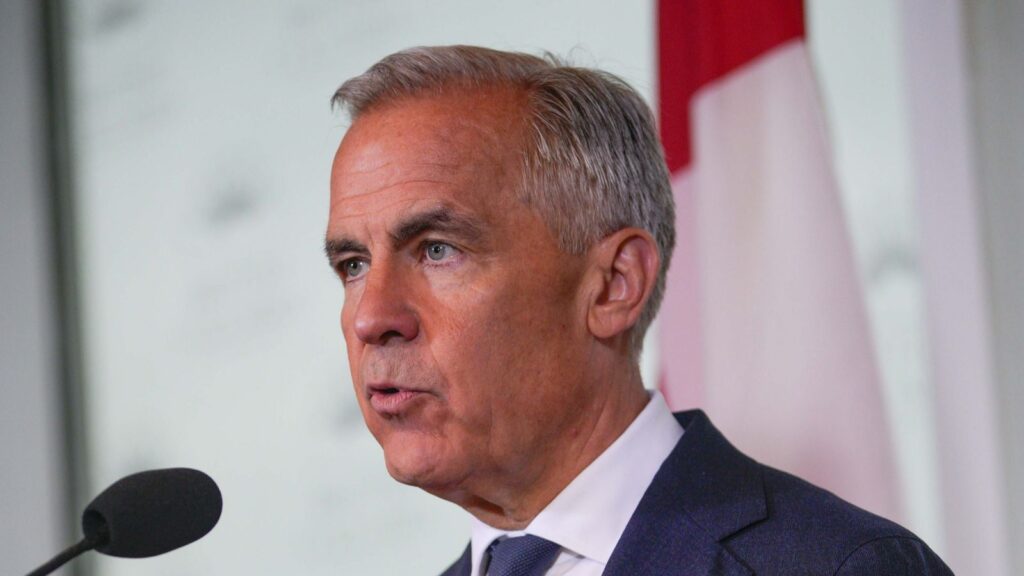
A diplomatic disagreement between Ottawa and Quebec is turning into a broader confrontation over political authority, provincial autonomy, and Canada’s international relationships. Quebec Premier Paul St-Pierre Plamondon has agreed to meet Prime Minister Mark Carney ahead of November’s Francophonie Summit, but only if the meeting takes place in Quebec City.
The demand follows a contentious Canada–European Union Summit in Montreal, where Ottawa refused to grant Quebec’s premier an official speaking role, prompting him to stay away. Although both leaders have signalled a willingness to talk, the disagreement has exposed deeper tensions over Quebec’s ability to represent its interests internationally. With another major diplomatic gathering approaching, the proposed meeting could become an important test of relations between the newly elected Quebec government and Ottawa.
An Invitation That Comes With Conditions
St-Pierre Plamondon’s November 1 response was carefully worded. Rather than rejecting Carney’s invitation, the Quebec premier publicly accepted it and thanked the prime minister for what he described as a change in tone. However, his acceptance came with a clear condition: the meeting should take place in Quebec City. Carney had proposed the discussion in an interview with La Presse published on October 31, explaining that he wanted to establish common objectives before the upcoming Francophonie Summit and maintain a constructive relationship between Ottawa and Quebec. The invitation represented a potential opening after several days of public disagreement, although neither leader had indicated that the underlying dispute was resolved.
The timing creates additional pressure for both governments. The Francophonie Summit is scheduled for November 15–16 in Phnom Penh, Cambodia, following ministerial meetings on November 14. That leaves a relatively narrow window for the two leaders to establish a common understanding before representing their respective governments internationally. For Carney, the proposed discussion offers an opportunity to prevent further diplomatic friction. For St-Pierre Plamondon, holding the meeting in Quebec City would reinforce his government’s commitment to defending the province’s political institutions. As of November 2, a specific meeting date and mutually confirmed location had not been publicly established in the available reporting. The willingness to meet is therefore an encouraging development, but the conditions surrounding that meeting remain politically significant.
Why Quebec City Has Become a Political Test
The location of the proposed meeting carries more significance than an ordinary scheduling decision. St-Pierre Plamondon has argued that Quebec law supports holding major government meetings in the provincial capital, specifically invoking the legislation governing Quebec’s National Capital Commission. The legal framework establishes Quebec City’s special political and institutional status. More explicitly, Section 4 of the Charter of the City of Québec identifies the city as the preferred and priority location for diplomatic meetings, government summits, major political gatherings and important negotiations involving Quebec’s government. However, that language establishes a priority rather than an unqualified prohibition against meetings elsewhere. The distinction is important when assessing the premier’s demand.
The debate also has a history that predates the current government. In March 2024, Quebec City Mayor Bruno Marchand criticized the decision by then-premier François Legault and former prime minister Justin Trudeau to meet in Montreal, arguing that their next meeting should take place in the provincial capital. The dispute reflected an ongoing concern that Quebec City’s official position as the seat of government was not always being respected in practice. Provincial legislation strengthened the city’s formal status in 2016, including identifying it as the official residence location of Quebec’s premier. By making Quebec City a condition of his first major bilateral discussions with Carney, St-Pierre Plamondon has revived a longstanding debate about political symbolism, institutional respect and the location of government decision-making.
The Montreal Summit That Triggered the Confrontation
The immediate confrontation began ahead of the Canada–European Union Summit held in Montreal on October 29 and 30. St-Pierre Plamondon wanted an official opportunity to address European representatives and sought meaningful participation in discussions affecting Quebec’s economic and political interests. Ottawa refused to grant him a formal speaking role, although Carney offered the premier a seat at the head table during a dinner with European leaders. St-Pierre Plamondon considered that arrangement insufficient, arguing that attending without the ability to speak or negotiate would reduce the Quebec government to the status of a spectator. He subsequently decided not to attend the gathering personally.
Quebec instead sent Pascal Paradis, the newly appointed chief diplomat, to represent the provincial government. St-Pierre Plamondon also communicated directly with European representatives, warning about the potential consequences of negotiating arrangements affecting provincial responsibilities without adequate Quebec participation. The dispute included disagreement over a proposed Quebec-hosted reception, which federal organizers had declined. Ottawa maintained that consultations with Quebec officials had taken place, while the provincial government questioned whether those discussions represented genuine involvement in decision-making. The result was an unusually visible conflict during a summit intended to strengthen Canada’s relationship with European partners. What began as a disagreement over speaking arrangements became a much larger argument about who has the authority to represent Quebec when international economic commitments are being discussed.
Carney Defends Ottawa’s Approach to Federal–Provincial Relations
Carney has defended his government’s handling of the situation by emphasizing what he calls cooperative federalism. During the Montreal summit, he said his approach involves working with provincial governments on shared priorities while maintaining Canada’s ability to conduct international relations. The prime minister argued that Ottawa had engaged with Quebec representatives during preparations for the European discussions. On October 29, he said federal officials had participated in four meetings with Quebec’s official delegation, including three in Europe and one in Montreal. The federal government also emphasized the importance of maintaining a coordinated national approach during an increasingly difficult international economic environment.
Federal Industry Minister Mélanie Joly reinforced that position, noting that geopolitical matters fall under federal jurisdiction and warning against prolonged political disagreements during a period of international tariff pressure. Ottawa’s position reflects a distinction between consulting provincial officials and granting a premier a formal negotiating or speaking role at a summit of international leaders. Carney has not ruled out cooperation with St-Pierre Plamondon, but the two governments differ over what meaningful participation should involve. The federal prime minister also avoided directly endorsing Quebec’s Gérin-Lajoie doctrine when questioned about it on October 29, instead emphasizing approaches that produce results. Those remarks added another dimension to a dispute already involving questions of political recognition and institutional authority.
The Gérin-Lajoie Doctrine Is at the Centre of the Dispute
At the heart of the disagreement is a principle that has shaped Quebec’s international policy for more than six decades. The Gérin-Lajoie doctrine was articulated in 1965 by Paul Gérin-Lajoie, who served as Quebec’s education minister during the Quiet Revolution. Its central argument is that Quebec’s constitutional responsibilities within Canada should extend to its activities internationally. In practical terms, the province maintains that it should be able to represent and defend its interests abroad in areas such as education, culture and health care, where it exercises substantial domestic authority. Successive Quebec governments of different political affiliations have incorporated that principle into their approaches to international relations.
The doctrine has helped establish Quebec’s distinctive international presence, including its diplomatic representations abroad and participation in organizations such as UNESCO and the Organisation internationale de la Francophonie. However, Quebec’s international policy doctrine does not eliminate the federal government’s constitutional responsibilities for conducting Canada’s foreign relations and concluding international treaties. That distinction creates room for disagreement over the level of provincial involvement required in particular negotiations. St-Pierre Plamondon views the exclusion of Quebec’s premier from formal summit discussions as a setback for provincial autonomy. Ottawa argues that coordination and consultation can protect provincial interests within a Canadian-led diplomatic process. The current confrontation demonstrates how different interpretations of long-established federal arrangements can become politically explosive when major economic decisions are involved.
Quebec’s Previous Role in European Trade Negotiations Adds to the Tension
Quebec’s frustration is partly rooted in its previous involvement in negotiations between Canada and the European Union. During the development of the Comprehensive Economic and Trade Agreement, commonly known as CETA, Canadian provinces and territories participated directly in the negotiating process. Quebec was especially active in advocating closer economic relations with Europe. Research published by the Institute for Research on Public Policy indicates that provincial representatives attended more than 275 meetings during the CETA negotiations, while Quebec submitted more than 150 position papers. The province’s involvement reflected the agreement’s reach into areas affecting provincial policies, including government procurement, services and regulatory responsibilities.
That history provides an important reference point for the present dispute, although the two situations are not identical. CETA negotiations involved the development of a detailed international trade agreement, while the October 2026 summit was a meeting of political leaders establishing broader strategic priorities. During the earlier negotiations, provincial representatives could influence Canada’s positions and participate in relevant sessions, but they did not independently control the formal negotiating process. Carney has cited that experience as evidence that Ottawa can work with Quebec while conducting international negotiations. St-Pierre Plamondon, however, argues that Quebec should not lose the influence it previously exercised when agreements directly affect provincial responsibilities. The dispute therefore raises a practical question: whether established consultation arrangements are sufficient for a changing relationship with Europe, or whether a more formal role for Quebec should be developed.
The European Summit Delivered More Than Political Symbolism
The disagreement occurred during a significant moment in Canada’s international economic strategy. At the Montreal summit, Carney met with European Council President António Costa and European Commission President Ursula von der Leyen. The leaders announced a new Alliance for the Future, designed to strengthen economic security and deepen cooperation across six areas, including trade, technology, critical resources, financial services, security and people-to-people connections. According to the European Council, trade in goods and services between Canada and the European Union reached approximately €130 billion in 2025, representing growth of more than 80% compared with 2016. Those figures highlight the importance of the European relationship as Canada seeks to strengthen economic partnerships beyond the United States.
The summit also produced concrete developments affecting future economic cooperation. On October 31, Global Affairs Canada announced the successful conclusion of negotiations for a Canada–EU digital trade agreement, intended to modernize commercial arrangements for the digital economy. Its conclusion did not mean that every requirement for implementation had been completed. European and Canadian leaders also committed to further cooperation involving energy, critical minerals, research and advanced technologies. These subjects matter directly to Quebec businesses, universities, resource producers and public institutions. For example, new opportunities involving critical mineral supply chains could affect investment decisions and regional employment, while research partnerships could expand opportunities for Quebec institutions. This explains why the provincial government considers its participation an economic concern rather than simply a question of diplomatic recognition.
Quebec’s New Minority Government Faces an Early Test
The confrontation comes at a particularly sensitive moment because St-Pierre Plamondon has only recently taken office. His Parti Québécois won Quebec’s October 5 provincial election, returning the sovereigntist party to government after more than a decade. However, the party failed to secure a majority in the National Assembly, meaning it must cooperate with opposition parties to pass legislation and maintain parliamentary confidence. The election also ended eight years of Coalition Avenir Québec government, dramatically reshaping the province’s political landscape. St-Pierre Plamondon was sworn in as Quebec’s 34th premier on October 21, leaving him relatively little time to establish a working relationship with Ottawa before the European summit dispute emerged.
The political implications extend beyond international protocol. The Parti Québécois continues to advocate Quebec independence, although St-Pierre Plamondon has indicated that he would delay a referendum until after Donald Trump’s presidency. His election victory should not be interpreted as a referendum mandate, particularly given that the party won approximately 28% of the popular vote. Carney has urged Quebec’s new government to prioritize immediate economic challenges, including affordable housing, infrastructure and support for workers affected by American tariffs. St-Pierre Plamondon, meanwhile, has made defending Quebec’s autonomy a central part of his governing approach. Their disagreement demonstrates how competing political priorities could influence federal–provincial relations even before any formal debate about independence becomes an immediate legislative question.
The Francophonie Summit Will Be the Next Major Test
The upcoming Francophonie Summit provides an opportunity for the two governments to demonstrate whether they can cooperate after the Montreal confrontation. The 20th summit will take place in Phnom Penh, Cambodia, on November 15 and 16, under the theme of strengthening peace, shared prosperity and long-term stability. A ministerial conference is scheduled for November 14. Quebec occupies a distinctive position within the Organisation internationale de la Francophonie because it participates as a full member in its own right, a relationship dating to 1970. The organization brings together 90 states and governments across its different membership categories. St-Pierre Plamondon has indicated that he intends to lead Quebec’s delegation personally, giving the provincial government a direct opportunity to advance its international priorities.
The proposed meeting with Carney could therefore help establish how the two governments intend to coordinate their activities before the Cambodian gathering. Successful discussions might produce clearer expectations concerning advance consultations, diplomatic representation and the handling of policy areas where provincial and federal responsibilities overlap. Conversely, another disagreement over protocol could reinforce perceptions that the governments are struggling to establish a constructive relationship. Neither outcome is inevitable, and there is no confirmed agreement that Carney will accept Quebec City’s proposed role as the meeting location. Ultimately, the significance of the confrontation will depend less on where the leaders exchange handshakes than on whether they can establish a practical arrangement for protecting Quebec’s interests while allowing Canada to pursue its international objectives.
