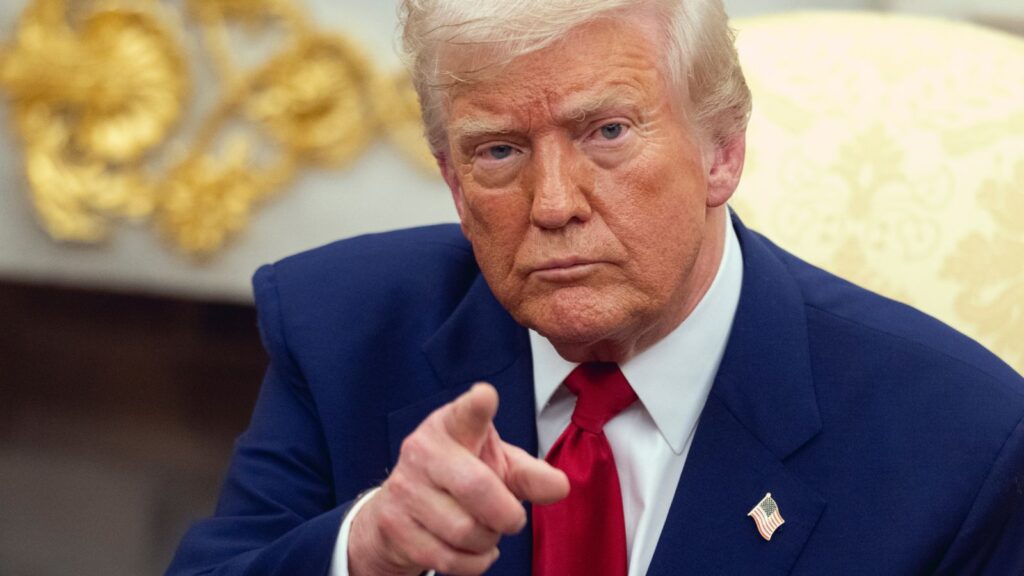
An American president congratulating a new provincial leader might normally pass as routine diplomacy. Donald Trump’s message to Quebec Premier Paul St-Pierre Plamondon carried more political weight. Posted on October 27, more than three weeks after the Parti Québécois won the provincial election, it also pointed readers to a headline portraying the result as a setback for Prime Minister Mark Carney.
The intervention arrived amid a Canada–U.S. trade war, an unresolved debate over Quebec independence and duelling accusations of political interference. Yet the election delivered the separatist party a minority government, not a mandate to leave Canada. That distinction is central to understanding why Trump’s brief message attracted so much attention.
Trump’s Congratulations Came With a Message for Ottawa
On October 27, Trump used Truth Social to congratulate St-Pierre Plamondon, writing, “Congratulations to Paul St-Pierre Plamondon on his WIN!” The timing alone attracted notice: Quebecers had voted on October 5, meaning the message appeared 22 days after the election. But the accompanying link was more pointed than a conventional diplomatic greeting. It led to an Irish Times report whose headline framed the sovereigntist victory as a blow to Carney. Trump did not spell out an endorsement of a Quebec independence referendum in the short post. Sharing that framing nevertheless invited readers to view a provincial election through the lens of his ongoing conflict with Ottawa.
The distinction matters because St-Pierre Plamondon is hardly an obvious Trump ally. He has criticized American tariffs and argued that Quebec should not rush into a sovereignty referendum while Trump remains in the White House. His Parti Québécois is a Quebec nationalist party with its own political history and priorities, not a Canadian branch of the U.S. Republican movement. McGill political scientist Daniel Béland described presidential commentary on Canadian provincial winners as highly unusual. Trump’s words were brief, but the combination of the recipient, the linked headline and the fraught state of bilateral relations made them more consequential than a congratulatory note.
Quebec Gave the Parti Québécois Power, but Not a Blank Cheque
The official numbers tell a more complicated story than a sweeping separatist mandate. Élections Québec records 60 seats for the Parti Québécois in the 127-member National Assembly, four short of the 64 required for a majority. The party received 28.02 per cent of valid votes, while turnout was approximately 66.9 per cent. It was a dramatic recovery for a party that had elected only three members in 2022, and it ended eight years of Coalition Avenir Québec government. But voters were selecting legislators and a government, not answering a referendum question about whether Quebec should become a country.
Even the final seat count reflected how closely contested parts of the election were. In Vachon, a judicial recount completed on October 21 overturned the initial result: Parti Québécois candidate Stephan Fogaing finished just three votes ahead of Liberal candidate Affine Lwalalika. That recount brought the PQ to 60 seats. As a minority administration, the government will need opposition support to advance major legislation and survive confidence votes. Its victory gives St-Pierre Plamondon a platform to argue for sovereignty, but it does not establish that most Quebecers support separation, or that they voted against Carney’s federal government.
Concerns About American Influence Began Before Election Day
Trump’s congratulations did not arrive in a political vacuum. During the Quebec campaign in September, then-premier Christine Fréchette raised concerns about possible U.S. involvement, following reports of an American think-tank essay urging support for Canadian sovereigntist movements. Fréchette also said American officials had previously approached her government about tariff arrangements involving Quebec. Her party contacted the Canadian Security Intelligence Service and sought federal assistance in clarifying the situation. Those steps demonstrated that provincial leaders were taking the possibility seriously, but they did not establish that U.S. officials had secretly influenced the election.
In fact, Fréchette’s office said at the time that it had no information confirming interference in the campaign. St-Pierre Plamondon said his party had not been approached by American officials and questioned why the allegations surfaced so close to advance voting. Québec solidaire’s Ruba Ghazal insisted that Quebecers, not Trump, must determine who governs the province, while Liberal Leader Charles Milliard argued that instability in Canada could benefit Washington. The disagreement was therefore not simply between separatists and federalists. Party leaders differed over the evidence, the timing of the warnings and the political risks of appearing to welcome outside involvement.
Independence Remains a Far More Difficult Question
The Parti Québécois wants Quebec to become an independent country, but the election campaign was driven by more than constitutional identity. In polling published September 30, Pollara Strategic Insights found that just 12 per cent of respondents identified independence as a ballot-box issue, while 22 per cent mentioned defending Quebec against Trump. Party platforms and leadership ranked higher still. The same poll found that only 24 per cent of decided voters supported Quebec separatism. These findings help explain how voters could elect a sovereigntist government without necessarily embracing its ultimate constitutional objective. Jobs, household bills, health care and uncertainty surrounding American tariffs also shaped the campaign.
St-Pierre Plamondon has pledged a future referendum but has said it will not occur while Trump is president, placing it after his expected departure in 2029. Quebecers have already rejected sovereignty-related proposals twice: the No side won 59.56 per cent in 1980 and 50.58 per cent in 1995. Even a future Yes result would not automatically produce an independent Quebec. Under the Supreme Court’s secession ruling and the federal Clarity Act, a clear referendum question and clear majority would be central to negotiations, with constitutional changes required for lawful separation. For now, the PQ must govern a minority legislature while trying to persuade voters who have not granted it an independence mandate.
A Separate Ottawa–Quebec Feud Raised the Political Temperature
The same day Trump offered his congratulations, St-Pierre Plamondon was publicly fighting with Ottawa over his role at the October 29–30 Canada–European Union summit in Montreal. Quebec’s premier wanted to address European leaders and accused the federal government of sidelining his province. Ottawa said he had been invited to a dinner with EU representatives, but not to speak at the summit. He announced a boycott. Carney responded that federal officials had consulted Quebec’s delegation three times and that declining the invitation was the premier’s choice. Industry Minister Mélanie Joly emphasized that foreign affairs fell within federal jurisdiction.
The argument crossed party lines. Bloc Québécois Leader Yves-François Blanchet challenged Ottawa’s decision, while Quebec Liberal Leader Charles Milliard said he understood the desire for a speaking role but considered a boycott the wrong response. The summit nevertheless proceeded, with Canadian and EU leaders announcing an Alliance for the Future on October 30, aimed at closer cooperation in areas including trade, technology, energy and security. These developments were not evidence of coordination with Trump. They showed instead why a foreign president’s congratulations could become politically sensitive: the new Quebec government was already testing the boundaries of its relationship with Ottawa on international matters.
British Columbia Became Part of Trump’s Political Narrative
Trump also praised Lorne Doerkson after the British Columbia Conservatives won the province’s October 24 election. His Truth Social post celebrated a “Big Victory” and asserted that Conservatives were gaining strength in Canada. Read alongside the Quebec message, it suggested that Trump saw provincial results as signs of trouble for Carney. But the provincial Conservative Party in British Columbia is not the federal Conservative Party, and neither election was a national vote on the prime minister. The B.C. outcome followed its own campaign, in which then-premier David Eby’s decision to call an early election backfired and local arguments about housing, jobs and economic development featured prominently.
Doerkson also resisted being cast as a Trump-style politician. During the B.C. campaign, he criticized Trump’s tariffs and described the American president’s behaviour as bullying. After his victory, he spoke with Carney about cooperation on growth and investment. Political scientists cited by the Associated Press cautioned against treating these provincial victories as evidence that Carney had lost public support. The irony was striking: Trump publicly embraced politicians who had challenged aspects of his trade agenda, while using their victories to make a broader point about Canadian politics. Their shared position as provincial election winners did not make them participants in a unified political movement.
Washington’s Election-Interference Accusations Deepened the Rift
The timing of Trump’s posts created another contradiction. On October 21, the U.S. Embassy in Ottawa issued a fact sheet accusing Canadian officials of seeking to influence American politics ahead of the November 3 midterm elections. It pointed to Industry Minister Joly’s remarks about retaliatory tariffs affecting Republican-leaning states and to Ontario Premier Doug Ford’s anti-tariff advertisement using remarks by former U.S. president Ronald Reagan. The embassy also cited 11 Canadians charged with voting illegally in U.S. elections over a period spanning 2012 to 2026, without establishing any connection between those cases and Canada’s government.
Canadian officials disputed the allegations. Ford said he had no interest in interfering in American elections, and Joly said meeting both Republican and Democratic officials was ordinary diplomacy. Carney said there was no merit to the embassy’s claims and expressed disappointment with Ambassador Pete Hoekstra. Legal experts distinguished open attempts to influence another government’s policy from covert or coercive election interference. That distinction applies in both directions: a presidential congratulation is not, by itself, proof of unlawful meddling, just as criticizing tariffs does not automatically amount to interference. What drew criticism was the asymmetry of Washington condemning Canadian political commentary while its president publicly interpreted Canadian elections.
The Trade Fight Matters More Than Any Social-Media Congratulations
The diplomatic friction has real economic stakes beyond social media. American tariffs have weighed on Quebec industries such as aluminum, steel and manufacturing, while U.S. border-state businesses face their own costs and uncertainty. With midterm elections approaching on November 3, the dispute has become an issue in places such as Michigan and Maine. Carney has maintained that Canada will negotiate only an agreement that protects its interests. On November 1, he reported a constructive conversation with Trump, while the U.S. president said the two countries had the “concept” of a trade deal. Negotiators still had work to do, and no final terms had been announced.
Meanwhile, Ottawa has been strengthening ties beyond the United States, including through the Canada–EU alliance unveiled in Montreal. Quebec’s minority government must decide how to advance its nationalist priorities while managing everyday concerns about housing, services and economic security. The federal government must work with that province even as it defends Canadian sovereignty in negotiations with Washington. Trump’s congratulations revealed the tension between domestic political symbolism and the practical demands of governing. Whether the next chapter brings a trade agreement, more disputes or a renewed independence debate will depend on decisions still ahead—not on the meaning assigned to one provincial election by an American president.
