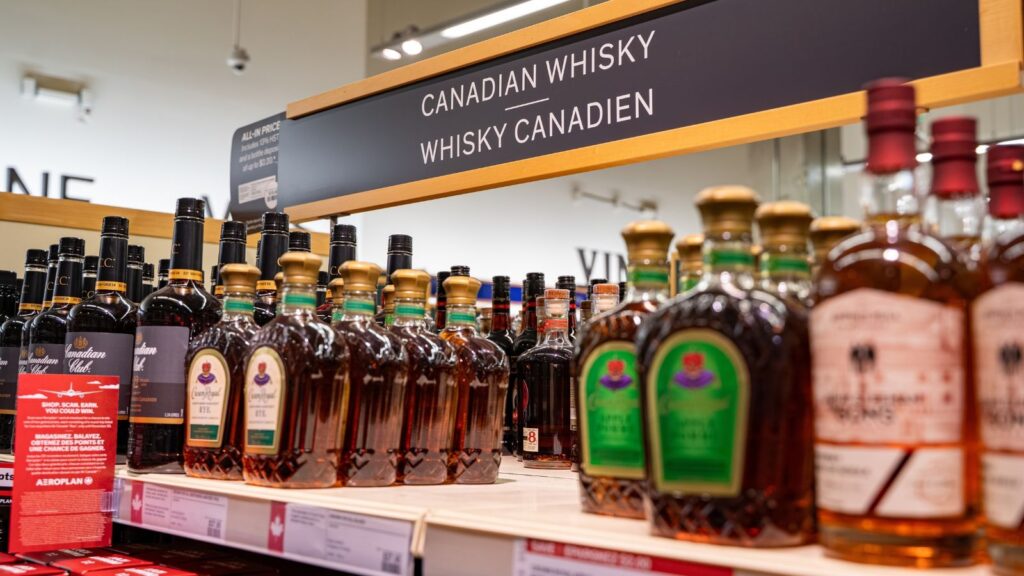
The holiday season is approaching, but American bars and restaurants are confronting a new challenge that has little to do with festive crowds or seasonal menus. President Donald Trump’s restrictions on Canadian whisky imports have added another layer of uncertainty to an already strained hospitality industry, raising concerns about rising costs, disrupted supplies and fewer choices for customers.
The restrictions, which took effect September 29, 2026, are part of an escalating trade dispute between Canada and the United States. While Washington has framed the measures as a response to Canadian restrictions on American alcohol, U.S. hospitality businesses are warning that the consequences extend far beyond the border. With holiday purchasing decisions already underway, the dispute is complicating preparations for one of the industry’s most important selling periods.
What Trump’s Canadian Whisky Ban Actually Means
The Trump administration’s restrictions took effect at 12:01 a.m. Eastern Time on September 29, following a presidential proclamation signed September 8. The measures prohibit imports of specified Canadian alcoholic beverages, including several classifications of whisky, along with numerous other spirits, wines and beers. U.S. Customs and Border Protection was instructed to reject shipments covered by the restrictions. The administration invoked Section 338 of the Tariff Act of 1930, which provides authority to impose trade penalties in response to certain discriminatory foreign commercial practices.
Importantly, the ban does not mean every bottle of Canadian whisky already sitting behind an American bar must disappear. The restrictions primarily prevent newly arriving covered products from entering the country. Certain shipments imported before the effective date may still be released under previously established tariff conditions, including a 50% duty. That distinction matters because existing inventory can provide temporary breathing room, even as businesses face uncertainty about future deliveries and replacement costs.
Why the United States and Canada Are Fighting Over Alcohol
The dispute began long before the latest restrictions on Canadian whisky. In March 2025, several Canadian provincial governments removed American alcoholic beverages from public liquor stores in response to U.S. tariffs. Ontario’s Liquor Control Board stopped purchasing American products, removed them from its retail channels and prevented bars and restaurants from placing new orders through its wholesale system. The Trump administration subsequently argued that these restrictions unfairly disadvantaged American producers and imposed additional duties on selected Canadian products.
The conflict intensified in 2026. After the United States implemented a 50% tariff on covered Canadian alcohol products in August, Saskatchewan announced a matching 50% levy on American alcohol, effective September 8. Washington responded by escalating from tariffs to import prohibitions on selected Canadian beverages. Both governments have presented their actions as protecting domestic economic interests, but businesses operating across the border face a different reality. Each new restriction creates another obstacle to selling products, maintaining customers and planning future shipments.
Holiday Preparations Are Becoming More Complicated
For many American hospitality businesses, the timing is particularly difficult. Restaurants and bars typically need to organize seasonal beverage offerings, negotiate purchases and establish inventory plans well before December. The Toasts Not Tariffs Coalition, representing 59 national and state organizations across the American alcohol supply chain, warned on September 29 that the Canadian import ban would disrupt the hospitality sector during its critical holiday planning period. The coalition includes producers, distributors, retailers and representatives of restaurants and bars.
The pressure comes as beverages are becoming increasingly important to restaurant strategies. The National Restaurant Association’s 2026 Beverage Trends report found that 87% of full-service restaurant operators believe beverages can help attract customers. Seasonal cocktails, specialty spirits and distinctive drink offerings are therefore more than decorative additions to holiday menus. They can help businesses differentiate themselves in a competitive market. When an imported ingredient becomes difficult to obtain, managers may have to revise recipes, negotiate alternative supplies or reconsider how much inventory they can responsibly commit to purchasing.
Rising Costs Could Make Holiday Cocktails More Expensive
A Canadian whisky import ban does not automatically increase the price of every cocktail sold in the United States. However, it can create financial pressure when bars must find alternative products, purchase remaining inventory at higher prices or change established recipes. Earlier 50% duties on covered Canadian alcohol shipments also complicated import economics. Businesses holding older stock may temporarily avoid shortages, but replacing that inventory can become more difficult as regular supply channels are disrupted.
Alcohol represents an important part of restaurant revenue. Research published by the National Restaurant Association found that alcoholic beverages accounted for approximately 21% of total sales at full-service restaurants offering them. That makes beverage costs particularly important to operators trying to maintain profitability. A restaurant facing higher purchasing expenses has several choices: increase menu prices, accept smaller margins or replace certain products with less expensive alternatives. None is necessarily attractive. For customers, the consequences could eventually appear as higher cocktail prices, smaller selections or changes to familiar drinks, although the impact will vary by establishment.
Major Whisky Brands May Have an Important Advantage
Not every Canadian whisky producer faces the same restrictions. U.S. Customs and Border Protection distinguishes between products imported in retail-ready packaging and certain bulk shipments. The government’s exclusion list covers several whisky classifications, particularly products in containers holding four litres or less. Some larger bulk shipments fall outside those prohibitions, creating opportunities for businesses that can transport whisky to the United States for bottling or further processing. This distinction means the policy’s effects are more complicated than a blanket prohibition on every Canadian-made whisky.
Crown Royal provides an important example. Its owner, Diageo, announced in August 2025 that it would close an Ontario bottling facility while continuing to mash, distill and age Crown Royal whisky in Canada. The company planned to shift some bottling activity closer to its American customers. That arrangement could help certain products avoid restrictions affecting retail-packaged imports. Smaller Canadian distillers may have fewer comparable options, particularly if they depend on shipping finished bottles directly to American distributors. The result could be an uneven impact across the Canadian whisky industry.
American Craft Distilleries Are Already Under Financial Strain
The dispute is unfolding at a difficult time for independent American spirits producers. According to the American Craft Spirits Association’s 2026 Craft Spirits Data Project, the number of active craft distillers declined 6.6% over the preceding year, reaching 2,131 by August 2026. The report also found that craft spirits sales volume declined 8% in 2025, while sales revenue decreased 3.7% to approximately $7.3 billion. The findings reflect broader difficulties involving distribution, weakening demand and restricted access to markets.
Small distilleries often lack the financial resources and international distribution networks available to large multinational producers. Losing an established export destination can force them to depend more heavily on domestic sales at precisely the moment local competition is intensifying. The industry report found that exports of American craft spirits declined 13.4% in 2025. Although those losses cannot be attributed entirely to the Canadian trade dispute, additional barriers make an already challenging environment more unpredictable. For independent producers, maintaining reliable access to retailers, restaurants and international customers can be essential to keeping their operations sustainable.
American Spirits Producers Are Also Losing a Major Export Market
The economic damage is not limited to Canadian whisky producers attempting to sell their products in the United States. American distillers have already experienced substantial losses because of Canada’s restrictions on U.S.-made alcohol. Data from the Distilled Spirits Council of the United States shows that American spirits exports to Canada declined approximately 70% between March and December 2025 compared with the same period in 2024. Export values fell from approximately $203 million to $60 million during those comparable periods. Canada subsequently dropped from America’s second-largest spirits export market in 2024 to sixth-largest in 2025.
The financial relationship runs in both directions. According to Spirits Canada, the country exported approximately $948.6 million worth of spirits to the United States in 2025, representing about 93% of Canadian spirits export value. That dependence makes disruptions particularly serious for Canadian producers, while American distillers lose access to customers across the border. An American bourbon producer that previously relied on Canadian retailers cannot automatically replace those sales simply because competing Canadian whisky shipments face new restrictions. Both industries have reasons to support reopening trade rather than prolonging the confrontation.
Restaurants Have Little Room to Absorb Another Financial Shock
American restaurants entered the final months of 2026 facing significant financial pressures unrelated to Canadian whisky. The National Restaurant Association reported that food and labour expenses each account for approximately one-third of restaurant sales. Its research also found that roughly one-third of operators were unprofitable during the first half of 2026. Meanwhile, the U.S. Bureau of Labor Statistics reported that employment in food services and drinking places declined by approximately 7,200 jobs in October. That employment decline cannot be attributed directly to the whisky restrictions, but it demonstrates the industry’s challenging operating environment.
For individual establishments, a relatively small increase in beverage costs can become another difficult decision. Owners must balance staffing, rent, utilities, ingredients and customer expectations while protecting already narrow profit margins. Reducing drink selections might simplify purchasing, but it can also disappoint regular customers. Increasing prices might protect profitability, but households facing their own financial pressures may respond by ordering fewer drinks. These competing concerns explain why hospitality organizations have criticized trade measures that introduce additional uncertainty into an industry already managing several economic challenges.
Scotch and Irish Whiskey Developments Highlight Trade Uncertainty
Recent changes affecting other imported whiskies demonstrate why American hospitality businesses are struggling to plan confidently. The United States removed tariffs on whisky produced in the United Kingdom, including Scotch, effective July 24, 2026. That decision followed an announcement by Trump in April. The development offered relief to British exporters and American businesses purchasing their products. However, the process also demonstrated that even an announced trade concession can take months to become operational, leaving importers uncertain about the costs of future shipments.
Irish whiskey encountered a similar situation. Trump announced in September that he intended to remove the existing 10% American tariff on whiskey produced in the Republic of Ireland. Yet Irish officials confirmed in October that implementation discussions were continuing, and an industry logistics update dated October 30 said importers still had to pay the duty. The contrasting treatment of British, Irish and Canadian whisky illustrates how quickly the trading environment can change. For bars preparing holiday menus, reliable implementation dates are nearly as important as the tariff decisions themselves.
A Trade Agreement Could Ease Pressure, but the Holiday Clock Is Ticking
There have been indications that the broader Canada–U.S. trade relationship could improve. Following discussions with President Trump in early November, Prime Minister Mark Carney said negotiations had progressed, although important differences remained unresolved. Trump also expressed optimism about reaching an agreement. The renewed discussions followed the collapse of negotiations in August, which preceded further tariffs and restrictions affecting numerous Canadian products. However, progress toward a wider trade agreement does not automatically mean that the existing alcohol restrictions have been removed.
Industry representatives have consistently argued that a negotiated settlement would provide greater benefits than continuing reciprocal restrictions. The Toasts Not Tariffs Coalition has called for American spirits and wines to return to Canadian shelves while protecting access to Canadian products in the United States. Even if both governments reached an agreement, suppliers would still need time to restore normal distribution and replenish inventory. For American restaurants and bars, the concern is therefore immediate as well as political. The coming holiday season could reveal how effectively businesses have adapted to restricted supplies, rising expenses and an uncertain trade environment.
