The most consequential concession in Canada’s latest trade talks with Washington may have nothing to do with a tariff rate. Prime Minister Mark Carney says the Trump administration has backed away from a demand that would have given the United States the final say over trade agreements Canada negotiates with other countries.
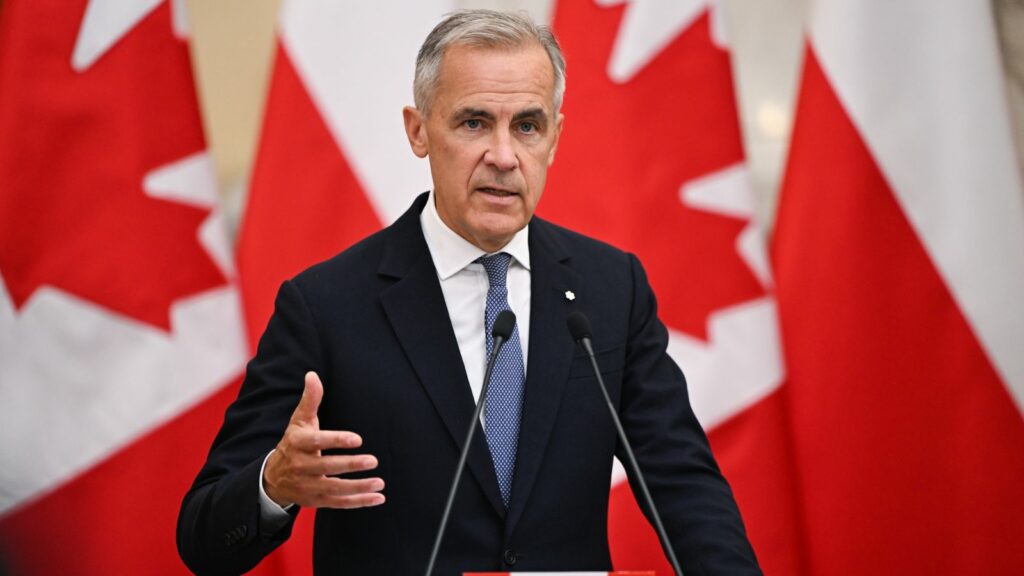
Speaking on November 3 in Antigua and Barbuda, Carney described a shift in Washington’s position after months of tense negotiations. The development goes to the heart of Canadian sovereignty: whether Ottawa can build new commercial partnerships without seeking American approval. It also arrives at a delicate moment for businesses facing U.S. tariffs and uncertain access to their largest export market. Carney, however, has been careful to distinguish progress at the negotiating table from an actual agreement.
The Demand That Ottawa Says Was Withdrawn
Carney’s disclosure revealed how far the trade dispute had extended beyond conventional arguments over duties and market access. At a November 3 news conference during a Commonwealth leaders’ meeting in Antigua and Barbuda, he said Washington had eased demands affecting Canada’s ability to negotiate with other markets. Reuters reported that an earlier U.S. proposal would have given Washington final approval over Canadian agreements with other countries. Such a provision would have reached directly into decisions normally made by Canada’s own government.
The prime minister also said that demands touching Canadian language and culture were no longer on the table. He portrayed the U.S. side as asking for less while offering more, but emphasized that a trade deal was not finished. That distinction is essential. Carney described a change in negotiating positions, not a signed document guaranteeing permanent protection. Public reporting has not supplied the full text of the proposed veto or its withdrawal. For Canadian exporters, the announcement is encouraging; for policymakers, it remains a reason to keep negotiating rather than declare the dispute over.
Why the Proposal Raised Serious Sovereignty Concerns
An American veto would have gone beyond the consultation rules already present in the Canada–United States–Mexico Agreement (CUSMA). Article 32.10 deals specifically with new free-trade agreements involving a non-market country. It requires advance notice before negotiations, information about objectives when requested, and an opportunity for the other CUSMA members to examine an agreement before it is signed. It also permits the other countries to terminate the trilateral arrangement on six months’ notice if such an agreement is concluded. These provisions create leverage, but they do not give Washington a general power to approve or reject Canada’s trade agreements.
That legal distinction helps explain why Carney treated the reported American demand as a red line. A country can coordinate trade security policies with its neighbours without handing over the authority to choose its economic partners. For Ottawa, that distinction becomes particularly important when diversification is a national economic priority. The withdrawal of the additional demand would not erase CUSMA’s existing restrictions, however, and those rules could still influence future negotiations with countries classified as non-market economies.
The August Breakdown That Nearly Derailed Negotiations
The apparent breakthrough becomes more significant when viewed against the collapse of negotiations in August. After days of discussions, Carney suspended formal trade talks on August 21 and ordered Canada’s negotiating team back to Ottawa. The decision came just before another round of American tariffs took effect. Washington imposed duties of 50% on a range of Canadian products, including clothing, cement, furniture and hockey equipment. Canadian officials estimated that approximately $28 billion worth of exports would be affected.
Carney subsequently explained that Washington’s last-minute demands had crossed boundaries his government was unwilling to accept. He identified Canadian sovereignty, language protections and cultural policy as fundamental concerns, alongside the economic treatment of major industries. Ottawa announced plans to retaliate against American goods, including products in the steel, dairy, appliance and agricultural equipment sectors. The August confrontation demonstrated that Canada was prepared to accept substantial economic disruption rather than sign an agreement it considered unacceptable. The November shift suggests Washington has become more flexible on at least some of the issues that previously prevented a deal.
A Weekend Conversation Helped Restart Trade Diplomacy
The diplomatic atmosphere began changing after Carney and Trump spoke by telephone on October 31. Carney publicly described the conversation the following day as constructive, explaining that discussions had advanced toward a possible agreement respecting Canada’s languages, culture and sovereignty. Trump offered an even more optimistic assessment while speaking to reporters in Iowa, suggesting the countries were close to reaching a deal that would benefit American farmers and businesses.
By November 3, Carney was discussing a more intensive phase of negotiations. His comments at the Commonwealth meeting in Antigua and Barbuda suggested that the two governments were moving beyond the confrontation that ended formal discussions in August. However, renewed communication does not necessarily mean every outstanding issue has been resolved. Trade agreements depend on detailed legal language covering tariffs, market access, enforcement and domestic obligations. For Ottawa, the central challenge is turning encouraging conversations into enforceable commitments that businesses can confidently use when making long-term decisions.
Major Tariffs Remain Despite the Diplomatic Progress
The withdrawal of Washington’s reported trade-veto demand does not automatically reduce the financial pressure facing Canadian exporters. Separate American tariff programs continue to affect Canadian products. Federal trade guidance identifies U.S. duties ranging from 15% to 50% on certain steel, aluminum and copper products, alongside 25% tariffs affecting vehicles and trucks, subject to important exemptions. Another American measure introduced 50% duties on various Canadian manufactured products in August, with the covered product lists subsequently modified.
The economic consequences extend beyond the companies directly paying border duties. Manufacturers must consider whether higher prices will cause American customers to switch suppliers, delay purchases or renegotiate contracts. In its October 28 economic outlook, the Bank of Canada estimated that the average U.S. tariff rate on Canadian goods had increased to 7.5% in October, compared with 5.0% in July. Canada had also imposed retaliatory duties on selected American imports. These figures illustrate why removing an objectionable negotiating demand is meaningful, but cannot substitute for the broader tariff relief industries still need.
The Economic Stakes Extend Far Beyond Trade Negotiations
The latest economic figures demonstrate why the dispute matters well beyond Ottawa and Washington. Statistics Canada’s November 4 report showed Canadian merchandise exports reaching $78.6 billion in September 2026, an increase of just 0.2% from August. Much of that improvement came from energy products and precious metals. Meanwhile, exports of motor vehicles and parts declined 4.9%, and forestry-related shipments fell 9.8%. The uneven performance illustrates how individual industries can struggle even when the overall export figures appear relatively stable.
The Parliamentary Budget Officer has also warned about the longer-term consequences of sustained trade restrictions. An October assessment estimated that measures introduced since early 2025 could reduce Canada’s real GDP by 1.4% after five years compared with a scenario in which the bilateral trading relationship remained at 2024 levels. Under a scenario where the tariffs remain permanent, employment could fall by as many as 185,000 jobs at the peak of the adjustment. These are model-based estimates, not job losses already recorded, but they underline the potential cost of allowing trade uncertainty to persist.
Canada Is Expanding Trade Relationships Beyond the United States
Canada’s determination to protect its freedom to negotiate with other countries is closely connected to its economic diversification strategy. The federal government currently lists 15 free-trade agreements covering 51 countries, including arrangements with the European Union, Japan and other Indo-Pacific economies. Ottawa is also pursuing negotiations with India, ASEAN and several additional partners. Budget 2026 identifies doubling Canadian exports to non-American markets by the end of 2035 as a major economic objective.
Recent developments show that this strategy is already taking shape. On October 30, Canada and the European Union announced an Alliance for the Future intended to deepen cooperation in trade, technology, energy and economic security. Negotiations on a separate Canada-EU digital trade agreement were also concluded, although the agreement was not yet in force. Canada additionally signed a comprehensive economic partnership agreement with the United Arab Emirates on October 27. These initiatives help explain why Ottawa would resist granting another country authority over its future commercial relationships. The government wants greater flexibility to pursue opportunities wherever Canadian businesses can compete.
Canada’s Dependence on American Trade Remains a Major Challenge
Building new partnerships is one objective; reducing dependence on the United States is considerably more complicated. Statistics Canada reported that 71.7% of Canadian merchandise exports went to the American market in 2025. The latest available monthly figures show that approximately 70.2% of goods exports still went to the United States in September 2026. Despite a gradual shift toward other destinations, the American market continues to account for an exceptionally large portion of Canadian international trade.
The relationship is particularly important for industries built around integrated North American supply chains. Automotive manufacturers, for example, rely on components, production facilities and customers distributed across the continent. Moving production or establishing new export relationships is rarely as simple as identifying another buyer. Businesses must consider transportation costs, regulatory requirements, distribution networks and available manufacturing capacity. The September figures also revealed that exports to non-American markets declined 1.1% after reaching a record in July. Diversification therefore offers potential long-term protection, but it cannot immediately replace the commercial relationships Canadian businesses have developed with the United States over decades.
The U.S. Midterm Elections Have Changed the Political Calculus
The November 3 U.S. midterm elections introduced another factor into the trade dispute. Democrats won control of both chambers of Congress, with the new lawmakers scheduled to take office in January 2027. Democratic leaders have identified Trump’s Canadian tariffs as a potential target for repeal. Senator Ron Wyden, who is expected to chair the Senate Finance Committee, has been particularly critical of the measures. In American communities where factories, farms and small businesses depend on cross-border trade, the debate has direct economic consequences. Higher import costs can affect everything from manufacturing contracts to the prices paid by local consumers.
Carney welcomed congressional efforts to restore a freer trading relationship but said on November 6 that he had not discussed repeal legislation with Democratic lawmakers. A change in congressional control also does not guarantee the tariffs will disappear. Trump could veto legislation designed to overturn his trade measures, and overriding a presidential veto requires substantial bipartisan support. The election may increase political pressure on the White House and strengthen Ottawa’s negotiating position, but it has not eliminated the need for a negotiated settlement.
The Next Test Is Turning Progress Into a Durable Agreement
A larger challenge still hangs over the relationship: the long-term future of CUSMA. At the agreement’s scheduled July 1, 2026, joint review, the United States declined to extend the pact in its existing form. That decision did not terminate the agreement. CUSMA remains in force under its current provisions, with annual reviews continuing unless the three countries agree to extend it. Without an extension, its existing term runs to 2036. For manufacturers making investment decisions years in advance, predictable continental trading rules can be just as important as immediate tariff relief.
Carney’s account of the withdrawn American demand is therefore significant but incomplete. The two governments have not announced a final, enforceable agreement, and the prime minister has not publicly detailed every outstanding obstacle. Negotiators still need to determine which tariffs will be reduced, how individual industries will be treated and whether any new commitments preserve Canada’s authority over its own trade policy. Businesses will ultimately judge the breakthrough by the written terms they can rely on, not simply the optimism expressed by political leaders. Washington’s apparent concession may have opened a path toward an agreement, but reaching one remains the real test.
