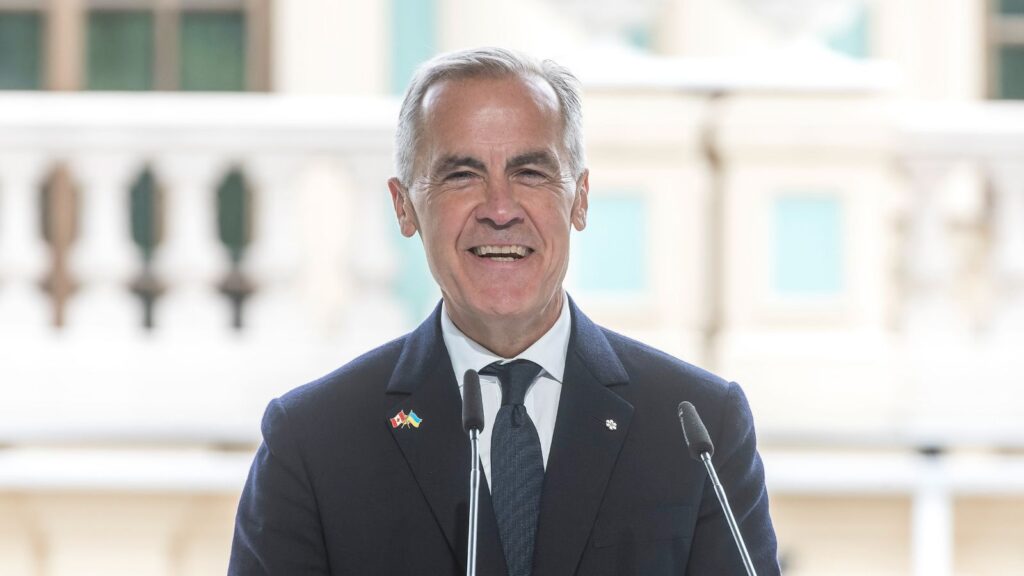
An oil shipment leaving British Columbia, a canola grower watching Chinese import rules, and a financial institution seeking overseas business now figure into the same diplomatic calculation. Prime Minister Mark Carney met Chinese President Xi Jinping in Shenzhen on November 17, putting energy, food and financial services at the centre of Canada’s effort to rebuild economic ties with Beijing.
The meeting produced expanded tariff relief for Canadian pork and seafood exports, alongside commitments to strengthen cooperation in energy and finance. The timing matters: President Donald Trump’s tariffs and threats of even higher duties on Canadian vehicles continue to strain Canada’s largest trading relationship. China offers another market for Canadian goods and expertise, but the opportunities come with commercial uncertainties and longstanding national-security concerns.
A Third Meeting Turns a Diplomatic Thaw Into Specific Deals
The Shenzhen meeting was Carney’s third with Xi since becoming prime minister, following discussions at the Asia-Pacific Economic Cooperation summit in South Korea in 2025 and a trip to Beijing in January 2026. That January visit was the first by a Canadian prime minister in more than eight years. The repeated meetings mark a departure from the years when political disputes and retaliatory tariffs made the relationship unusually difficult for Canadian exporters. In Shenzhen, ahead of this year’s APEC leaders’ gathering, the two governments moved beyond general expressions of goodwill to extend and widen an existing trade arrangement.
The practical result was a commitment to reduce barriers on additional Canadian farm and seafood products. Both leaders also discussed conventional and clean energy, financial services, investment and cooperation through international institutions. Those subjects reach far beyond the meeting room: decisions made in Beijing can influence what a Prairie farmer can sell, whether a coastal fishing business can reach another customer, and which companies can finance expansion abroad. Yet the announcement was not a sweeping free-trade agreement. Many of its provisions are targeted, while other areas of cooperation will depend on further negotiations and actual commercial deals.
Rising Oil Shipments Give Canada a Stronger Position
Canadian crude oil was already gaining ground in China before the leaders sat down. Shipments to the Chinese market increased by about 37% in 2026, according to a Reuters calculation using LSEG data. That growth follows an important change in Canada’s export infrastructure: the expanded Trans Mountain pipeline began operating in May 2024, bringing the system’s capacity to roughly 890,000 barrels a day and improving access to tankers leaving British Columbia. The Canada Energy Regulator reports that the share of Canadian crude exports reaching destinations outside the United States rose from 2% in 2021 to 10% in 2025.
The conversation in Shenzhen went beyond selling more barrels. A Canada-China ministerial energy dialogue held November 3 and 4 addressed oil and gas, renewables, nuclear energy, uranium and nuclear services, including the possibility of future investments and purchase commitments. Carney and Xi subsequently identified opportunities in both conventional fuels and lower-carbon technologies. For Canadian producers, a broader customer base can provide flexibility when one market dominates sales. But diplomatic interest should not be confused with a guaranteed supply contract: actual export volumes will still depend on infrastructure, prices, buyers and the terms companies can negotiate.
Canola Shows What Tariff Relief Means on the Ground
Few products illustrate the stakes better than canola. After a dispute involving Chinese electric vehicles and Canadian agricultural exports, China’s combined tariff on Canadian canola seed had climbed to almost 85%. An agreement reached during Carney’s January visit helped lower the applied rate to 14.9% from March 2026. Canadian canola seed exports to China reached 2.8 million metric tonnes during the year through mid-November, according to Reuters. For growers and grain handlers, that difference in market access can affect where a shipment goes and whether a sale is competitive against supplies from another country.
The reopening remains incomplete, which is why continued talks matter. China suspended its 100% anti-discrimination tariff on Canadian canola meal in March, and the two countries extended that relief through the end of 2028. Peas, lobster and crab received extended access as well. However, the Canola Council of Canada reported in November that canola oil still faced a 100% tariff, even as the rate for seed stood at 14.9%. The distinction is important: an agreement that helps a farmer sell raw seed does not necessarily provide the same opening to a Canadian processor selling a higher-value product. That unfinished business gives Ottawa a reason to keep negotiating.
Pork and Seafood Secure the Most Tangible New Concessions
The biggest new trade announcement from Shenzhen concerned roughly C$400 million in Canadian exports eligible for additional Chinese tariff relief. Ottawa identified about C$116 million in frozen pork cuts and C$285 million in fish and seafood, including cold-water shrimp and prawns, geoduck, sea cucumber and Greenland halibut. These are values of exports covered by the measures, not C$400 million in tariff savings or fresh purchase orders. Under the expanded arrangement, China agreed to suspend specified anti-discrimination tariffs from January 1, 2027, through December 31, 2028, giving exporters a defined period of improved access.
The concessions also required something from Canada. Ottawa agreed to extend existing tariff-remission measures for selected Chinese steel and aluminum goods through 2028 and expand coverage to 32 additional tariff items where Canadian supply is insufficient or unavailable. That exchange reveals the mechanics of trade diplomacy: farmers and seafood harvesters may gain access while Canadian officials make carefully limited concessions on imports. The benefits will be felt differently across regions, from pork producers trying to regain Asian customers to fishing businesses evaluating export prices. The test is whether lower barriers produce sustained orders, rather than a temporary increase in shipments while the agreement remains in force.
Financial Services Enter the Negotiations in a Serious Way
Finance may be less visible than a tanker or a cargo of canola, but it was an explicit part of Carney’s agenda. On November 9, Canadian Finance Minister François-Philippe Champagne and Trade Minister Maninder Sidhu joined Chinese Vice Premier He Lifeng for an economic and financial dialogue in Vancouver. Their governments agreed to deepen contacts among finance ministries, central banks and regulators, including discussion of market access for financial institutions. In Shenzhen, Carney and Xi welcomed that work and identified more room for trade in services, including financial services and education.
Some commitments were unusually specific. The two sides welcomed steps toward implementing a central-bank currency-swap arrangement, with an operational exercise planned for late 2026 and a test drawing in 2027. China also expressed support for eligible Canadian institutions issuing yuan-denominated Panda bonds in its market, while regulators established a forum to discuss supervisory issues. For an exporter, financing and payments can be as important as finding a buyer; for a financial firm, access to another capital market could create business. None of this means Canadian banks have received unrestricted access to China. Eligibility rules, regulatory supervision and the management of financial risk remain central to any expansion.
Trump’s Tariff Threat Changes the Calculation for Ottawa
Canada’s outreach to China cannot be separated from the tariff dispute with Washington. Trump threatened in August to increase U.S. duties on Canadian cars, trucks and automotive parts to 50% starting January 1, 2027, up from a 25% rate on affected vehicles. That is a threat about a future rate, not a claim that every Canadian export already faces a 50% charge. For a sector built around components crossing the Canada-U.S. border repeatedly, uncertainty over tariffs can complicate factory planning and investment long before a higher rate takes effect.
The scale of Canada’s dependence explains the urgency. Statistics Canada reported that 71.7% of Canadian merchandise exports went to the United States in 2025, down from 75.9% in 2024 but still an overwhelming majority. Carney has said negotiations with Trump remain a priority, particularly for protecting an integrated North American auto industry. Selling more oil, food and services to China would not replace that relationship, nor would it automatically shield Canadian factories from U.S. measures. It could, however, give businesses additional customers and Ottawa more room to manoeuvre if the tariff fight continues without a durable settlement.
Chinese Electric Vehicles Add a Difficult Industrial Choice
The auto industry connects the China talks to Canada’s dispute with Trump in another way. Under a January arrangement, Canada removed its previous 100% surtax on Chinese electric vehicles within a new quota, allowing an initial 49,000 EVs annually at a 6.1% tariff. Government documents say the quota increases by 6.5% a year, with half the permitted volume reserved by the fifth year for EVs priced at C$35,000 or less on a free-on-board basis. The original quota represented less than 3% of the Canadian new-vehicle market, but it opened a politically sensitive door.
Before travelling to Shenzhen, Carney said Canada could consider Chinese, European or Japanese auto partnerships if negotiations with the United States failed to preserve Canadian manufacturing opportunities. That possibility is not the same as announcing a Chinese vehicle factory in Canada. The government has described prospective joint ventures and investment as goals, not guaranteed outcomes. The concern for Canadian workers is straightforward: more vehicle choices for consumers will matter little to an assembly-plant community if imports arrive without creating local production. Ottawa must weigh price competition and potential investment against the risk of further disrupting its deeply integrated North American supply chain.
Security and Human Rights Remain Unresolved
Closer trade does not erase the diplomatic disputes that strained Canada-China relations. Before the meeting, Carney said he intended to raise the importance of foreign countries not interfering in Canadian affairs. Canada’s public inquiry into foreign interference found that the 2019 and 2021 federal elections had been targeted, although it concluded the interference did not change which party formed government. China has denied interfering in Canada’s domestic politics. The distinction matters: the inquiry established a serious threat to public trust without concluding that Beijing determined the national election outcomes.
Human rights concerns also remain prominent. Canada’s government condemned China’s execution of four Canadian citizens in 2025, while critics of deeper engagement have pointed to the imprisonment of Hong Kong pro-democracy publisher Jimmy Lai. Carney has argued that dealing with China does not amount to endorsing all its actions. The official account of the Shenzhen discussion highlighted open communication on security matters and cooperation against illicit drug trafficking, but did not detail an outcome on election interference. For Ottawa, the challenge is to make room for legitimate commerce without treating security questions, consular cases or democratic safeguards as bargaining chips.
The Long-Term Test Is Diversification, Not a Single Handshake
The trade momentum is measurable. Statistics Canada figures reported by The Canadian Press put Canadian merchandise exports to China at C$33.5 billion in the first nine months of 2026, nearly 40% above the same period a year earlier. Ottawa says Canada exported C$35.1 billion in merchandise to China during all of 2025, while two-way merchandise trade reached C$125.6 billion. Carney told Xi that Canada was ahead of schedule on its ambition to increase exports to China by 50% by the end of the decade. Those figures show a substantial opening, even though China remains far smaller than the United States as a destination for Canadian exports.
The next steps will be less ceremonial. Ottawa announced a major trade mission to China in 2027 and a Canada-China Year of e-Commerce intended to help smaller Canadian companies sell through Chinese online platforms. The government also says it has restored access for more than 90% of the Canadian export trade previously affected by bilateral tariff measures, worth nearly C$7.5 billion. That is a meaningful recovery, not proof that every obstacle has disappeared. The durable measure of Shenzhen’s success will be whether exporters retain predictable access, new investments materialize and Canadian businesses can grow without exchanging dependence on one powerful trading partner for dependence on another.
