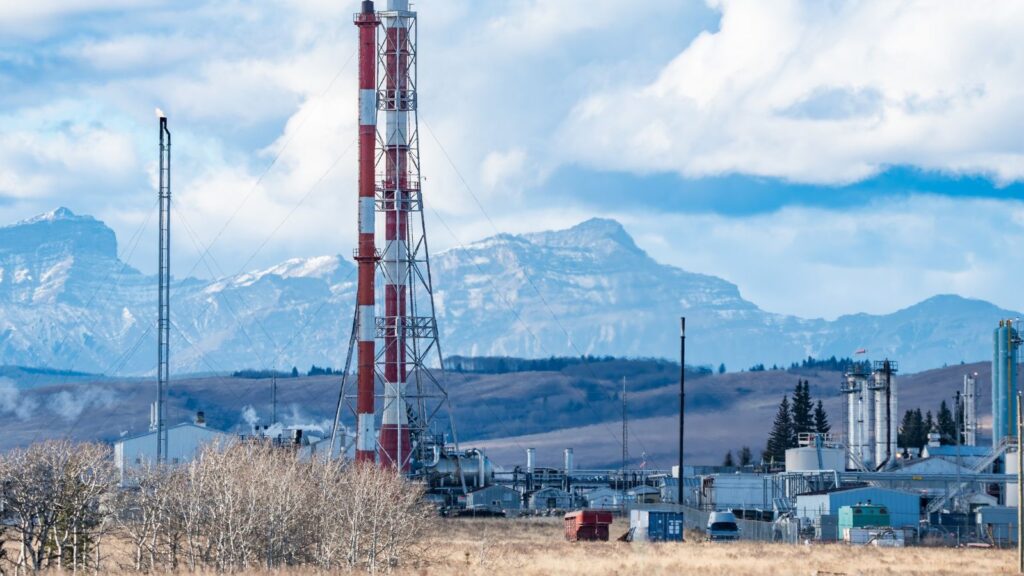
A gas producer can have a buyer ready to sign a contract and still face a serious obstacle: not enough pipeline capacity to complete the delivery. That problem is at the heart of a growing dispute in Alberta, where the provincial government is considering a direct role in building natural gas infrastructure.
Proposed legislation would create a path for government-owned pipelines if private companies cannot meet rising demand. However, TC Energy, which operates one of Western Canada’s most important gas transportation networks, warns that the changes could undermine expansion plans already in development.
CIBC Capital Markets analysts have also identified potential risks to TC Energy’s future growth. With billions of dollars in infrastructure investment and Alberta’s industrial competitiveness at stake, the debate extends well beyond who owns the pipelines.
Alberta Opens the Door to Government-Owned Natural Gas Pipelines
For decades, Alberta has depended heavily on privately operated pipelines to move natural gas from producing regions to industrial customers and export connections. That arrangement is now facing a significant policy test. On November 23, Energy and Minerals Minister Brian Jean introduced Bill 45, the proposed Natural Gas Infrastructure Act, giving the province a potential role in planning, financing and even constructing gas infrastructure when industry does not meet identified needs. The government describes direct public construction as a last resort, rather than its preferred approach.
The distinction matters. No new Crown pipeline company has been created, and the bill does not identify a construction route or announce a specific spending commitment. Instead, it would allow cabinet to establish provincial corporations for planning or infrastructure ownership and authorize public participation under specified conditions. For communities hoping a nearby industrial project will proceed, the proposal signals urgency. For established pipeline operators, it raises questions about who ultimately decides where future capacity is built and how it is paid for.
Alberta’s Growing Pipeline Capacity Problem Is Driving the Debate
Alberta’s immediate concern is not a shortage of natural gas underground. The provincial government estimates proven and probable reserves at 144 trillion cubic feet. It says production averaged approximately 11.3 billion cubic feet per day in 2025, representing roughly 60 per cent of Canada’s output, with about 4.5 billion cubic feet per day exported to the United States. The difficulty, according to the province, is moving enough of that supply to the places where customers need it.
Officials say the main NGTL transmission system is fully subscribed through 2029, with uncertain capacity additions beyond 2030. Such constraints matter to more than gas producers. A prospective data centre needs dependable electricity, an oilsands expansion needs fuel and steam, and a petrochemical facility needs predictable feedstock deliveries. A project can have investors and willing suppliers yet still face delays if transportation capacity is unavailable at the right location. That is the economic problem Alberta’s proposed legislation is intended to address.
TC Energy Operates a Pipeline Network Central to Western Canada
At the centre of the debate is TC Energy’s NGTL system, a vast network of gathering and transmission pipelines carrying Western Canadian natural gas to customers and connecting transportation systems. The Canada Energy Regulator lists approximately 25,409 kilometres of federally regulated NGTL pipeline, with facilities stretching across Alberta and into northeastern British Columbia. The system began operating in 1957, and its federal regulatory status dates to 2009. It is an established piece of energy infrastructure, not a proposed network waiting to be built.
NGTL also works commercially alongside infrastructure owned by ATCO. The two systems began integrating services in 2011, allowing customers to use a common transportation framework while the companies retained distinct operating assets. This arrangement matters because a pipeline’s value depends partly on the connections and contracts surrounding it. Adding a separate government-backed route could expand access in an underserved area, but duplicating well-used facilities could also increase system costs. Which outcome would prevail depends on the design of any actual project.
TC Energy Has Already Proposed a Major 370-Kilometre Expansion
TC Energy is not standing still. On November 16, one week before Alberta introduced the legislation, the company outlined its proposed Alberta Growth Connector. The project would run approximately 370 kilometres from west to east, using a 48-inch pipeline to link growing Western Canadian gas supplies more directly with the oilsands region. TC Energy expects it could initially add roughly one billion cubic feet of daily transportation capacity, with opportunities for further expansion as demand develops.
The proposal also includes additional pipeline loops and compressor units across the integrated NGTL-ATCO network. Those improvements can increase the amount of gas an existing corridor handles without relying exclusively on entirely new routes. However, the Growth Connector is not an approved or guaranteed project. TC Energy must secure customers willing to contract for service, consult affected rights holders and stakeholders, obtain regulatory approvals and complete its investment decision. Its announcement therefore addresses part of Alberta’s capacity challenge while leaving important commercial and timing questions unresolved.
Natural Gas Demand Could Increase by 25 Per Cent by 2031
The dispute becomes more consequential when projected demand is considered. TC Energy’s latest planning forecast calls for NGTL system demand to rise from 14.4 billion cubic feet per day in 2026 to approximately 18 billion by 2031, an increase of about 25 per cent. That 2031 projection is roughly 1.5 billion cubic feet per day above the outlook in the previous year’s plan. More than 60 per cent of the anticipated growth comes from the oilsands, electricity generation and data centres.
To address that demand, TC Energy intends to offer additional transportation service to customers as early as January 2027. Depending on contracting, those offerings could represent more than 1.3 billion cubic feet per day of new delivery service between 2030 and 2032. The timing is crucial for industrial developers making decisions years before operations begin. Forecasts and invitations to contract, however, are not the same as pipelines placed into service. Alberta wants assurance that capacity will materialize when new customers need it.
CIBC Warns That Government Competition Could Threaten TC Energy’s Growth
CIBC Capital Markets analysts Robert Catellier and Rogan Anantharajah have identified a narrower risk than some alarming interpretations of the dispute might suggest. In a November 24 assessment reported by The Canadian Press, they warned that provincial involvement could complicate both the scheduling and financial case for future NGTL expansions. Uncertainty about potential competitors, planning powers or infrastructure ownership can affect how a company evaluates years of capital spending before construction begins.
Their assessment did not suggest that TC Energy’s existing network was about to lose its business. Instead, the concern centres on whether the company can secure the next round of growth projects on attractive terms. The analysts also pointed to NGTL’s federal regulation, which complicates assumptions about how far Alberta can intervene. For investors, the distinction between an operating asset and a proposed expansion is significant. Today’s contracted transportation business can continue even as executives reconsider whether future projects offer acceptable risks and returns.
TC Energy’s Chief Executive Raises Concerns About Investment Stability
The company’s concerns were unusually direct. In a November 21 letter to Premier Danielle Smith, TC Energy chief executive François Poirier warned that changes affecting the integrated NGTL-ATCO system could disrupt long-term investment and contracting decisions. He argued that the company’s proposed new service offerings, which could exceed 1.3 billion cubic feet per day, depend on the existing integrated arrangement remaining intact. His warning concerned the consequences of certain legislative outcomes, not confirmation that a project had been cancelled.
Poirier said TC Energy representatives met Alberta officials on November 19 to explain the company’s expansion plans but learned that legislative changes were still proceeding. The stakes are substantial: TC Energy says it invested more than $15 billion in NGTL over the past decade and has approximately $1.2 billion in sanctioned expansion work underway. New construction requires companies and industrial customers to make commitments far in advance. When future transportation rules become uncertain, those decisions can become harder even if everyone agrees that more pipeline capacity is needed.
ATCO’s Existing Infrastructure Adds Another Layer of Complexity
ATCO is not merely a bystander in a disagreement between the province and TC Energy. Its pipeline infrastructure is part of a commercially integrated transportation system that has operated under a shared framework since 2011. Federal records describe the arrangement as allowing customers to access services through a common rates and contracting structure, even though the companies own separate facilities. That helps explain why changes to system planning could have consequences beyond a single new pipeline.
Canadian Utilities, ATCO’s power and pipelines arm, said it was reviewing the proposed legislation while remaining prepared to invest in infrastructure needed by Alberta customers. Its emphasis was on reliability, affordability and efficient use of existing assets. A newly built line might improve service to an emerging industrial district, yet another route alongside an existing corridor would need a convincing economic justification. That practical distinction matters to gas shippers, who ultimately need dependable deliveries and predictable transportation charges rather than overlapping systems competing for the same volumes.
Government-Owned Pipelines Could Raise Questions About Taxpayer Exposure
Bill 45 would provide more than a mechanism for drawing pipeline plans. Its financing provisions would allow Alberta, with cabinet approval, to offer loans, guarantees, grants, equity investments and joint ventures linked to natural gas infrastructure. The province could also participate directly in construction if the responsible minister concluded the required facilities would not otherwise be built. None of those powers, on its own, means taxpayers have already funded a project or that a government-owned pipeline is inevitable.
Still, the financial consequences deserve scrutiny. Poirier has warned that duplicated infrastructure and changes to an integrated system could increase costs for families and businesses and expose the public to financial risk. Jean has argued that improved natural gas availability should support affordability. Neither outcome is settled. A new pipeline might remove an expensive bottleneck, but its construction and operating costs must eventually be recovered somehow. The question for Albertans is whether any public participation produces benefits that justify its financial obligations.
Federal Regulation and Upcoming Investment Decisions Will Shape the Outcome
An unresolved complication is the division of responsibility between provincial and federal regulators. NGTL is regulated by the Canada Energy Regulator, while ATCO’s provincially regulated facilities fall within Alberta’s framework. Bill 45 would let Alberta establish system-wide plans and require private owners of designated infrastructure to consider relevant plans; it would not, by itself, erase federal authority. The eventual interaction of those rules remains an important question for companies and policymakers.
As of November 25, 2026, Bill 45 had received first reading but had not become law. TC Energy expects to file its updated NGTL annual plan with the federal regulator by the end of 2026 and hopes to solicit new customer commitments beginning in January 2027. Actual construction would still depend on economics, approvals and engagement with affected communities and Indigenous rights holders. Alberta’s challenge is to create credible routes for additional gas without unsettling the investment needed to build them. The next decisions will show whether the province and pipeline operators can reconcile those goals.
