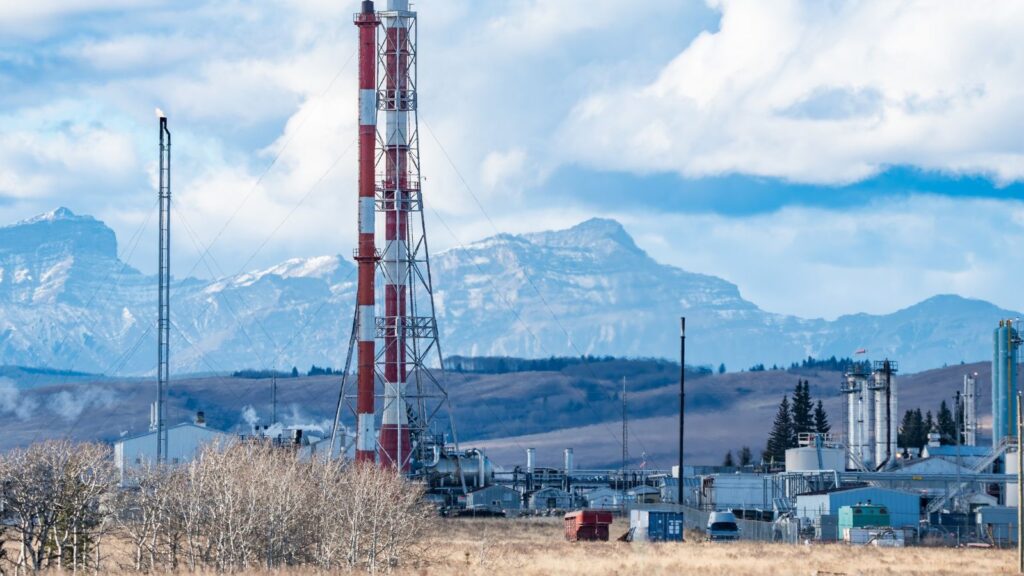
Alberta’s oil and gas industry is facing renewed scrutiny as natural gas flaring is projected to increase by 10% in 2026, reversing a significant decline recorded last year. The increase comes after the province eliminated its annual flaring limit in June 2025, removing a long-standing restriction intended to reduce the amount of natural gas burned during energy production.
New figures show producers flared 644 million cubic metres of gas during the first nine months of 2026, bringing the province close to its former annual ceiling of 670 million cubic metres.
The development has intensified debate over Alberta’s environmental regulations, the economic pressures facing energy producers and Canada’s commitments to reducing greenhouse gas emissions. While provincial officials maintain that existing safeguards remain effective, environmental researchers warn that rising flaring volumes could undermine previous progress.
Alberta Is on Track for a 10% Increase in Natural Gas Flaring
Natural gas flaring in Alberta is projected to increase approximately 10% in 2026 compared with the previous year, according to Reuters calculations using Alberta Energy Regulator data. The anticipated increase reverses a decline of roughly 15% reported for 2025. Producers burned approximately 644 million cubic metres of gas between January and September 2026, placing the province on course to exceed the annual limit that previously applied to solution gas flaring. That former ceiling stood at 670 million cubic metres, meaning nine months of activity had already brought flaring volumes close to what was once the full-year provincial threshold.
The figures are particularly significant because Alberta remains the centre of Canada’s oil production industry. Natural gas flaring is closely connected to petroleum extraction, meaning increases in production can also create additional volumes of associated gas requiring management. However, the 10% increase remains a projection based on available 2026 data rather than a finalized annual total. The final outcome will depend on production levels, conservation performance and operating conditions during the remaining months.
Alberta Removed Its Province-Wide Flaring Limit in June 2025
The regulatory change behind the current debate occurred on June 19, 2025, when the Alberta Energy Regulator revised Directive 060 to eliminate the province-wide solution gas flaring limit. The decision followed a ministerial order signed in May by then-environment minister Rebecca Schulz. The directive instructed the regulator to remove the annual ceiling while maintaining the other regulatory provisions governing flaring and venting. The previous limit of 670 million cubic metres had provided a province-wide benchmark for controlling the amount of associated natural gas burned during upstream oil production.
The limit had already been exceeded before its removal. Alberta Energy Regulator records show solution gas flaring reached approximately 769 million cubic metres in 2023 and 914.5 million cubic metres in 2024. Those figures demonstrate that the ceiling was not functioning as an absolute physical restriction on industry activity. Nevertheless, eliminating it represented a significant policy change. Rather than maintaining a numerical provincial threshold, Alberta increasingly relies on facility-level requirements, conservation assessments and emissions-management incentives to influence how producers handle excess natural gas.
Oil Production Growth Is Adding Pressure to Flaring Volumes
Natural gas flaring occurs because oil production frequently brings additional hydrocarbons to the surface alongside crude oil or bitumen. This associated natural gas, commonly called solution gas in Alberta’s regulatory system, must be collected, used, stored, processed or otherwise managed. When producers cannot economically capture or transport the gas, burning it through a flare may become an available disposal method. Flaring can also serve an important safety function during equipment failures, maintenance operations or emergency situations when pressure must be controlled.
Increasing petroleum output can therefore place additional pressure on gas-handling infrastructure. Alberta’s oil production increased approximately 2% between January and September 2026 compared with the same period in 2025, according to figures reported by Reuters. The Alberta Energy Regulator identified rising industry activity as a likely contributor to the increase in flaring. However, production growth does not automatically require a proportional rise in gas burned. Facilities equipped with sufficient gathering systems, processing capacity and conservation infrastructure can potentially handle additional production while limiting flaring.
Alberta’s 2025 Flaring Decline Showed Reductions Were Possible
The projected increase stands in contrast to the improvements recorded in 2025. Alberta Energy Regulator figures show solution gas flaring declined to approximately 787.8 million cubic metres that year, down 13.9% from the 914.5 million cubic metres recorded in 2024. The regulator also reported that solution gas conservation improved from 96.5% to 97.1%. These results suggested producers were finding ways to capture more associated gas instead of disposing of it through flaring, even while the broader petroleum industry continued expanding.
According to the regulator, the decline reflected several factors, including better operational performance, additional gas conservation efforts and economic incentives encouraging emissions reductions. This matters because it demonstrates that higher production and lower flaring volumes can occur simultaneously. The subsequent rebound in 2026 raises questions about whether those improvements can be sustained without a province-wide limit. It does not establish that eliminating the cap alone caused the increase, particularly because activity levels and operational conditions also changed. The concern is whether existing incentives are strong enough to maintain reductions when production expands.
Alberta Still Regulates Flaring Despite Eliminating the Annual Cap
Removing the annual provincial ceiling did not eliminate Alberta’s broader regulatory framework for natural gas flaring. Directive 060 continues to establish requirements for upstream petroleum facilities, including operational safeguards, reporting obligations and assessments of gas conservation opportunities. Operators must evaluate alternatives to flaring and retain documentation explaining their decisions. Where conservation is economically feasible under the directive’s prescribed assessment, operators are required to conserve the gas rather than routinely dispose of it. Separate volume limits also remain applicable to certain gas-processing facilities.
The distinction is important for understanding the regulatory debate. A province-wide limit sets an overall benchmark for industry activity, while facility-level requirements determine how individual operators manage their equipment and production processes. Alberta’s system also includes requirements for evaluating conservation economics at sites handling significant gas volumes, including a 900-cubic-metre-per-day assessment threshold in specified circumstances. These measures can discourage unnecessary flaring, but their effectiveness depends on compliance, operating economics and enforcement. The absence of an overall annual ceiling means regulators must increasingly rely on those remaining mechanisms to influence provincial totals.
Rising Flaring Creates Climate and Local Air Quality Concerns
Burning natural gas releases carbon dioxide into the atmosphere, contributing to climate change. Flaring can also produce black carbon, nitrogen oxides and other pollutants, depending on the composition of the gas and the efficiency of combustion. Although flaring generally converts much of the methane into carbon dioxide, the process is not perfectly efficient. Unburned methane can escape when combustion is incomplete or a flare stops burning properly. Consequently, greater flaring volumes can create additional environmental pressures even when facilities operate within applicable regulations.
The consequences extend beyond greenhouse gas inventories. Research published in the International Journal of Environmental Research and Public Health in December 2024 estimated that approximately 3% of Alberta’s population lived within 1.5 kilometres of an active flare. The study also identified associations between proximity to upstream oil and gas operations and certain cardiovascular and respiratory outcomes, although its observational findings do not establish that flaring caused those conditions. For households near energy facilities, questions about emissions are closely connected to everyday concerns about air quality, environmental monitoring and the cumulative effects of industrial activity.
Flaring Can Be Preferable to Venting, but Both Have Environmental Costs
Alberta’s approach to managing natural gas emissions involves an important distinction between flaring and venting. Flaring burns unwanted gas, converting much of its methane into carbon dioxide. Venting releases gas directly into the atmosphere without combustion. Because methane has substantially greater warming power than carbon dioxide over shorter periods, direct venting can create a more severe climate impact. Federal environmental information describes methane as more than 80 times as potent as carbon dioxide over a 20-year period, helping explain why regulators sometimes favour controlled flaring over unrestricted venting.
Alberta has also reported substantial progress in reducing methane emissions. The Alberta Energy Regulator’s November 2026 data indicates that its modelling estimates a 62% reduction from 2014 levels by 2025. However, the Pembina Institute has questioned the accuracy of provincial methane estimates, arguing that independent measurements suggest emissions may be significantly higher than the provincial model indicates. These competing assessments highlight the importance of measurement methods and transparent reporting. They also demonstrate why methane reductions and flaring volumes must be examined separately: improvements in one measure do not necessarily guarantee progress in the other.
Capturing Natural Gas Could Reduce Waste and Create Economic Value
Gas that is burned through flaring can sometimes be redirected into productive uses. Producers may capture associated gas for sale through pipelines, use it to generate electricity, employ it as fuel at production sites or reinject it into underground formations. Alberta’s regulatory framework explicitly recognizes several of these conservation options. The financial case varies considerably between operations, however. A large production facility close to an existing gas-gathering network may have attractive conservation opportunities, while a smaller remote site can face substantial infrastructure costs relative to the gas available.
The scale of wasted energy is significant internationally. According to the World Bank’s 2026 Global Gas Flaring Tracker, approximately 167 billion cubic metres of natural gas were flared worldwide in 2025, representing an estimated US$54 billion in wasted gas value. Those are global figures, not an estimate of Alberta’s losses, but they demonstrate why flaring is also an economic issue. Capturing gas requires investment, and not every project can recover its costs under prevailing market conditions. Nevertheless, technological improvements, coordinated gathering systems and long-term infrastructure planning can make conservation increasingly practical.
Alberta Defends Its Approach as Environmental Groups Demand Stronger Rules
Alberta’s government maintains that its emissions-management system provides meaningful safeguards without requiring the former province-wide flaring limit. Provincial officials have pointed to the Technology Innovation and Emissions Reduction system, known as TIER, which establishes industrial carbon-pricing obligations for covered facilities. Alberta’s published carbon price for 2026 is $95 per tonne of carbon dioxide equivalent. The province also requires operators to evaluate alternatives to flaring under existing regulatory rules. Its position is that the former numerical limit no longer adequately reflected the broader framework used to manage emissions.
Environmental organizations question whether those measures provide sufficient protection against rising flaring volumes. Amanda Bryant, an oil and gas policy specialist with the Pembina Institute, has argued that binding requirements are important because companies may not consistently pursue reductions beyond what regulations demand. The institute’s March 2026 research also highlighted that Alberta’s solution gas flaring had more than doubled between 2019 and 2024. The disagreement therefore extends beyond the projected increase in 2026. It concerns whether industry-wide limits remain necessary to sustain environmental improvements when production and investment continue expanding.
Federal Methane Rules and Canada’s 2030 Commitment Increase Pressure on Alberta
Alberta’s projected flaring increase comes as Canada prepares to implement stronger federal methane regulations. Amendments finalized in December 2025 introduce requirements beginning in 2028, including restrictions on hydrocarbon gas destruction and requirements for engineering assessments demonstrating when productive use is not feasible. For facilities operating before January 2028, major gas-destruction requirements are generally scheduled to apply beginning in 2030. Ottawa and Alberta are also negotiating an equivalency agreement that could allow provincial regulations to replace direct application of federal requirements where equivalent environmental outcomes are demonstrated. Their agreement in principle targets a 75% reduction in oil and gas methane emissions from 2014 levels by 2035.
Canada has also endorsed the World Bank’s voluntary initiative to eliminate routine gas flaring by 2030. That commitment does not prohibit emergency or safety-related flaring, but it establishes a clear expectation that gas burned during ordinary production should increasingly be conserved or used. The broader challenge is substantial. The Canadian Climate Institute warned in September 2026 that existing policies leave Canada far from its national emissions targets. Alberta’s projected flaring increase adds another issue requiring attention as governments balance energy production, competitiveness and climate commitments. Whether the province can reverse the rebound without reinstating an annual cap will be an important test of its current regulatory approach.
