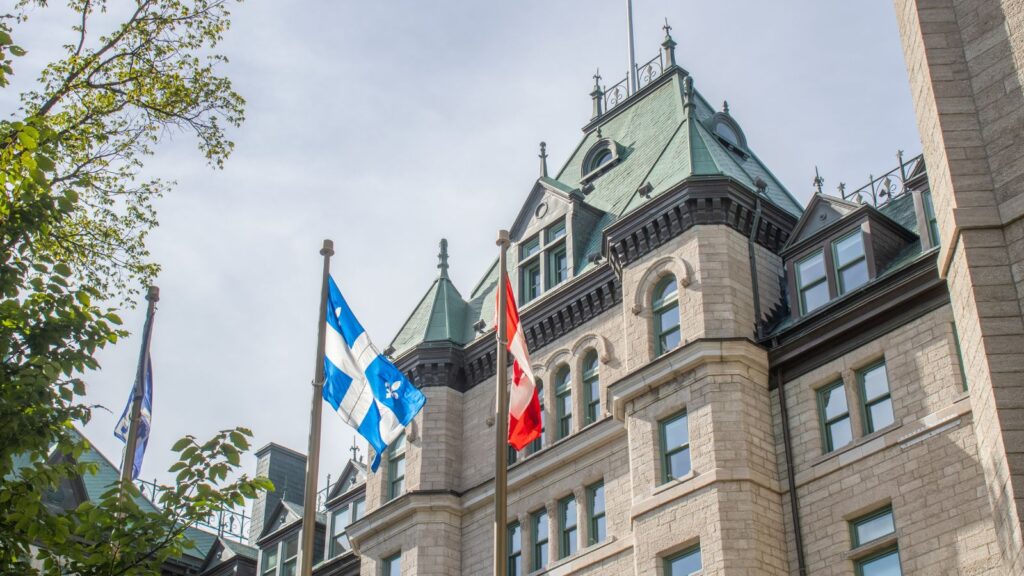
Quebec’s newly elected lawmakers are facing an extraordinary political dilemma: a court says they must pledge allegiance to a monarch they deliberately excluded from their oaths of office. A November 23 Superior Court ruling suspended Quebec’s 2022 law eliminating the mandatory oath to King Charles III, leaving all 127 members of the National Assembly confronting a constitutional dispute just days before the legislature’s scheduled December 1 opening. Premier Paul St-Pierre Plamondon’s Parti Québécois government has appealed the decision, while opposition leaders insist parliamentary business must resume without further delays. What began as a disagreement over the monarchy has become a much larger confrontation involving constitutional authority, Quebec’s political identity, and the ability of elected representatives to carry out their responsibilities.
A Court Ruling Threatens the December 1 Opening
On November 23, 2026, Quebec Superior Court Justice Ian Demers issued a decision that immediately complicated the province’s political calendar. The judge suspended a law adopted in 2022 that had removed the requirement for members of the National Assembly to swear allegiance to the Canadian monarch. His ruling means legislators face the reinstated oath requirement before taking their seats. Crucially, the suspension takes effect even though the government is appealing. The decision places Quebec’s newly elected representatives in an uncomfortable position, particularly those who consider an oath to King Charles III incompatible with their understanding of Quebec’s political autonomy.
The timing has made the confrontation especially consequential. The National Assembly is scheduled to open its first session of the 44th Legislature on December 1, following an October election that produced a new minority government. Opposition politicians are concerned that another delay would prevent elected representatives from beginning their parliamentary responsibilities. Meanwhile, the government is examining whether the legislature can open without requiring members to reverse their earlier decision to swear allegiance exclusively to Quebecers. The immediate question is no longer simply whether the oath is politically appropriate. It is whether the province can begin its legislative work while the constitutional disagreement remains unresolved.
Why All 127 Provincial Lawmakers Are Caught in the Dispute
Quebec’s National Assembly now has 127 seats, two more than the 125 contested in previous provincial elections. The increase followed legislation adopted in June 2026 to revise the provincial electoral map while preserving representation in certain regions. The October 5 election produced a fragmented legislature: the Parti Québécois won 60 seats, the Liberals secured 39, the Conservatives captured 19, and Québec solidaire won nine. The formerly governing Coalition Avenir Québec failed to win a seat. With 64 seats needed for a majority, Premier Paul St-Pierre Plamondon leads a government that must seek cooperation beyond its own caucus to pass legislation.
What makes the oath controversy particularly unusual is that it affects every elected member, regardless of party affiliation. All 127 lawmakers took an oath to the people of Quebec rather than swearing allegiance to the King. This was not simply a refusal by a handful of sovereigntist politicians. It represented a collective departure from the traditional constitutional ceremony. That shared decision now creates a practical problem for the entire legislature. If the oath requirement remains enforceable, representatives from different parties must decide how to reconcile their political commitments with the court’s interpretation of the law. Even parties that disagree sharply on Quebec’s constitutional future have a common interest in preserving the legislature’s ability to function.
The 2022 Law That Removed the Mandatory Royal Oath
The current confrontation traces directly to events after Quebec’s 2022 provincial election. Three Parti Québécois representatives, including Paul St-Pierre Plamondon, refused to pledge allegiance to the monarch and were prevented from taking their seats. Their refusal intensified an existing debate over whether elected Quebec politicians should be required to demonstrate loyalty to the Crown when their political mandate comes from provincial voters. On December 9, 2022, the National Assembly unanimously passed Bill 4, formally titled An Act to recognize the oath provided in the Act respecting the National Assembly as the sole oath required in order to sit in the Assembly. The legislation was intended to resolve the conflict.
The law added Section 128Q.1 to the Constitution Act, 1867, declaring that the constitutional oath requirement in Section 128 did not apply to Quebec. Under the revised arrangement, legislators needed only to take the oath established by Quebec’s own National Assembly legislation. That pledge requires members to demonstrate loyalty to the people of Quebec and perform their responsibilities honestly and justly, in accordance with Quebec’s constitution. For supporters, the reform reflected an important distinction between loyalty to democratic institutions and loyalty to a hereditary monarch. The arrangement remained in place through the October 2026 election, when every newly elected lawmaker used the Quebec oath. The November court decision has now placed the validity of that earlier reform squarely in question.
Why Canada’s Constitution Is Central to the Disagreement
At the centre of the legal challenge is Section 128 of the Constitution Act, 1867, which requires members of provincial legislatures to take an oath of allegiance before assuming their seats. The oath is administered by the lieutenant-governor or an authorized representative, connecting the requirement to Canada’s constitutional monarchy. Quebec’s 2022 legislation attempted to remove that obligation through a provincial constitutional amendment. However, Justice Ian Demers concluded that the province lacked the unilateral authority to make the change. His reasoning relied partly on the constitutional role of the lieutenant-governor and a 1979 Supreme Court of Canada decision concerning constitutional protections.
The distinction matters because Canadian provinces possess certain powers to amend their own constitutions, but those powers have limits. Section 45 of the Constitution Act, 1982, permits provincial constitutional amendments, while Section 41 protects fundamental institutions, including the office of the lieutenant-governor, through a requirement for unanimous constitutional agreement. Demers concluded that eliminating the royal oath affected an institution beyond Quebec’s independent amending authority. Quebec disputes that interpretation and is pursuing an appeal. Importantly, the November 23 decision suspends the law while the underlying constitutional challenge proceeds; it does not represent a final appellate determination of the issue. The courts must still address the substantive arguments concerning the province’s authority to establish its own parliamentary oath.
Premier St-Pierre Plamondon Refuses to Back Down
For Premier Paul St-Pierre Plamondon, the controversy involves far more than the administrative requirements of taking office. As leader of the sovereigntist Parti Québécois, he has consistently argued that elected representatives should answer first to the people who gave them their mandates. Following the November 23 ruling, he reiterated that he could not personally swear allegiance to the King. He also questioned the democratic legitimacy of compelling Quebec politicians to take an oath associated with a constitutional arrangement they oppose. His comments reflected a longstanding political position, but the practical consequences are now considerably greater because he leads the provincial government rather than a small opposition caucus.
On November 24, Quebec Justice Minister Marie-Claude Sarrazin confirmed that the province had formally initiated appeal proceedings. The government is seeking permission to appeal and asking the Quebec Court of Appeal to suspend the lower court’s order while the legal challenge continues. Sarrazin defended the 2022 law as a unanimous democratic decision and argued that allegiance to the monarch belongs to an earlier era. St-Pierre Plamondon has also suggested that a solution could allow lawmakers to sit without repeating their oaths, although he has not clearly committed to defying the court. His challenge is finding a path that protects the government’s constitutional position without producing the prolonged legislative disruption that opposition parties fear.
Quebec Liberals Demand a Clear Answer Before December 1
Quebec’s Liberal opposition has responded by making the legislature’s opening date its immediate priority. Parliamentary leader André Fortin sent a letter to National Assembly Speaker Nathalie Roy requesting clarification about the consequences of the Superior Court judgment. Roy remains the institution’s presiding officer until the new legislative session begins and her successor is appointed. Fortin asked her to use an exceptional procedure identified in the court ruling to determine whether the 127 elected members can legally take their seats. If the ruling prevents them from doing so, the Liberals want the necessary conditions for a lawful opening established before December 1.
Liberal Leader Charles Milliard has similarly warned against allowing the constitutional dispute to become another justification for postponing parliamentary business. The party supports the principle that elected lawmakers should be loyal to Quebecers, but it also insists that the legislature must operate within the law. That position presents a challenge to the Parti Québécois government: the Liberals are not demanding an ideological retreat from opposition to the monarchy, but they are demanding a workable legal solution. Their concern is that political disagreement should not prevent elected representatives from scrutinizing government decisions, debating proposed legislation, and raising constituency issues. With the opening date approaching, procedural certainty has become as important to the opposition as the broader constitutional debate.
Conservatives Say Parliament Must Open, Even if the Oath Is Required
Quebec Conservative Leader Éric Duhaime has taken a more pragmatic position on how to resolve the immediate confrontation. Although he strongly opposes the court’s reinstatement of the royal oath, he has indicated that Conservative lawmakers would reluctantly swear allegiance to the King if that is what it takes to resume parliamentary business. Speaking on November 24, Duhaime emphasized that the opening of the National Assembly had already been postponed twice. From his perspective, another delay would only deepen frustration over a political dispute that should not prevent representatives from doing their jobs. His position separates opposition to the monarchy from the practical obligation to keep democratic institutions functioning.
Duhaime also argued that the parties should maintain their common opposition to the compulsory royal oath rather than allowing the court ruling to divide them. He pointed out that federal Bloc Québécois parliamentarians have taken the traditional oath, as have Parti Québécois representatives in earlier legislatures. The Conservatives’ willingness to comply does not mean they endorse the monarchy or accept the ruling as the final word on Quebec’s constitutional powers. Instead, their approach recognizes that political disagreements can continue after legislators take their seats. With 19 Conservative representatives elected in October, the party has a substantial role in the minority legislature and an interest in ensuring that its voters receive effective representation.
The Court Warns That Future Quebec Laws Could Be Invalid
One of the most serious concerns raised by Justice Demers involves the legal status of legislation passed by representatives who have not taken the constitutionally required oath. In his November 23 decision, he warned that allowing the current legislature to operate without addressing the issue could expose its future laws to constitutional challenges. If courts ultimately determine that Quebec’s 2022 exemption was invalid, legislation passed by improperly qualified members could require corrective action, potentially including re-enactment. This was a central reason for granting the immediate suspension. The judge concluded that avoiding widespread uncertainty over the validity of future laws was an important public interest.
However, the ruling does not mean that Quebec’s existing laws have suddenly become invalid or that the province’s public services must immediately stop operating. It concerns the qualification of members of the new legislature and the legality of future parliamentary proceedings. Constitutional experts have also pointed to judicial remedies that can prevent legal uncertainty from becoming an administrative disaster. A historical example comes from Manitoba, where the Supreme Court of Canada temporarily preserved the effect of laws that had been enacted in English only while the province addressed its constitutional obligations. The comparison illustrates why the present situation requires careful legal handling rather than assuming every disputed legislative act would automatically disappear. For Quebecers, the important question is whether their government can legislate with legal certainty.
What Happens Next Could Determine Whether Quebec’s Legislature Can Function
The immediate focus is now on Quebec’s appeal and the approaching December 1 deadline. The provincial government wants the Court of Appeal to suspend the Superior Court order so lawmakers can begin their parliamentary work without pledging allegiance to the King. If that request succeeds, the National Assembly could potentially open under the oath arrangements established in 2022 while the constitutional challenge continues. If the request fails, politicians face more difficult choices: comply with the reinstated oath requirement, postpone the opening, or risk a confrontation over the legality of parliamentary proceedings. A procedural ruling by the Speaker has also been suggested, although its ability to resolve the broader legal dispute remains uncertain.
The underlying constitutional case is unlikely to disappear even if the immediate parliamentary deadline is resolved. Justice Demers has ordered the parties to submit a timetable or case-management protocol by December 18, 2026, allowing the litigation to proceed toward a more complete examination. The eventual outcome could clarify how far Quebec can go in changing the constitutional rules governing its elected representatives without broader Canadian agreement. For the 127 lawmakers involved, the immediate responsibility is considerably more practical: establishing a lawful way to represent their constituents. Whether the solution emerges through the courts, a political compromise, or reluctant compliance with the oath requirement, the dispute has exposed an unresolved tension between Quebec’s democratic aspirations and Canada’s constitutional structure.
