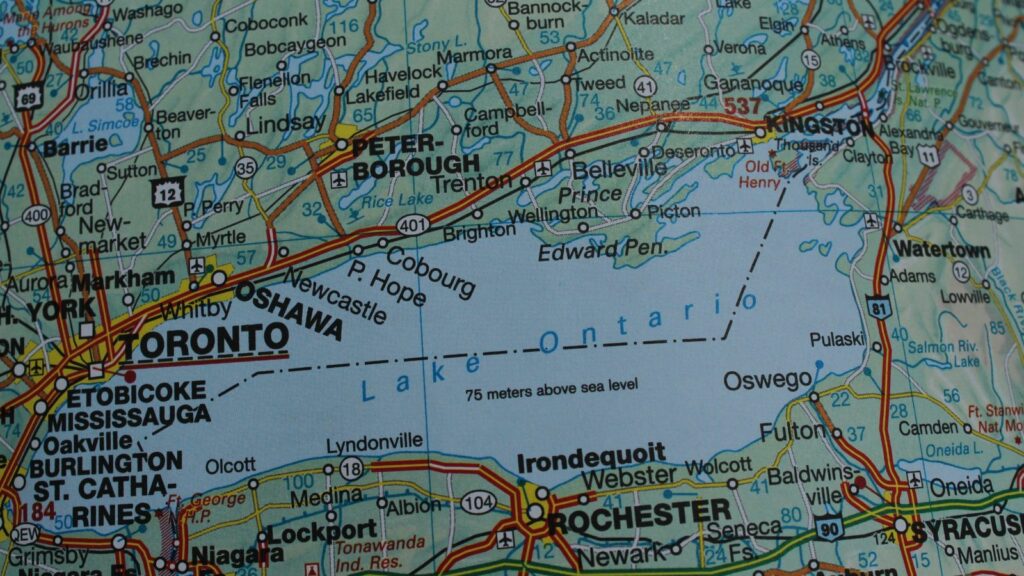
A geographic name has become an unusually personal symbol of the widening Canada–U.S. rift. After U.S. President Donald Trump ordered Lake Ontario renamed “Lake America” for American federal use, several U.S.-born residents of Canada told The Canadian Press that they found the move embarrassing, pointless or “childish.” Their criticism comes as the dispute moves beyond political theatre: Washington and Ottawa are already locked in a new tariff fight, Canadian travel patterns have shifted, and major digital maps now show different names depending on which side of the border a user is on.
The controversy is striking because Lake Ontario is not merely a landmark beside the border. It is a shared waterway governed through decades of binational cooperation, carrying an Indigenous-derived name that appears in official and historical records going back centuries.
Americans in Canada Say the Move Crosses a Line
The strongest criticism did not come only from Canadian politicians. Ben Davis, a retired law professor who moved from Virginia to Quebec in 2025, described the renaming as beneath the U.S. presidency. Dawna E. Wade, an American-born Canadian citizen living in Nova Scotia, argued that the lake was not Trump’s to rename. Hamilton resident Chris Palermo, originally from Long Island, called the change useless and linked it to failed trade talks.
Perhaps the sharpest wording came from London, Ontario, resident Chris Kubinski, who called the move “childish” and “bizarre.” Kubinski had moved to Canada as a child and later became a Canadian citizen. These interviews are anecdotes rather than a representative sample, but they matter because the criticism comes from people with ties to both countries. Their reactions show how a symbolic presidential order can become a question of identity and respect.
The Order Changes U.S. Federal Usage, Not Canada’s Name
Trump signed Executive Order 14422 on August 27, directing the U.S. secretary of the interior and Board on Geographic Names to replace “Lake Ontario” with “Lake America” in the Geographic Names Information System. The order gives the department 30 days to make the update and requires federal maps, contracts, documents and communications to use the designation. That makes the change real inside the U.S. federal bureaucracy rather than merely rhetorical.
Its reach stops well short of an internationally binding rename. Canada’s geographical-names system continues to list Lake Ontario as the official Canadian name, and the U.S. order cannot require Canadian governments, international organizations or citizens to adopt Washington’s terminology. The distinction is central to the dispute: the Trump administration can determine what federal agencies call the lake, but it cannot unilaterally settle what a shared international body of water is called everywhere else.
The Name Carries Centuries of History
The historical argument against the rename is unusually concrete. Natural Resources Canada says “Ontario” comes from an Iroquoian word associated with sparkling water and records the name in Jesuit Relations from around 1641. More than a century later, the 1794 Treaty of Canandaigua between the United States and the Six Nations explicitly used “Lake Ontario” while describing Seneca territory. The treaty was concluded during George Washington’s presidency, a detail Davis cited when criticizing Trump’s decision.
The name also predates the creation of Ontario as a province in 1867. Canada’s geographical-names database still designates Lake Ontario as official, preserving that continuity as the U.S. federal database changes. Indigenous languages and historical spellings do not always produce one simple translation, but the basic point is documented: “Ontario” was attached to the region long before this political dispute. That turns the argument from branding into a debate over historical memory.
American Opinion Is Mostly Against the Rename
The expatriate criticism also lines up with national polling inside the United States. An Ipsos poll for Reuters, conducted from August 28 to 30 among 1,023 U.S. adults, found that 63% opposed renaming Lake Ontario and only 14% supported it. Another 21% said they did not know enough about the change or were unsure. Opposition therefore outweighed support by more than four to one.
The resistance crossed party lines, although not evenly. Ipsos reported that 43% of Republicans opposed the name change while 33% supported it; opposition was much higher among Democrats and independents. The same poll found 57% opposed the latest U.S. tariffs on Canada and 20% supported them. Those figures do not prove that every critic objects for the same reason, but they undercut any suggestion that anger over “Lake America” is simply a Canadian reaction to an American policy.
A Shared Lake Is an Awkward Stage for Unilateral Branding
Lake Ontario has always required cooperation that ignores slogans. The U.S. Environmental Protection Agency describes it as the smallest Great Lake by surface area, at about 18,960 square kilometres, bordered by Ontario and New York. Canada and the United States also manage Great Lakes issues through institutions created because water, pollution, shipping and ecosystems do not stop at the border.
The Great Lakes Water Quality Agreement was first signed in 1972 and most recently updated in 2012. It commits both governments to cooperative action to restore and protect the lakes, with the International Joint Commission assessing progress. That history helps explain why the renaming feels larger than a label. Federal naming rules can change quickly, but the lake remains physically shared and institutionally binational. Neither water levels nor environmental obligations respond to a unilateral terminology change, highlighting the contrast between political symbolism and practical cross-border governance.
Google and Apple Turned the Dispute Into a Map Split
The naming fight became visible on millions of screens within days. Google said it follows official government naming sources, so after the U.S. Geographic Names Information System changed, Maps began showing “Lake America” to users in the United States. Canadian users continue to see “Lake Ontario,” while users outside the two countries see both names. The same body of water can therefore carry different labels depending on location.
Apple Maps later adopted the U.S. designation for American users as well. The change illustrates how government databases can flow directly into consumer technology even when a name is politically contested. It also creates an unusually literal version of the diplomatic divide: people standing on opposite sides of the border may open similar mapping apps and see different words. What began as an executive order has therefore moved from federal paperwork into everyday navigation, searches and screenshots shared online.
The Rename Landed in the Middle of a Real Trade War
The timing matters. U.S.-Canada trade talks collapsed on August 21 after three days of negotiations, with each side accusing the other of changing or rejecting the terms. The United States then imposed 50% tariffs on roughly $20 billion worth of Canadian goods. Reuters reported that affected products included wine, furniture, dairy products, cement, clothing, fishing rods and hockey equipment—an unusually broad mix that brings the dispute into factories, stores and household budgets.
Canada responded with dollar-for-dollar retaliation on about $20 billion of annual U.S. imports, with duties scheduled to take effect September 8 across hundreds of products. Against that backdrop, “Lake America” was not introduced in a diplomatic vacuum. Trump had linked the proposed renaming to his frustration with Ontario and trade. That connection is why critics see the order not simply as presidential branding, but as another pressure point in a confrontation already carrying measurable economic consequences.
Canadian Leaders Answered With Their Own Symbolism
Ottawa and Ontario did not treat the new U.S. label as something to quietly ignore. Prime Minister Mark Carney said the lake would continue to be called Lake Ontario in Canada and emphasized the name’s Indigenous and historical roots. Two days after Trump signed the order, Ontario Premier Doug Ford unveiled a large sign near Grimsby declaring “Lake Ontario, Now and Always,” turning a naming dispute into a deliberately visual statement of provincial defiance.
The rejection was not confined to Canada. New York Governor Kathy Hochul also rejected the new designation, underscoring that federal usage does not automatically determine state or international practice. By September 1, Carney was connecting the broader dispute to the stalled trade relationship, saying Washington needed to approach negotiations more seriously and respectfully before talks could resume. The exchange shows how quickly symbolic gestures can harden into diplomatic messaging when trust between two traditionally close neighbours is already thin.
Travel Data Show the Relationship Was Already Cooling
The political chill has had a real-world travel dimension. Statistics Canada found that Canadian-resident return border crossings from the United States fell 25.4% in 2025 compared with 2024. Excluding the pandemic years, the resulting 11-month run of year-over-year declines was the deepest and most sustained in records dating to 1972. That pullback began well before the Lake Ontario order, showing that the bilateral relationship was already affecting behaviour.
There are signs of partial recovery, which makes the picture more nuanced. In June 2026, Canadian-resident return trips from the United States rose 5% from a year earlier but remained 24.6% below June 2024 levels. American tourism organizations have responded with promotions and other efforts to win Canadians back. The numbers suggest the rename did not create the travel rift by itself; instead, it arrived after political tensions had already helped reshape where many Canadians chose to spend time and money.
For Americans in Canada, the Rift Can Feel Personal
The Canadian Press interviews highlight a group that can disappear in nationalist arguments: Americans whose homes, spouses, careers and communities are now in Canada. The Association of Americans Resident Overseas estimated in 2023 that more than one million Americans, including dual citizens and people on long-term visas, lived in Canada. Their experiences vary widely, so a handful of interviews cannot speak for that population as a whole.
Still, some reactions reveal how the broader confrontation has become personal. Kubinski said Trump’s repeated “51st state” rhetoric helped lead him to decide to renounce his U.S. citizenship after decades in Canada. Others interviewed described embarrassment at watching the dispute from north of the border. The lake’s name may ultimately matter less than the accumulated message people hear behind it. A label can change with an executive signature; rebuilding confidence between neighbours, families, consumers and institutions is slower, particularly once political conflict becomes part of everyday identity.
