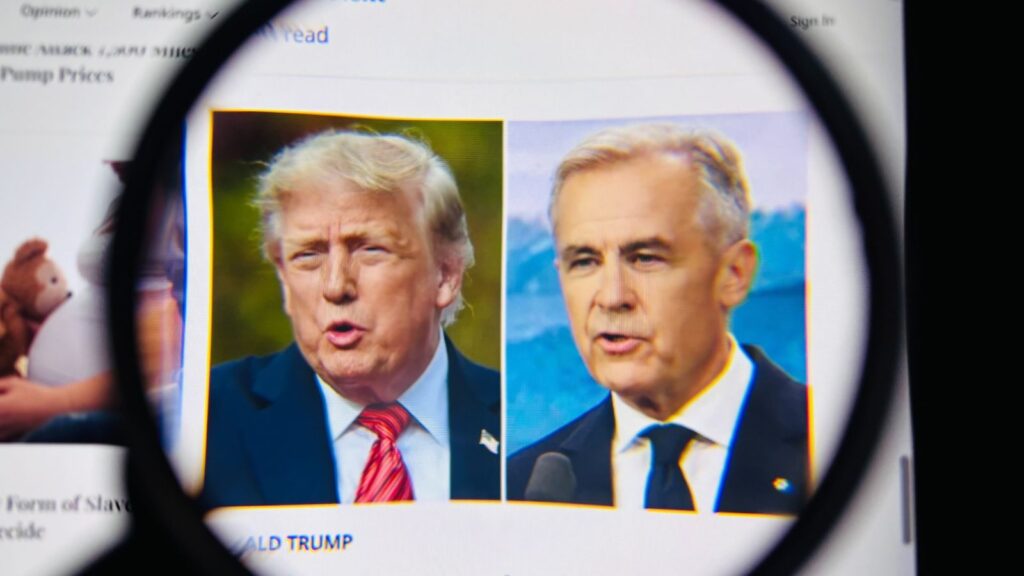
The centre of gravity in global development assistance is shifting quickly. The United States has sharply reduced foreign aid under President Donald Trump, dismantling USAID and recasting much of what remains around narrower American interests. Canada, meanwhile, is looking toward Europe and other partners to help build a new development coalition.
Yet Prime Minister Mark Carney is not responding to Washington’s retreat by simply spending more. Ottawa is cutting its own international assistance envelope, with global health specifically targeted for reductions, while putting greater emphasis on private investment and economic partnerships. That leaves Canada trying to expand its diplomatic influence at the same moment it is asking the development system to operate with less public money.
Trump’s Pullback Has Redrawn the Aid Map
The scale of the American retreat is difficult to separate from the broader crisis in development funding. Preliminary OECD figures show U.S. official development assistance fell 56.9% in 2025 to about US$29 billion. The decline was so large that Germany overtook the United States as the world’s biggest government aid provider for the first time. Across major donor countries, total official development assistance dropped 23.1% to US$174.3 billion, the largest annual contraction recorded by the OECD. Washington alone accounted for roughly three-quarters of that overall decline.
Trump’s overhaul went beyond the headline spending numbers. USAID was dismantled, most of its awards were cancelled, and responsibility for surviving global health programs shifted toward the State Department. Congress has protected some health spending from the administration’s proposed reductions, including roughly US$11.3 billion appropriated for global health in fiscal 2026, but the system is fundamentally smaller and more fragmented. A major study published in The Lancet estimated that continued steep USAID cuts could contribute to more than 14 million additional deaths by 2030, including roughly 4.5 million children under five. That is a projection rather than a confirmed death toll, but it illustrates how consequential the funding shift could become.
Canada Is Building an Aid Coalition Around Europe
Ottawa’s response increasingly runs through Europe. Canada’s Secretary of State for International Development, Randeep Sarai, attended an informal meeting of European Union development ministers in Dublin on October 8 and 9, where governments discussed the future of development cooperation and a widening gap between humanitarian needs and available resources. Canada was there as a non-EU partner at a moment when European governments are also trying to determine how much of the space vacated by Washington they can realistically fill.
Sarai has described the emerging effort as broader than a Canada-EU arrangement. Ottawa is also looking toward countries such as Japan and South Korea, along with Gulf states and other development partners, to combine public money, philanthropy and commercial capital. The strategy fits Carney’s broader foreign-policy push to deepen relationships with reliable partners as Canada reduces its economic dependence on the United States. Development assistance is increasingly being treated as part of that larger network: not simply charity, but a tool connecting diplomacy, economic resilience, security and commercial relationships. Europe therefore gives Canada something beyond money. It offers Ottawa a larger coalition through which a middle power can still exert influence as American leadership becomes less predictable.
Ottawa Is Cutting While Asking Partners to Do More
There is an important complication in that strategy: Canada is reducing its own aid budget. Budget 2025 lowered the International Assistance Envelope by $2.7 billion over four years beginning in 2026-27, with the government describing the change as a return toward pre-pandemic spending levels. The envelope had reached about $10.3 billion in 2024-25 after years of extraordinary spending related to COVID-19, Ukraine and other global crises. Global Affairs Canada’s current spending plan includes hundreds of millions of dollars in annual reductions, rising to more than $1.1 billion by 2028-29.
Global health is not merely being affected indirectly. Ottawa’s budget documents explicitly identify it as one of the areas where development funding will be reduced, and a senior Global Affairs official told a parliamentary committee in June that the department’s reductions were concentrated “mostly” in global health programming. Preliminary estimates from the Institute for Health Metrics and Evaluation suggest Canadian development assistance for health is falling by about 10% between 2025 and 2026, a reduction of more than US$100 million. Canada also pledged $1.02 billion to the Global Fund to Fight AIDS, Tuberculosis and Malaria for 2026 through 2028, still a substantial commitment but about 16% below the $1.21-billion pledge made for the previous three-year cycle.
Carney Is Betting on Blended Finance
The alternative Ottawa is emphasizing is not withdrawal but leverage. Carney spent years advocating for greater mobilization of private capital before entering politics, including as the United Nations special envoy on climate action and finance. His work focused heavily on the idea that governments cannot finance enormous global challenges alone. Public money can instead be used to absorb risk, provide guarantees or create structures that make projects attractive enough for pension funds, banks, foundations and other investors to participate.
That philosophy is now increasingly visible in Canadian development policy. Ottawa has expanded the use of loans, guarantees, repayable contributions and partnerships with FinDev Canada, the country’s development finance institution. The 2026 Spring Economic Update proposed $2 billion in additional paid-in capital for FinDev Canada and another $732 million for its concessional finance facility, with the government aiming to mobilize more than $3 in private capital for every $1 of public investment through that facility. Sarai also announced $51.5 million in new blended-finance and impact-investment initiatives at a G7 meeting in May. More recently, Canada backed an $85-million FinDev loan supporting financing for women-owned businesses in rural Thailand as part of a wider package involving other lenders. The premise is straightforward: a smaller pool of taxpayer dollars can potentially support a much larger pool of investment.
Private Capital Has Clear Limits in Global Health
There is evidence that this model can work, but also evidence that it cannot replace traditional aid. Convergence, a Toronto-based global blended-finance network, reported that private investors put US$11.2 billion into blended-finance transactions in 2025, up 27% from the previous year. Its data suggested that every dollar of concessional capital in those transactions mobilized a record US$5.33 in commercially priced financing. For infrastructure, renewable energy, financial services and profitable businesses in emerging markets, the ability to multiply public investment can be significant.
The harder question is where that money actually goes. OECD research shows that nearly 70% of mobilized private finance has flowed to middle-income countries outside the least-developed-country category, while only about 8% has reached low-income countries. Social sectors such as health and education accounted for just 6% of mobilized private finance. That matters because a rural vaccination campaign, tuberculosis clinic or maternal-health program rarely generates the predictable commercial return available from an energy project, bank loan portfolio or toll road. OECD guidance also warns that blended finance has not scaled as rapidly as advocates once hoped and can become an ineffective subsidy if projects lack sound fundamentals. Private capital can stretch public aid further, but the evidence suggests it is much better at complementing grants than replacing them.
The Global Health Funding Crunch Is Bigger Than Canada
Canada’s reductions are taking place during an unusually difficult period for global health finance. Recent estimates from the Institute for Health Metrics and Evaluation indicate development assistance for health fell again in 2026 after a much larger contraction the previous year. The United Kingdom recorded the largest absolute reduction among major government donors this year, cutting assistance by an estimated US$891 million, or 37%. U.S. health assistance fell by about US$668 million, or 8%, while Canada and Germany each reduced spending by more than US$100 million.
OECD projections point in the same direction. Bilateral aid for health and population programs could fall between 29% and 46% from 2024 to 2026, equivalent to a loss of roughly US$5 billion to US$8 billion and pushing assistance toward its lowest level in almost two decades. Governments in poorer countries are trying to compensate. IHME estimates government health spending per person in low-income countries grew by an average of about 8% annually from 2024 through 2026. Yet total health spending per person still declined because donor reductions were larger. In practical terms, countries are being asked to assume more financial responsibility just as the external funding that helped them build health systems is disappearing.
Canada’s Influence Will Depend on What It Protects
None of this means Canada is abandoning global health. Ottawa’s current departmental plans still commit the government to health, humanitarian assistance, poverty reduction, gender equality and the health and rights of women and girls. The $1.02-billion Global Fund pledge remains one of Canada’s largest multilateral health investments. The Global Fund itself raised US$12.64 billion for its latest replenishment, although the tighter funding environment has forced it to reduce allocations and place greater emphasis on the poorest, highest-burden countries and on eventual self-reliance.
The question is therefore less whether Canada will remain involved than what kind of development power it wants to become. Working with Europe, Japan and other partners could allow Ottawa to preserve more influence than its budget alone would suggest. Blended finance could also make Canadian dollars travel further in markets where commercially viable projects exist. But neither mechanism can fully substitute for grants in areas where financial returns are weak and human needs are greatest. As Ottawa approaches its next federal budget, the tension will become harder to avoid: Canada wants to help organize a post-USAID development landscape while simultaneously cutting some of the public funding that made it influential in the first place. If Europe and private investors amplify a stable core of Canadian aid, the strategy could produce meaningful leverage. If that core shrinks too far, Canada may find itself coordinating scarcity rather than filling the vacuum Washington left behind.
