A conflict centred on Yemen is once again becoming a problem for ships, supply chains and economies thousands of kilometres away. Canada and the United States have joined their G7 partners in warning that escalating Houthi military activity threatens maritime security in the Red Sea and Bab al-Mandab Strait, with potential consequences for global energy, food and fertilizer flows. The September 22 statement comes as renewed fighting has pushed Yemen back toward large-scale conflict and placed greater attention on one of the world’s most sensitive maritime chokepoints. For governments and businesses, the concern extends beyond another round of Middle East tensions: previous Red Sea disruptions demonstrated how quickly insecurity around a narrow shipping corridor can translate into longer voyages, higher freight costs and difficult supply-chain decisions.
The G7 Warning Goes Beyond Another Regional Security Statement
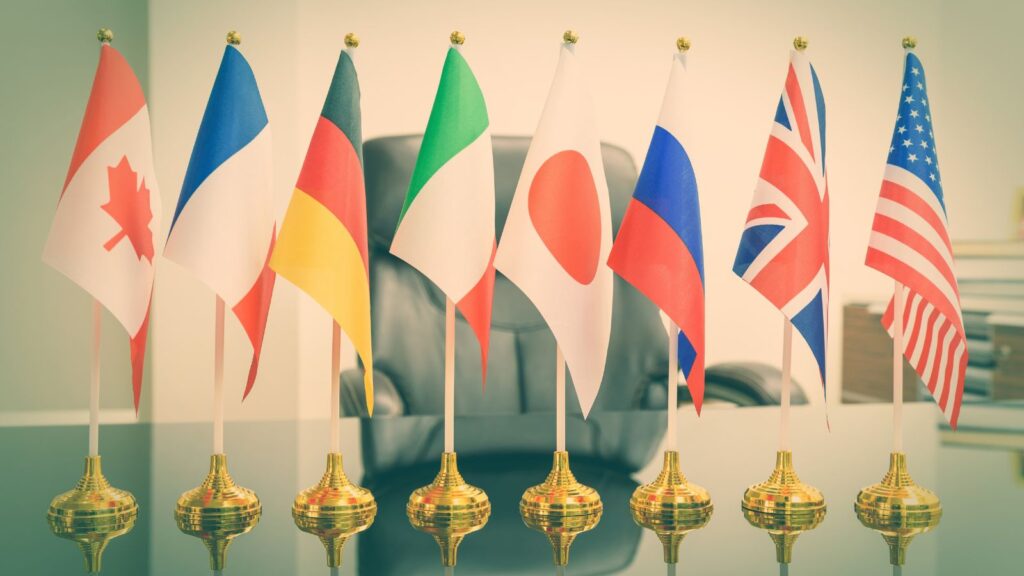
The September 22 declaration brought together the foreign ministers of Canada, France, Germany, Italy, Japan, the United Kingdom and the United States, along with the European Union’s High Representative. They described the situation in Yemen as a threat not only to regional security but also to global energy security, navigational rights and maritime security in the Red Sea and Bab al-Mandab Strait. The ministers condemned continuing Houthi strikes in Yemen and against Saudi Arabia and called for an immediate halt to military actions and threats against civilian shipping.
What makes the language economically significant is the attention given to supply chains. The G7 specifically warned against lasting disruption to energy, fertilizer and food flows and said continued escalation could undermine international trade and contribute to global economic instability. That turns what might otherwise be viewed as a distant security confrontation into an issue that can reach factories, ports, retailers and households well outside the Middle East. The statement also called for a return to a political process rather than presenting maritime security as a problem that can be solved entirely through military measures.
A Narrow Strait Connects Yemen to the Global Economy
The Bab al-Mandab is geographically small but commercially enormous. Sitting between Yemen and the Horn of Africa, it forms the southern entrance to the Red Sea. Ships moving between the Indian Ocean and the Suez Canal normally pass through it, making the strait an important link between Asian manufacturing centres, Middle Eastern energy producers and markets in Europe and beyond. The UN’s trade agency has repeatedly identified the Red Sea and Suez route as one of the major chokepoints whose disruption can reshape international shipping.
The numbers show why governments pay attention when security deteriorates there. U.S. Energy Information Administration data estimate that approximately 8.1 million barrels per day of crude oil and petroleum liquids moved through the Bab al-Mandab during the second quarter of 2026. The Suez Canal and SUMED pipeline handled another 5.8 million barrels per day during that quarter. Maritime transportation also carries more than 80% of world trade by volume, according to UN Trade and Development. A disturbance at one strategic passage therefore does not require the entire route to close before companies begin reconsidering schedules, insurance, fuel costs and vessel deployment.
Renewed Fighting Has Made the Shipping Risk More Immediate
The latest warning comes against a deteriorating security picture rather than a theoretical future risk. In September, UN Special Envoy for Yemen Hans Grundberg told the Security Council that Yemen’s risk of returning to large-scale conflict had become a reality. Fighting intensified across several fronts, particularly along the strategically important western coast. Houthi forces, also known as Ansar Allah, advanced on Mokha, a port city roughly 75 kilometres from the Bab al-Mandab, according to the UN briefing.
Commercial shipping has also faced direct violence. In August, the International Maritime Organization reported that the cargo ship Tihamah had been hit by a projectile off the coast of Al Mokha and that several seafarers had been killed. IMO Secretary-General Arsenio Dominguez warned that continued attacks threatened supply chains and urged operators to conduct careful risk assessments before entering dangerous waters. Such incidents matter because crews, insurers and shipping companies make decisions based on perceived risk as well as confirmed closures. A route can remain technically open while commercial traffic begins avoiding it because the financial and human risks have become unacceptable.
Energy Security Raises the Economic Stakes
Oil markets give the Bab al-Mandab crisis another layer of global importance. EIA figures indicate that oil flows through the strait increased from about 5.6 million barrels per day in the first quarter of 2026 to roughly 8.1 million barrels per day in the second quarter. That period also coincided with sharply reduced flows through the Strait of Hormuz, demonstrating how disruptions at one Middle Eastern chokepoint can shift pressure toward another route rather than making the underlying problem disappear.
The G7 consequently framed its warning in terms of global energy security as well as shipping safety. Energy markets react not only to barrels physically removed from supply but also to the possibility of future disruption. Tankers taking longer routes consume more fuel, occupy ships for additional days and can require higher insurance coverage. Saudi Arabia and other regional producers also depend on combinations of pipelines, export terminals and maritime passages to reach customers. When several routes face instability simultaneously, the system has less flexibility to absorb another shock. The significance of the G7 statement is therefore partly preventive: governments are signalling concern before a prolonged disruption becomes embedded in global transport and energy networks.
Canada Is Treating Freedom of Navigation as an Economic Interest
Canada’s participation is consistent with a broader position Ottawa has taken on maritime security in the region. On September 21, Foreign Affairs Minister Anita Anand met Qatar’s prime minister and foreign minister on the margins of the UN General Assembly. Global Affairs Canada said Anand reaffirmed Canada’s support for the safe passage of vessels through the Strait of Hormuz, the Bab al-Mandab and the Red Sea, while stressing continued cooperation with regional partners on maritime security.
Canada does not need to be physically beside the Red Sea for disruption there to matter. Canadian retailers and manufacturers participate in international supply chains in which components, finished products and commodities can move through several countries and ocean corridors before reaching their destination. Freight capacity is also global: when vessels spend additional days sailing around dangerous areas, fewer ships are effectively available elsewhere. Previous Red Sea disruptions demonstrated that longer routes can tighten capacity and increase costs even for cargo that never passes directly through the affected chokepoint. Ottawa’s stance therefore links freedom of navigation with economic resilience rather than treating it solely as a distant defence issue.
U.S. Support Adds Weight, but Not an Automatic Military Commitment
The United States joined Canada and the other G7 members in demanding that Houthi forces cease military actions and attacks or threats against civilian shipping. Washington’s participation matters because the U.S. is simultaneously a major trading economy, energy producer and longstanding security actor in the Middle East. Yet the diplomatic statement should not automatically be interpreted as an announcement of a new American combat operation. The declaration itself focuses on de-escalation, maritime security and a return to political negotiations.
That distinction is especially relevant in the current phase of the Yemen conflict. Reuters reported on September 21 that President Donald Trump had spoken with Yemeni President Rashad al-Alimi but had not committed the United States to providing direct military support against the Houthis. The U.S. position can therefore combine strong diplomatic opposition to attacks on shipping with caution about deeper military involvement. For businesses trying to interpret political statements, that means the G7 warning is best understood as a collective signal about unacceptable risks to international commerce and regional stability rather than proof that a particular military response has already been decided.
The G7 Is Also Putting Iran at the Centre of the Dispute
The G7 statement called on Iran to end what the ministers described as its arming and support of the Houthis, citing UN Security Council resolutions including 1747, 2140 and 2216. Western governments have long accused Tehran of providing the movement with weapons, expertise and other assistance. Recent reporting has added allegations that Iranian support contributed to the Houthis’ latest advances along Yemen’s Red Sea coast. Reuters reported in September, citing Iranian, Yemeni and regional sources, that Iranian weapons and military advice had assisted the offensive.
The Iranian position is different and should be distinguished from the G7’s claims. Tehran has publicly denied directing Houthi military operations and has described the movement as an ally rather than a proxy under Iranian command. That disagreement matters because responsibility for Houthi actions is central to wider tensions between Iran, the United States and Gulf states. The G7’s decision to explicitly connect Iranian support with risks to international trade broadens the dispute from the battlefield in Yemen to questions of sanctions, arms transfers, diplomacy and maritime security. It also increases the pressure on negotiations to address both Yemen’s domestic conflict and its regional dimensions.
Longer Routes Can Turn Security Problems Into Higher Prices
The economic mechanism linking Red Sea attacks to consumers is straightforward. When shipping companies judge the Suez-Red Sea route too dangerous, vessels can travel around Africa’s Cape of Good Hope instead. The cargo still arrives, but the journey becomes longer. UN Trade and Development estimated during the earlier Red Sea disruption that rerouting could add roughly 12 days to an Asia-Europe voyage. Longer journeys consume additional fuel, require vessels and crews for more time and reduce the effective amount of shipping capacity available to move other cargo.
The effects have already been demonstrated. UNCTAD reported that container freight costs rose sharply during the 2024 disruption, while the IMF found that Suez trade fell by roughly half in the first two months of that year compared with the previous year. The IMF also noted that a standard 40-foot container travelling from China to the Mediterranean had risen from roughly $1,000 to more than $4,000 during the early phase of that crisis. Current conditions are different, so those figures should not be treated as a forecast for 2026. They do, however, show why another sustained security shock worries governments and importers before shelves begin showing obvious effects.
Food and Fertilizer Make This More Than an Oil Story
The G7 deliberately singled out fertilizer and food alongside energy. Those commodities matter because transportation costs can have disproportionate effects on countries that depend heavily on imported staples or agricultural inputs. Fertilizer prices influence farming costs, while shipping delays can be especially difficult for food products with limited shelf lives. A vessel carrying crude oil can often tolerate a longer voyage more easily than a supply chain built around tight delivery windows for fresh produce, animal feed ingredients or manufacturing inputs.
Earlier Red Sea disruption offered practical examples. UNCTAD reported that longer voyages around Africa affected container availability and contributed to disruptions involving goods including coffee, tea and perishables. The agency has also warned that higher freight costs tend to hit small island developing states and least-developed countries particularly hard because many have limited shipping connectivity and high dependence on imports. That explains the wording of the new G7 statement, which says disruption would be particularly damaging to vulnerable populations. The concern is not simply whether wealthy economies pay more for imported goods, but whether logistics instability makes essential commodities harder to obtain in countries with far less room to absorb additional costs.
Yemen’s Civilian Crisis Is Worsening at the Same Time
Behind the discussion of shipping lanes is a rapidly worsening humanitarian emergency. At a September 18 UN briefing, officials reported that more than 112,000 people had recently been displaced inside Yemen as fighting intensified, particularly along the western coast and in southern Taiz. UN representatives described families leaving with little more than they could carry, roads becoming inaccessible and humanitarian access being severely constrained. Nearly 3,000 people had also reached Djibouti after dangerous journeys across the water.
The broader humanitarian burden was already immense. The UN said more than 22 million people across Yemen needed humanitarian assistance, while health facilities were operating under severe limitations. The economic and human consequences therefore reinforce one another: fighting near ports and trade routes can disrupt commerce, while the same fighting forces families from homes, interrupts medical care and makes relief deliveries more difficult. That is one reason the G7 statement connects attacks on civilian infrastructure and shipping with calls for political negotiations. Preventing maritime disruption without addressing the conflict ashore would leave the underlying source of insecurity unresolved.
The Bigger Test Is Whether Diplomacy Can Keep the Route Open
The immediate question for shipping companies is whether conditions around the Bab al-Mandab deteriorate enough to trigger broader rerouting. The larger diplomatic question is whether governments can reduce the risk before that happens. The G7 has called for the Houthis to halt military activity and return to negotiations while reaffirming support for UN Special Envoy Hans Grundberg and what it describes as an inclusive, Yemeni-led political settlement. The UN envoy has similarly argued that Yemen requires a credible political path addressing security, economic and political issues rather than another prolonged military cycle.
For global trade, successful de-escalation would have consequences far beyond Yemen. Shipping schedules could become easier to plan, insurance risks could ease and businesses would have less reason to build expensive buffers against another prolonged Red Sea disruption. Failure would create the opposite problem: another strategic waterway operating under persistent uncertainty at a time when other global trade routes are already exposed to geopolitical and economic pressure. Canada and the United States are therefore joining the G7 warning at a moment when maritime security, energy security and the future of Yemen have become increasingly difficult to separate.
