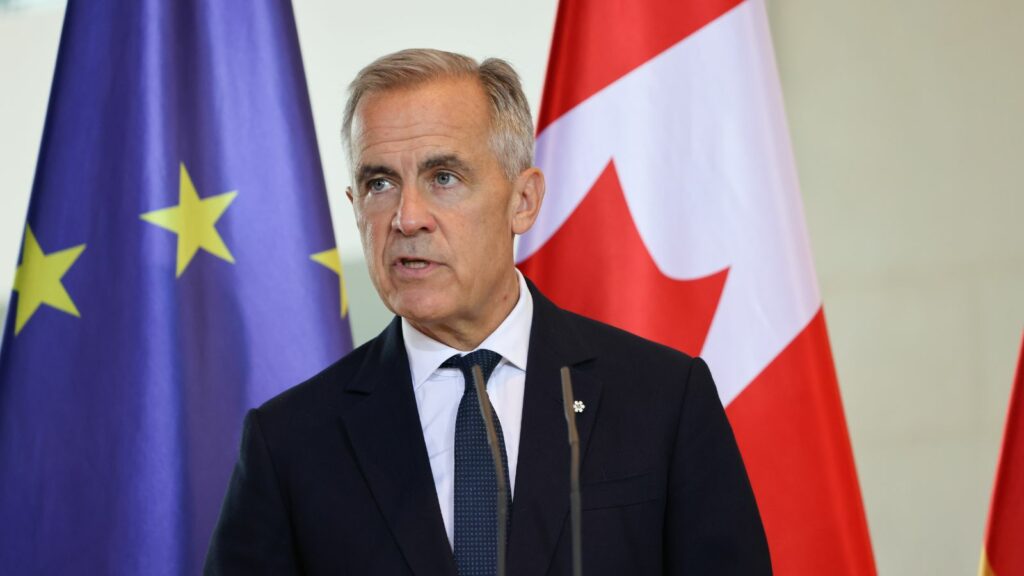
For generations, Canada’s economic map has pointed south. Now, amid a widening trade confrontation with President Donald Trump, Ottawa is looking much more seriously across the Atlantic. Prime Minister Mark Carney’s government is exploring a deeper relationship with the European Union that one Canadian official described as potentially stopping “just short of membership,” with possibilities ranging from expanded existing agreements to an entirely new treaty.
No model has been chosen, and consultations are still under way. Yet the idea is significant because Canada already has a far-reaching trade pact with the EU, growing defence links and expanding cooperation on critical minerals, digital rules and research. The shift does not mean the United States is about to be replaced as Canada’s dominant economic partner. It does show that a relationship once built around continental integration is being recalculated under pressure.
Ottawa’s European Turn Is Becoming More Concrete
Ottawa’s European turn is no longer limited to promises about trade diversification. A Canadian official familiar with the discussions said the government is considering ways to deepen ties with the European Union that could stop just short of membership. The possibilities include expanding agreements already in place, negotiating a new treaty or creating another form of structured cooperation. Provinces, territories and labour groups are being consulted, while officials stress that no model has been selected.
That distinction matters. Canada is not simply looking for another free-trade agreement; it already has one of the EU’s most comprehensive deals. The emerging question is whether economic, security and regulatory cooperation can be bundled into something more durable and politically significant. Carney’s planned September visit to Strasbourg, including an appearance during the European Commission president’s State of the Union week, gives that discussion a high-profile stage at a moment when relations with Washington are deteriorating quickly.
The Trump Trade Fight Is Accelerating the Shift
The push toward Europe is unfolding as the Canada-U.S. dispute moves well beyond routine tariff friction. Canada’s latest countermeasures, effective September 8, impose tariffs of 15%, 25% and 50% on C$27.6 billion in U.S. imports, matching American measures across sectors including steel, dairy, appliances, agricultural equipment, pulp and paper, and electronics. Ottawa has also announced billions of dollars in support for workers and businesses hit by the conflict.
Washington responded with another escalation. The Trump administration announced import exclusions on selected Canadian products beginning September 29 and directed federal procurement officials to start removing Canadian goods from certain government purchasing schedules. Carney has argued that the cumulative U.S. demands sought greater Canadian dependence rather than a balanced partnership. That language marks a deeper political rupture: diversification is no longer being sold merely as an export-growth strategy, but increasingly as a way to reduce Canada’s vulnerability to decisions made in Washington.
Canada’s Dependence on the U.S. Remains Enormous
The scale of that vulnerability is visible in the trade data. Statistics Canada reported that 71.7% of Canadian merchandise exports went to the United States in 2025, down from 75.9% in 2024. The U.S. share of Canadian merchandise imports also fell, from 62.3% to 58.8%. At the same time, exports to countries other than the United States rose 17.2%, showing diversification was already accelerating before the latest retaliation.
Still, more than seven out of every ten export dollars in goods flowing abroad remain tied to the American market. That concentration reflects decades of integrated factories, energy networks, highways and supply chains built around continental trade. Carney has set a goal of doubling non-U.S. exports over the coming decade, and Ottawa is pairing that ambition with major infrastructure investments. The numbers explain why Europe is attractive, but also why the transition cannot be quick: geography, industrial integration and established customer relationships remain powerful economic forces.
CETA Gives Canada a Major Head Start
Canada has a major advantage in any European pivot: CETA is already in place. The Comprehensive Economic and Trade Agreement has applied provisionally since September 2017 and eliminated tariffs on 98% of tariff lines at the outset; by 2024, roughly 99% had been abolished. The agreement also opens access in services and public procurement and provides mechanisms for regulatory cooperation, giving Canadian firms a framework many other non-European exporters do not enjoy.
The results are substantial. European Commission data show bilateral EU-Canada trade in goods and services reached €130 billion in 2025, up 80% from €72.1 billion in 2016. Canadian government figures put the 2025 total at C$178.6 billion. Yet CETA itself is still not fully ratified across the bloc: 17 EU member states have completed national ratification, while 10 still have not. Any deeper relationship would therefore be built on a strong foundation that remains politically and legally unfinished.
Defence Cooperation Is Already Going Much Further
Defence cooperation may be the clearest example of how quickly Canada-EU ties have moved beyond commerce. At the June 2025 Canada-EU summit, the two sides signed a Security and Defence Partnership covering Ukraine, maritime security, cyber threats, military mobility, crisis management, space security and defence-industrial cooperation. The agreement gave political structure to a relationship that had previously been spread across several separate channels.
That framework produced a concrete breakthrough in 2026. Canada became the first non-European country permitted to participate in procurement under the EU’s Security Action for Europe, or SAFE, instrument after the Council formally concluded the agreement in June. SAFE is a €150 billion financing mechanism designed to support joint defence procurement and expand European defence production. For Canadian aerospace, technology and defence firms, access creates opportunities conventional trade agreements do not. Strategically, it also shows how Ottawa and Brussels are building institutional links in areas once dominated by North American cooperation.
Critical Minerals and Technology Add Another Layer
The emerging partnership also reaches into industries likely to shape the next decade. Canada and the EU already operate a Strategic Partnership on Raw Materials aimed at strengthening critical-mineral supply chains, investment, research and environmental standards. In 2025, leaders agreed to seek more opportunities for two-way investment and expertise, while officials have since discussed rare earths, magnets, energy security and clean-technology supply chains as areas for deeper cooperation.
Digital policy is moving in the same direction. In March 2026, Canada and the EU formally launched negotiations on a Digital Trade Agreement intended to complement CETA and establish clearer rules for digital transactions, consumer protection and online commerce. Canada also joined Pillar 2 of Horizon Europe in 2024, giving Canadian researchers access to a research-and-innovation program with a €93.5 billion budget. Together, these initiatives show that closer ties are being built around strategic capacity, not simply around selling more traditional exports across the Atlantic.
‘Just Short of Membership’ Does Not Mean Canada Is Joining the EU
The phrase “just short of membership” sounds dramatic, but the legal reality makes full Canadian membership a different proposition. Article 49 of the Treaty on European Union states that any “European State” meeting the Union’s values may apply to join. Canada is therefore not a conventional candidate under the EU’s existing accession framework, even if political enthusiasm for closer ties grew on both sides of the Atlantic.
More realistic comparisons come from European countries that participate deeply in EU systems without being members, although none offers a ready-made Canadian template. Norway, Iceland and Liechtenstein participate in the European Economic Area and share the EU’s internal market across goods, services, capital and people, while incorporating relevant EU law. Switzerland instead relies on a network of bilateral arrangements. Ottawa could borrow elements from such models without reproducing them. The Canadian discussions are explicitly open-ended, making a bespoke treaty more plausible than importing an existing European structure wholesale.
Deeper Access Could Require Deeper Regulatory Alignment
A deeper arrangement would bring opportunities, but it would also raise difficult questions about rules and sovereignty. Canada and the EU already cooperate on standards through CETA’s Regulatory Cooperation Forum. At its May 2026 meeting, officials described deeper regulatory alignment as a shared objective and discussed issues ranging from motor-vehicle regulations to raw materials. Moving closer to European market structures would make these technical discussions increasingly important because easier cross-border commerce depends heavily on compatible standards and predictable enforcement.
That also helps explain why Ottawa is consulting provinces, territories and labour groups before settling on a model. Many policies affecting Canadian commerce involve multiple levels of government, while labour rules, procurement practices and professional qualifications can vary across jurisdictions. A more ambitious arrangement could therefore require substantially more domestic coordination than a conventional tariff deal. Politically, Ottawa would face a delicate balancing act: gaining meaningful access to European markets while demonstrating that Canada is diversifying its partnerships rather than simply replacing reliance on American decisions with reliance on European ones.
Europe Cannot Replace the U.S. Market Overnight
Europe can reduce Canada’s exposure to the United States, but it cannot replace the American market quickly. The EU is Canada’s second-largest trading partner, yet it accounted for only 7.9% of Canada’s total goods trade in 2024. By contrast, more than 70% of Canadian merchandise exports still head south. Those numbers show that diversification involves more than signing agreements; companies must find customers, adjust products, arrange shipping and sometimes invest in equipment.
The Bank of Canada has repeatedly warned that this transition is costly and gradual. Its business surveys found that many exporters trying to expand outside the United States face transportation costs, regulatory requirements and the expense of entering distant markets. Most U.S.-focused exporters had not yet meaningfully diversified by early 2026. Europe therefore offers a large, wealthy market and an increasingly important strategic hedge, but the economics favour a long rebalancing rather than a sudden continental divorce.
Strasbourg Could Reveal How Far Ottawa Wants to Go
The next visible test comes in Strasbourg. Carney is expected to attend European Commission President Ursula von der Leyen’s State of the Union address on September 16 and address the European Parliament on September 17. European officials have framed the visit as a signal of the closeness between Canada and the EU, and the timing gives both sides an opportunity to turn an ambitious concept into clearer priorities.
What matters most will be the substance behind the symbolism. Ottawa could seek faster work on the Digital Trade Agreement, greater regulatory compatibility, expanded defence-industrial access, stronger critical-mineral investment or a new umbrella treaty linking existing partnerships. But the government has not announced a finished model, and any major agreement would require negotiation at home and in Europe. For now, the significance lies in the direction of travel: Canada is treating Europe as a central pillar of economic and strategic resilience rather than simply as a secondary market.
