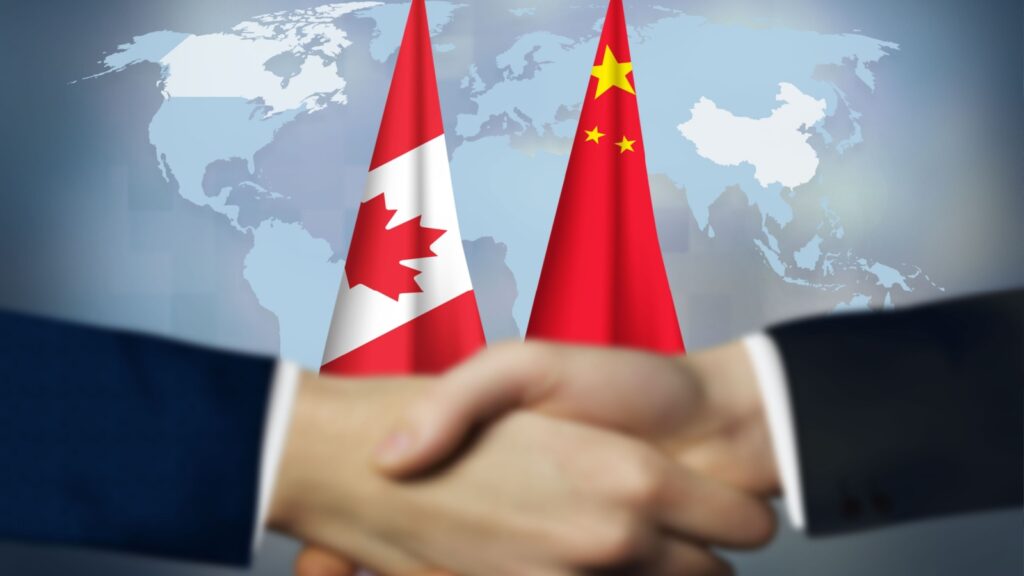
Canada’s efforts to diversify its international trade relationships are gaining momentum as ongoing tariff tensions with the United States push Ottawa to strengthen economic ties with other major markets.
On November 8 and 9, 2026, Canadian and Chinese officials met in Vancouver and signed several agreements aimed at expanding financial cooperation, improving regulatory communication, and supporting future trade and investment opportunities.
The agreements represent another step in Prime Minister Mark Carney’s efforts to rebuild Canada’s economic relationship with China while President Donald Trump’s trade policies continue to create uncertainty for Canadian businesses.
Although the arrangements do not eliminate existing trade barriers or guarantee new investments, they establish formal channels for cooperation between two economies with substantial commercial ties. Their significance extends beyond banking, potentially influencing Canadian exporters, investors, manufacturers, and businesses seeking opportunities outside the United States.
Vancouver Talks Produce Three New Financial Agreements
The breakthrough came during the second Canada–China Economic and Financial Strategic Dialogue, held in Vancouver on November 8 and 9. Finance Minister François-Philippe Champagne and International Trade Minister Maninder Sidhu co-chaired the meetings with Chinese Vice Premier He Lifeng. Officials discussed global economic conditions, financial regulation, investment, and ways to make commercial relations more predictable. The gathering also included a business roundtable, allowing executives from both countries to describe the challenges they encounter when trying to expand across borders.
Three documents emerged from the talks: a memorandum between the two finance ministries, a cooperation agreement between financial supervisors, and terms of reference for a bilateral financial working group. They are institutional agreements rather than a single major trade deal. None announces a substantial loan, an immediate tariff cut, or a guaranteed wave of Chinese investment. Their purpose is to establish more regular communication and practical coordination, which can become important when companies assess financial risk before making long-term commitments.
Finance Ministries Establish a New Cooperation Framework
The memorandum of understanding between Finance Canada and China’s Ministry of Finance creates a framework for closer discussion of economic issues. That might sound technical, but decisions about trade and investment are frequently affected by currency conditions, financial stability, and shifting economic policy. A Canadian exporter considering a new Asian customer, for example, must think beyond the sale price to the banking arrangements and policy environment that will support payment and future orders.
Both governments used the Vancouver dialogue to exchange views on the global outlook and their domestic economic policies. They also signalled support for cooperation through the G20, APEC, and international financial institutions. The memorandum does not mean that Ottawa and Beijing agree on every economic issue or will automatically adopt joint policies. Instead, it gives officials a defined setting for keeping conversations open when market conditions change, potentially reducing misunderstandings even when broader political disagreements and economic challenges persist.
Canadian and Chinese Banking Regulators Formalize Cooperation
A separate agreement brings Canada’s Office of the Superintendent of Financial Institutions, known as OSFI, into a more formal relationship with China’s National Financial Regulatory Administration. The regulators agreed to establish a Financial Regulatory and Supervisory Dialogue and held its inaugural meeting during the Vancouver engagement. The arrangement is intended to support technical exchanges about supervision and the financial sector, giving both sides a clearer channel to raise questions rather than relying exclusively on high-level diplomatic meetings.
For banks and other financial firms operating internationally, differences in regulatory expectations can complicate expansion and add costs. More frequent communication may help supervisors understand developments in the other market and identify areas requiring attention. Still, cooperation is not the same as mutual approval of financial products, automatic licensing, or relaxed standards. Canadian institutions remain subject to the laws and supervisory requirements that apply to them. The immediate achievement is a mechanism for conversation, not a promise that every barrier to market access will disappear.
A Financial Working Group Will Address Complex Economic Issues
The third document sets terms of reference for a Canada–China Financial Working Group involving the countries’ central banks and other financial authorities. Unlike an entirely new initiative, the group began operating earlier in 2026. Its first meeting took place in Beijing on April 3, with Finance Minister Champagne and People’s Bank of China Governor Pan Gongsheng involved in the launch. The November document therefore builds structure around work that had already started rather than announcing the group’s creation for the first time.
Its stated agenda covers monetary and financial policies, market stability, regulation, anti-money-laundering efforts, cross-border capital flows, and global financial governance. Those subjects may appear distant from everyday commercial decisions, but they shape whether businesses can move funds reliably and manage risk across jurisdictions. Regular meetings could also help officials distinguish temporary market disruption from longer-term regulatory problems. The group provides a forum for examining those issues; any actual policy change would still require separate decisions by the appropriate authorities.
An Existing Currency Swap Agreement Adds Financial Stability
One financial arrangement discussed in Vancouver was not new. The Bank of Canada and the People’s Bank of China renewed their bilateral currency swap agreement in January 2026, and officials welcomed its implementation during the November meetings. China’s central bank described the renewed facility as worth 200 billion yuan and valid for five years. It builds on a mechanism first established in 2014, well before the latest dispute between Ottawa and Washington.
A currency swap gives central banks a potential way to obtain each other’s currency if financial conditions require it. In practice, that could help support liquidity for institutions facing unusual payment pressures linked to cross-border business. It is not a transfer of 200 billion yuan to Canadian companies, nor evidence that the entire facility has been drawn. For an importer paying Chinese suppliers, the broader significance is confidence that financial authorities have tools available during market stress. The safeguard matters, but it should not be mistaken for a subsidy or a new trade concession.
Canada’s Trade Relationship With China Is Already Worth Billions
The stakes become clearer in the trade figures. Finance Canada says merchandise trade between Canada and China reached $125.7 billion in 2025, a 5.7% increase from the previous year. Canada exported about $35.0 billion in goods to China but imported $90.6 billion, leaving a substantial imbalance. China is already a major customer for Canadian resource and agricultural products, while Chinese-made machinery, electronics, and other manufactured goods are part of Canadian supply chains.
The relationship also extends into services, which generated $13.8 billion in two-way trade in 2025. Those figures help explain why financial dialogue matters: a large commercial relationship depends on payments, financing, insurance, regulatory expectations, and confidence on both sides. Yet the numbers also show the limits of treating China as an uncomplicated substitute for the United States. Expanded exports would need to grow alongside imports, and companies would still have to compete for customers. Stronger official connections may make that process easier, but cannot manufacture demand.
Trump’s Tariff Dispute Adds Urgency to Canada’s Trade Diversification
The latest agreements were signed while Canada’s trade dispute with Washington remained unresolved. In August, the United States imposed a 50% tariff on $27.6 billion worth of Canadian goods, according to Canada’s Department of Finance. Ottawa responded with matching countermeasures on selected U.S. imports beginning September 8. Other trade restrictions continued to affect industries such as automobiles, steel, and aluminum. Although Trump suggested in early November that a deal was approaching, Carney said negotiations had made progress without reaching a conclusion.
Canada cannot quickly move away from its largest customer. Statistics Canada reports that 71.7% of Canadian merchandise exports went to the United States in 2025, even after that share declined from 75.9% in 2024. For an Ontario manufacturer whose components cross the border repeatedly, tariff uncertainty can complicate pricing, staffing, and investments. Developing relationships with China and other markets is therefore more about reducing concentrated risk than replacing integrated North American supply chains. The Vancouver agreements fit that longer-term approach.
Canadian Farmers and Seafood Exporters Are Already Seeing Trade Changes
An earlier agreement in November illustrates what more predictable access can mean outside banking. On November 4, International Trade Minister Maninder Sidhu announced that China and Canada would extend favourable access for Canadian canola meal, peas, lobster, and crab through the end of 2028. The understanding followed talks in Beijing and built on arrangements reached during Carney’s January visit. Canada also extended specified tariff remissions for Chinese steel and aluminum products not produced domestically in sufficient quantities.
The timing matters for businesses planning several seasons ahead. A Prairie processor deciding how much canola meal to sell abroad, or an Atlantic seafood exporter negotiating orders, needs confidence that market conditions will not change suddenly. Agriculture and Agri-Food Canada reported $6.7 billion in Canadian agriculture, agri-food, fish, and seafood exports to China in 2025. In November, officials also discussed expanded access for Canadian pet food, identifying a potential market worth $530 million. These measures are separate from the Vancouver financial agreements, but they show why stable commercial and financial channels are valuable.
Chinese Electric Vehicles Highlight the Opportunities and Risks of Closer Trade
The closer economic relationship is not limited to finance. Under the agreement reached during Carney’s January visit to Beijing, Canada implemented an initial quota of 49,000 China-built electric vehicles a year at a 6.1% tariff, replacing the previous 100% surtax for vehicles admitted under the program. The quota took effect on March 1. Ottawa also plans to reserve an increasing share of those imports for lower-priced vehicles, reaching 50% by 2030 for vehicles with an import value of $35,000 or less.
That policy creates a delicate balance for Canadian consumers and workers. More competition could broaden vehicle choice, while automakers and suppliers with plants in Ontario must weigh the consequences for local production. The government hopes the arrangement encourages Chinese companies to invest in Canadian manufacturing partnerships, but those prospective investments are not guaranteed. Electric Autonomy Canada reported on November 11 that only 603 China-built vehicles entered under the quota in September, down from 5,982 in July. The figures illustrate how trade openings can take time to translate into sustained commercial activity.
Investment Opportunities Could Expand Beyond Traditional Trade
Investment is another reason Ottawa wants more routine communication with Beijing. Finance Canada estimates that Chinese direct investment stock in Canada stood at $43.4 billion in 2025, while Canadian direct investment stock in China was $15 billion. Those amounts represent established investment positions, not money newly committed under the November agreements. At the Vancouver business roundtable, company executives discussed conditions affecting commercial relations, while officials highlighted financial services as an area for further cooperation.
For a Canadian financial institution assessing expansion in China, clearer regulatory contacts could reduce uncertainty about whom to approach and which issues need attention. A Chinese investor considering a Canadian project would likewise benefit from understanding the rules before committing capital. However, neither side published a blanket authorization for new banking operations or promised unrestricted access to its capital markets. Licensing, local regulation, commercial viability, and investment screening still matter. The agreements create opportunities for discussion, while individual investments remain separate decisions that must stand on their own merits.
National Security and Regulatory Oversight Remain Important
A warmer financial relationship does not mean Canada’s national security responsibilities have been set aside. Under the Investment Canada Act, the federal government can review foreign investments of any size for potential harm to national security. Its concerns can include sensitive technology, critical infrastructure, and personal information. These powers remain relevant whether an investor is Chinese, American, or from another country, and the Vancouver documents do not indicate that they have been suspended or weakened.
Financial cooperation also raises questions about data protection, fraud prevention, money laundering, and supervisory independence. The bilateral working group’s mandate already includes anti-money-laundering issues and financial stability, making safeguards part of the official agenda rather than an afterthought. For Canadian businesses, predictable rules are valuable only if confidential information and financial integrity are protected. Ottawa’s challenge is to pursue useful trade opportunities without abandoning scrutiny where it is warranted. Building contact between regulators can support that goal, but public accountability will depend on how the arrangements are implemented in practice.
Canada’s Next Challenge Is Turning Agreements Into Economic Results
The next test will be whether diplomatic language becomes measurable commercial progress. Carney’s November 11–19 international trip includes a planned stop in Shenzhen for the Asia-Pacific Economic Cooperation leaders’ meeting, with other stops in Ireland, the Philippines, and Cambodia. Canada and China have also said their next high-level Economic and Financial Strategic Dialogue will take place in China. Together, those engagements offer opportunities to revisit market access concerns and determine whether new financial channels are producing useful results.
Ottawa has set a goal of increasing Canadian exports to China by 50% by 2030. Reaching it will require more than signed memorandums: exporters need buyers, banks need workable rules, and prospective investments must survive commercial and security reviews. Progress might show up in faster regulatory discussions, new approved financial services, or more reliable export shipments, rather than a single headline announcement. With the U.S. tariff dispute still unsettled, Canada’s approach is to develop alternatives while preserving its closest trading relationship. Whether that strategy delivers will be judged by outcomes, not signatures.
