Canada’s Arctic has moved from the edge of national security planning to the centre of it. Ottawa is committing tens of billions of dollars to northern bases, surveillance, airports and logistics as strategic competition intensifies and relations with Washington become more complicated under U.S. President Donald Trump. Yet money and concrete do not automatically produce a durable military presence. The Canadian Armed Forces is still rebuilding personnel strength, training capacity and specialized occupations after years of shortages, while northern housing and labour markets add another layer of difficulty. That leaves Canada with a two-part challenge: expand Arctic capability quickly enough to meet a harsher security environment, while finding, training and retaining enough people to operate it. The pressure is visible from Yellowknife to Iqaluit, where national strategy increasingly depends on local capacity.
Ottawa’s Northward Shift Is No Longer Symbolic
Ottawa’s northern expansion is no longer a collection of isolated projects. In March 2026, the federal government announced a plan backed by more than C$40 billion, including over C$35 billion in investments tied to defence, infrastructure and northern development. Roughly C$32 billion was directed toward upgrades at Forward Operating Locations in Yellowknife, Inuvik and Iqaluit, along with 5 Wing Goose Bay. Another C$2.67 billion supports Northern Operational Support Hubs and nodes.
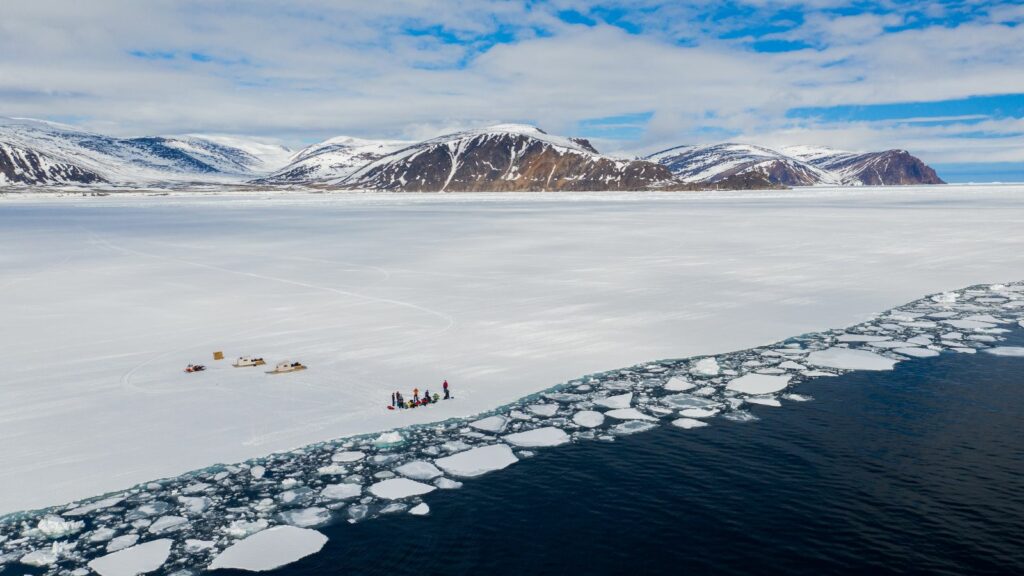
The scale reflects the geography Canada is trying to defend. The Arctic accounts for about 40% of the country’s landmass and more than 70% of its coastline, while supporting more than 140,000 residents. Ottawa is also investing in airports and transport because a northern military presence cannot function on bases alone. The pivot is therefore about logistics as much as combat capability. A facility that cannot be supplied reliably or staffed year-round remains limited, regardless of its construction budget.
The Capital Plan Is Growing Faster Than the Force
The Canadian Armed Forces remains below its authorized strength. As of August 31, 2026, the Regular Force stood at 68,714 members against an authorized 71,500. The Primary Reserve average paid strength was 25,783 against an authorized 30,000. Departmental planning documents put the Royal Canadian Navy’s Regular Force at 75% trained effective strength, while the Canadian Army reported 77% of personnel fully trained and ready at trained effective strength.
That matters in the Arctic because expansion requires more than headcount. New northern facilities need specialized technicians, logisticians, communications specialists, aircrew, engineers and maintainers. Recruiting has accelerated: about 13,100 people joined the CAF in fiscal 2025–26, substantially more than two years earlier. Construction funding can be approved faster than experienced personnel can be produced. A radar site, support hub or additional patrol becomes useful capacity only when a trained workforce can keep it running through severe weather, distance and long supply chains.
Recruiting Success Still Has to Survive the Training Pipeline
Recruiting is only the first gate. The Office of the Auditor General found that about 192,000 people applied to the Canadian Armed Forces between April 2022 and March 2025, yet 15,000 were recruited against a planned total above 19,700. Only about one in 13 applicants was successfully recruited. Median processing times ranged from 245 to 271 days, well above CAF targets of 100 to 150 days, while security-screening backlogs grew.
Training creates a second bottleneck. Basic-training capacity rose from about 4,900 places in 2022–23 to 6,100 in 2024–25, but recruitment in that final year exceeded permanent capacity, forcing temporary measures. The Auditor General also identified shortages of instructors, equipment and facilities and said temporary instructors used in 2025 were not sustainable. For Arctic expansion, Ottawa must not only attract applicants, but move them through screening, training and occupational qualification fast enough to create deployable strength rather than a larger queue.
The Arctic Multiplies Every Staffing Weakness
Arctic postings magnify problems that are easier to absorb elsewhere. A 2024 Department of National Defence evaluation, examining operations from 2018 to 2022, found that Joint Task Force North faced staffing challenges linked to isolation, living costs and northern benefits. The evaluation said command tasks at JTFN were staffed at about 67%, below the 90% to 95% staffing priority assigned to the organization. It also noted reliance on contractors and temporary augmentees.
Those findings are not a 2026 headcount, but they expose a structural challenge expansion must address. Defence material describes JTFN as a small headquarters organization with detachments in Whitehorse and Iqaluit, covering the Arctic. Personnel can fill planned exercise gaps, but unplanned operations are harder when outside staff lack experience with Arctic conditions, communities and logistics. In the North, institutional knowledge is operational capacity. Rotating people through assignments can fill positions without creating the depth of local expertise.
Housing Is Part of the Defence Equation
Military staffing cannot be separated from the northern housing market. In 2025, Iqaluit’s rental vacancy rate was just 0.3%, representing six vacant units in the market tracked by Canada Mortgage and Housing Corporation. Yellowknife’s rate was 1.3%, while Whitehorse’s was 1.9%. CMHC also found construction costs roughly 50% higher in Yellowknife and 30% higher in Whitehorse than in Calgary, reflecting logistics, limited land, short building seasons and labour constraints.
Those numbers turn housing into a defence issue. A technician transferred north needs somewhere to live; contractors brought in for construction need accommodation; families weigh costs and services alongside the posting. Ottawa can fund hangars or radar infrastructure, but communities must absorb the people who operate them. Federal development planning has identified infrastructure, housing and workforce constraints as barriers to major projects. Without investment in local capacity, defence expansion could pressure scarce labour and housing while making recruitment and retention harder.
Canadian Rangers Provide Reach Ottawa Cannot Quickly Replicate
The Canadian Rangers offer something conventional units cannot quickly reproduce: a permanent presence rooted in remote communities. The force included about 5,000 Rangers nationwide, with more than 1,500 serving in 66 northern communities. More than a quarter self-identified as First Nations, Inuit or Métis. Their duties include observing unusual activity, supporting patrols, gathering local information, assisting search-and-rescue efforts and helping during emergencies.
That local knowledge is valuable as Canada expands surveillance and exercises across the North. Defence planners have developed concepts connecting Rangers more closely with sensors and other systems, strengthening situational awareness. But Rangers remain one part of a larger force. Long-range aviation, warship deployments, communications networks, radar maintenance and sustained logistics require specialized Regular and Reserve personnel, civilians and contractors. The Rangers extend reach where a large permanent military footprint would be costly. Their presence narrows gaps, but it does not remove the broader staffing requirement created by Ottawa’s expansion.
Technology Helps, but It Does Not Staff a Radar Screen
Canada’s technology purchases show the Arctic mission is becoming more complex. In June 2026, Ottawa committed C$2.5 billion to acquire Australian over-the-horizon radar technology, part of a program expected to exceed C$6 billion once infrastructure, installation and integration are included. The system is designed to detect activity at range by using the ionosphere to see beyond the Earth’s curvature, with initial capability targeted for December 2029.
Major Arctic projects show that infrastructure can lose value when assumptions change. In May 2026, Defence moved the Nanisivik Naval Facility out of operational use after construction delays, a short seasonal access window, scope reductions and jetty repairs. The department said improved range on Arctic and Offshore Patrol Ships had reduced the facility’s importance. The lesson is not that infrastructure is unnecessary, but that it must be supportable. Radar arrays and hubs need operators, maintainers, power, transport and supply chains throughout their service lives.
Trump’s Greenland Pressure Changed the Strategic Clock
Trump’s pressure over Greenland has added urgency to a debate Canada was already having. Reuters reported in March that strained relations with Washington helped accelerate Ottawa’s Arctic defence push, as Prime Minister Mark Carney argued Canada could no longer rely on others to secure its North. Canada’s modernization did not begin with Trump; NORAD upgrades and Arctic investments predated the dispute. What changed was the political weight attached to dependence and sovereignty.
After months in which Trump pushed for U.S. control over Greenland, the United States, Denmark and Greenland signed a trilateral agreement on September 22, 2026 that expanded U.S. military access and infrastructure while affirming Greenlandic and Danish sovereignty. The deal reduced the territorial confrontation, but showed how quickly Arctic questions can move from planning to top-level international diplomacy. For Ottawa, that compressed timetable adds pressure to develop credible Canadian-controlled capacity that can still work closely with allies.
Strategic Autonomy Still Runs Through Allies
Canada’s search for greater autonomy does not mean retreating from alliances. In May 2026, Canada joined other Arctic allies, including the United States, Denmark, Finland, Iceland, Norway and Sweden, in committing to greater military presence, surveillance, training and cooperation. The statement linked those efforts to NATO’s Arctic Sentry activities and continuing NORAD modernization. Canada has also continued exercising with U.S. and European forces throughout 2026.
Operation NANOOK-NUNALIVUT in spring 2026 involved about 1,300 Canadian Armed Forces members and participation from Belgium, Denmark, France and the United States. Operation LATITUDE later placed Canadian ships, aircraft and Coast Guard assets alongside U.S. forces in northern waters, including the Bering Sea. The missions clearly show Ottawa’s balance: more sovereign capacity at home, but deeper interoperability with partners. Staffing shortages complicate that balance because the same pilots, sailors, technicians and headquarters staff are needed for domestic readiness, continental defence and multinational exercises abroad.
The Real Pivot Is a People-and-Place Strategy
Ottawa is also trying to build more of the Arctic workforce locally. In April 2026, Ottawa announced up to C$1.5 million over three years for the Nihtat Gwich’in Council in Inuvik to develop defence-readiness and training hub. The program helps northern businesses and workers prepare for procurement, cybersecurity, project management and opportunities linked to defence investment. It is part of a broader territorial defence-investment initiative.
The CAF is modernizing recruiting and onboarding, expanding training throughput and trying to retain experienced members. Arctic strategy will ultimately be tested by whether budgets become human capability. Bases require operators. Radar needs technicians. Ships and aircraft need crews. Communities need housing, contractors and services to support them. Canada’s staffing problem is not a side issue to the Arctic pivot. It is the operational test at the centre: whether a rapid strategic shift can be matched by a workforce capable of sustaining it for years.
