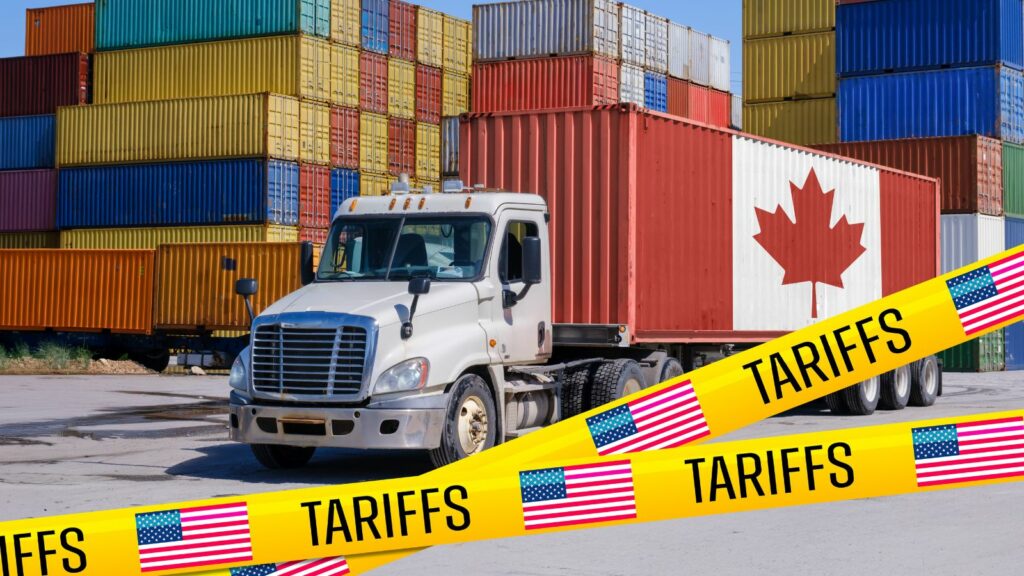
Canada’s latest retaliation in its escalating trade dispute with the United States is moving beyond factory floors and industrial supply chains. Since September 8, Ottawa has imposed counter-tariffs of 15%, 25% and 50% on a new group of U.S.-origin imports valued at $27.6 billion, matching tariffs Washington imposed on Canadian products in August. The list reaches into sectors familiar to households and small businesses, including appliances, dairy products, furniture and selected electronics, while also covering steel, aluminum, plastics and agricultural equipment.
That makes the latest round particularly visible. Tariffs that begin as customs charges can eventually appear in supplier invoices, store prices and purchasing decisions. Exactly how much Canadians ultimately pay, however, will depend on how long the dispute lasts and how quickly businesses find alternatives.
The $27.6-Billion Package Took Effect September 8
The new Canadian measures came into force at 12:01 a.m. on September 8, after the federal government announced that it would match a new round of U.S. tariffs “dollar for dollar” and “rate for rate.” Finance Canada says the package covers $27.6 billion in U.S.-origin imports. Rather than imposing one uniform levy, Canada assigned rates of 15%, 25% or 50% to different tariff classifications, generally matching the U.S. rate applied to the corresponding Canadian products.
The distinction matters because a 50% tariff on one product does not mean every American item entering Canada suddenly costs 50% more. The countermeasure applies only to specified tariff classifications and only to goods considered to originate in the United States under the applicable origin rules. Goods already in transit when the measure took effect were also excluded. Canada’s existing counter-tariffs on automobiles remain in force separately, meaning the $27.6-billion figure describes the new September package rather than a simple measure of every U.S. product currently subject to Canadian retaliation.
It Is Targeted, but $27.6 Billion Is Still a Significant Amount of Trade
Canada and the United States exchange such enormous volumes of goods that $27.6 billion represents only one slice of their commercial relationship. Statistics Canada reported that the United States still supplied 58.8% of Canadian merchandise imports in 2025, even after that share fell from 62.3% in 2024. Meanwhile, 71.7% of Canadian merchandise exports went to the United States. Those numbers show why even deliberately targeted retaliation can spread through a large number of supply chains.
The government has concentrated the newest measures in sectors Ottawa says are particularly affected by American tariffs: steel and aluminum, dairy, appliances, agricultural equipment, pulp and paper, plastics and electronics. That approach differs from simply placing a blanket tariff on everything crossing the border. It can reduce exposure elsewhere in the economy, but it also concentrates pressure on companies that rely heavily on particular U.S. suppliers. A hardware distributor, appliance retailer or food importer may therefore feel the measures much more directly than a business sourcing mostly Canadian, European or Asian products.
Major Appliances Put the Trade Fight Directly Into Canadian Homes
Some of the clearest household examples are found in the appliance categories. Finance Canada’s tariff schedule puts a 25% counter-tariff on specified U.S.-origin household refrigerators and freezers. Certain fully automatic household washing machines are also subject to a 25% rate. These are not obscure industrial components; they are products families encounter when a refrigerator unexpectedly stops cooling or an old washer finally gives up.
That does not mean the sticker price of every refrigerator or washing machine in Canada will immediately jump by one-quarter. Country of origin matters, and many familiar appliance brands manufacture different models in multiple countries. Retailers may also absorb part of the tariff, change suppliers, reduce promotions or shift customers toward non-U.S. models. Previous research shows that these adjustments can happen gradually. The practical consequence is therefore likely to vary by brand, model and retailer rather than appearing as one uniform increase across the appliance aisle. Still, for U.S.-origin products on the tariff list, importers now have an additional cost that must be absorbed somewhere in the supply chain.
Furniture and Dairy Products Broaden the Consumer Exposure
Furniture is another category where the tariff rates can become substantial. The current list includes a 50% rate on specified U.S.-origin metal furniture and bedroom furniture, while wooden kitchen furniture in the cited tariff classification carries a 25% rate. Finance Canada has explicitly identified furniture and clothing or apparel among goods subject to some of the highest rates in the new countermeasure package.
Food shelves are not completely insulated either. Numerous categories of U.S.-origin cheese—including classifications covering cheddar, mozzarella, Parmesan, Gouda, Brie and other cheeses—are listed at a 25% counter-tariff rate. The actual impact at a supermarket depends heavily on origin, existing Canadian supply, import quotas, retailer contracts and whether distributors switch to products made elsewhere. A Canadian-made cheese obviously does not become subject to the U.S.-origin surtax simply because an American company owns the brand. This makes country-of-origin information increasingly important: two visually similar products sitting beside each other can face very different trade costs depending on where they were produced.
Industrial Tariffs Can Reach Consumers Without Appearing on a Store Label
The most important price effects may not always come from finished products. Large portions of the countermeasure list involve steel, aluminum and other materials used by manufacturers. Many specified steel and aluminum products now face 50% Canadian counter-tariffs, including categories that had previously been subject to a 25% countermeasure. Those inputs can ultimately become part of machinery, building products, furniture, packaging or other goods produced inside Canada.
That creates what economists describe as an indirect tariff channel. A Canadian manufacturer buying a tariffed American component may face a higher input cost even though the finished Canadian product itself never crosses the border. The company then has several options: accept lower margins, find a Canadian or third-country supplier, redesign the product or eventually raise its selling price. Recent economic research on U.S. tariffs found that indirect effects through imported inputs and reduced competitive pressure can emerge more slowly than the immediate increase in imported-product prices, sometimes taking nine to 12 months to work through supply chains. That U.S. evidence cannot be mechanically applied to Canada, but it illustrates why tariff effects can appear well after the customs charge begins.
Canada Already Has Evidence of How Counter-Tariffs Affect Store Prices
The best guide to what could happen next may come from Canada’s own recent experience. Bank of Canada researchers studied more than 110,000 products sold by seven major Canadian retailers during the broad counter-tariff episode of 2025. They found that prices for tariffed goods eventually rose about 6% more than comparable non-tariffed products. Because the tariff rate studied was 25%, that amounted to roughly one-quarter of the tariff being passed through to consumer prices.
The research also found that businesses did not pass the entire cost through immediately. Expectations mattered. Retailers appeared more willing to raise prices when they believed the tariffs would last, while prices moved back toward previous relative levels after most of those counter-tariffs were removed in September 2025. The researchers estimated that the 2025 measures added roughly 0.3 percentage points to consumer price inflation while they were operating. The latest tariff package is structured differently and covers a different product mix, so that number should not be treated as a forecast for 2026. It does, however, show that Canadian counter-tariffs can reach retail prices without being passed through one-for-one.
Importers Have More Choices Than Simply Raising Prices
A tariff creates a cost at the border, but the journey from customs to checkout is complicated. Importers may negotiate lower prices from U.S. suppliers, retailers may accept thinner margins, and companies may source equivalent products from Canada, Europe, Mexico or Asia. Businesses can also reduce the range of tariffed products they stock. During the 2018–19 U.S. trade dispute, economic research found substantial changes in international supply chains as firms responded to tariffs rather than simply continuing to import the same quantities at higher costs.
Ottawa has also kept a tariff-remission process available for exceptional circumstances. Finance Canada says relief can be considered where goods used as inputs cannot be sourced domestically, regionally or reasonably from a non-U.S. supplier. That mechanism matters for manufacturers dependent on highly specialized components for which replacing an American supplier is not as simple as changing brands. The government has paired the countermeasures with a $7.5-billion package of new and enhanced support measures for workers and businesses. Such programs can soften some of the shock, but they do not eliminate the underlying sourcing decisions firms must make while tariffs remain in effect.
Canada-U.S. Trade Was Already Changing Before the New Tariffs Arrived
The latest countermeasures land after more than a year of disruption in continental trade. Statistics Canada reported that Canadian merchandise exports to the United States fell 5.8% in 2025, while imports from the United States declined 2.9%. At the same time, Canadian trade with countries outside the United States expanded sharply: total merchandise trade with non-U.S. markets rose 14.3% from 2024 to 2025.
That diversification has continued in parts of 2026. In July, exports to the United States fell 6.6% from June, the sharpest percentage decline since April 2025, while Canadian exports to countries other than the United States rose 7.4% to a record $25.6 billion. U.S. imports still remain enormous, however, and actually increased 1.8% in July, partly because of stronger Canadian imports of passenger vehicles and light trucks. The numbers illustrate the central challenge of a prolonged trade dispute: companies can redirect some commerce, but decades of integrated North American production and distribution networks cannot be replaced overnight.
The Biggest Price Effects May Take Months to Become Clear
Canadians looking at current inflation numbers should be careful not to attribute existing price increases to tariffs that had not yet taken effect. Statistics Canada reported that the Consumer Price Index was up 3.0% year over year in August 2026, while grocery prices increased 2.8%. But the new $27.6-billion counter-tariff package only began on September 8, meaning August CPI data cannot show its retail impact. The first effects may initially appear in individual product categories rather than in the headline inflation rate.
The Bank of Canada has indicated that it expects the inflation effect of the new Canadian counter-tariffs to be comparatively muted and spread over time because many measures apply to intermediate inputs or products with Canadian substitutes. At the same time, the Bank has acknowledged that U.S. tariffs and Canadian retaliation raise costs for some businesses and could eventually feed through to consumers. That leaves duration as one of the most important variables. A short-lived tariff can be absorbed through inventories and margins; a prolonged dispute gives firms more reason to rewrite contracts, change suppliers and reset prices. For households, that means the real cost of the $27.6-billion package will become clearer over the months ahead, not on the day the tariff schedule changes.
