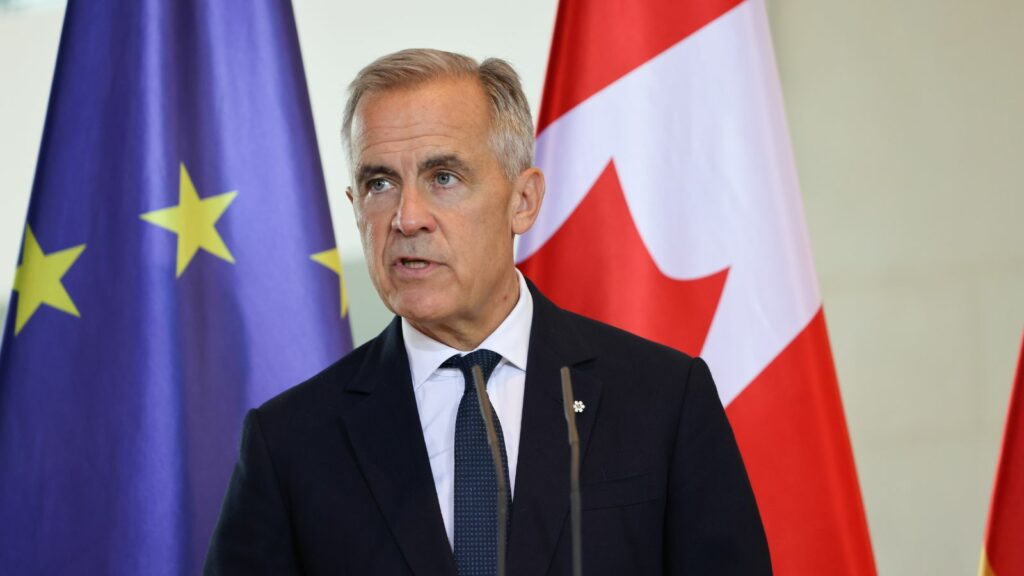
Canada’s latest trade agreement with China signals another shift in Prime Minister Mark Carney’s effort to strengthen economic ties beyond the United States. Following talks with Chinese President Xi Jinping in Shenzhen on November 17, 2026, Ottawa agreed to extend targeted tariff exemptions for Chinese steel and aluminum products through 2028. In exchange, Beijing committed to providing additional tariff relief covering approximately $400 million in Canadian pork and seafood exports annually.
The agreement offers new opportunities for Canadian farmers, seafood producers, and businesses that depend on imported industrial materials. It also demonstrates how Canada is balancing domestic manufacturing protections against the need for more reliable international trade relationships. With American tariffs continuing to reshape Canadian trade priorities, the latest commitments carry economic and political significance well beyond the products immediately affected.
A Two-Year Deal Built on Earlier Trade Negotiations
The November 17 meeting did not create the Canada-China trade reset from scratch. It expanded a preliminary arrangement reached during Carney’s visit to Beijing in January and extended during ministerial negotiations on November 4. The latest commitments maintain key tariff-relief measures through December 31, 2028, giving Canadian exporters a longer planning horizon than the year-end expiration they had previously faced. Ottawa’s official announcement specifies that China will suspend its additional tariffs on the newly covered products from January 1, 2027, through December 31, 2028. The timing is important because a diplomatic announcement does not necessarily mean every shipment immediately receives different tariff treatment.
The negotiations took place in Shenzhen ahead of the Asia-Pacific Economic Cooperation summit, against a backdrop of changing international trade relationships. Both governments offered concessions in sectors where the other country wanted relief. Beijing agreed to improve access for Canadian agricultural and seafood products, while Ottawa extended exemptions for specified industrial imports. The agreement also commits both governments to continue addressing unresolved trade barriers. For businesses negotiating supply contracts, the additional certainty could be almost as important as the tariff reductions themselves, particularly when investment and production decisions must be made months in advance.
Ottawa Keeps Targeted Steel and Aluminum Tariff Exemptions
Canada introduced a 25 percent surtax on specified Chinese steel and aluminum imports on October 22, 2024, as part of measures intended to protect domestic manufacturers from unfair trade practices. Those broader tariffs are not being eliminated. Instead, Carney’s government is extending existing tariff remissions through the end of 2028 and expanding eligibility to another 32 tariff items. The newly covered categories include 23 steel items and nine aluminum items that Ottawa says are either unavailable from Canadian producers or cannot be supplied domestically in sufficient quantities. A tariff remission allows eligible businesses to avoid or recover duties that would otherwise apply.
The distinction matters for manufacturers that depend on specialized materials. Canada’s earlier remission arrangements covered 66 lines of product-specific relief, including 11 full and 55 partial remissions, alongside 49 tariff lines involving company-specific exemptions. The latest extension continues that selective approach rather than removing protection across the entire metals industry. Canadian factories may need imported materials to complete production, even when domestic suppliers produce other forms of steel or aluminum. Keeping relief available for products facing supply shortages could help businesses manage costs without automatically exposing every Canadian metal producer to additional competition. Eligibility, however, remains tied to the relevant product classifications and remission rules.
Canadian Pork Exporters Gain Relief on $116 Million in Trade
Canadian pork producers are among the direct beneficiaries of the expanded agreement. Beijing has agreed to remove an additional 25 percent tariff from selected Canadian frozen pork cuts representing approximately $116 million in exports to China in 2024. The duties were part of retaliatory measures introduced in March 2025, which affected several agricultural and seafood products. The Canadian Meat Advocacy Office welcomed the November 17 announcement, describing it as an important development for producers, meat processors, and exporters. The change covers specified pork products rather than every category of Canadian pork entering the Chinese market.
The concession arrives after a difficult period for the industry. Agriculture and Agri-Food Canada figures show that Canadian pork exports to China totalled approximately $211.2 million during the first nine months of 2026, down 16.7 percent from the corresponding period in 2025. That figure includes products beyond the frozen cuts covered by the latest agreement, but it illustrates the commercial pressure facing exporters. For meat processors, reduced duties could improve their ability to compete for Chinese orders and negotiate longer-term sales arrangements. Nevertheless, tariff relief alone does not guarantee higher shipments. Demand, competing suppliers, exchange rates, and Chinese import requirements will continue to determine how much business Canadian exporters recover.
Seafood Producers Account for Most of the New Tariff Relief
Fish and seafood account for approximately $285 million of the trade covered by China’s latest concessions. According to Ottawa’s breakdown of 2024 export values, the affected products include $96 million in Greenland halibut, $87.5 million in selected frozen cold-water shrimp and prawns, $61.4 million in certain molluscs, including geoduck, and $39.4 million in sea cucumber. These categories represent different fisheries and processing operations across Canada, including valuable seafood industries on the Atlantic and Pacific coasts. The agreement therefore reaches well beyond major urban exporters, extending potential benefits to smaller coastal communities where fishing remains an important economic activity.
The stakes are particularly significant for fisheries that depend heavily on Asian markets. Fisheries and Oceans Canada reports that 78 percent of British Columbia’s sea cucumber export volume went to China in 2024. The department also identifies mainland China and Hong Kong as major destinations for the province’s valuable geoduck harvest. When additional tariffs make Canadian products more expensive, exporters can lose business or face pressure to absorb costs through lower margins. Removing those duties could improve competitiveness and strengthen commercial relationships. However, the actual benefits will depend on market prices, Chinese demand, and the ability of harvesters and processors to maintain reliable supplies.
The $400 Million Figure Does Not Represent New Revenue
The approximately $400 million at the centre of the agreement represents the value of Canadian exports eligible for additional tariff relief, not a payment from Beijing or a guarantee of new business. Ottawa’s estimates use export values from 2024, before China’s additional tariffs disrupted trade in the affected products. The five categories identified by the federal government total approximately $400.3 million, rounded to $400 million in the official announcement. This provides a measure of the trade affected by the agreement, but it should not be confused with the amount of duties being eliminated or the value of additional sales expected in 2027.
That distinction matters for businesses assessing the potential financial benefits. Removing an additional 25 percent tariff can lower the cost of eligible Canadian goods entering China, making them more competitive. However, exporters will not automatically receive a corresponding increase in revenue or profit. Buyers, distributors, and producers may negotiate how the savings are shared, while changing market demand could influence sales volumes. Ottawa has also reported restoring Chinese market access for more than 90 percent of Canadian trade previously affected by tariff measures, representing nearly $7.5 billion in exports. That is a significant measure of improved market access, although it does not mean that the entire amount represents new sales already completed.
The Latest Agreement Builds on January’s Electric Vehicle and Canola Deal
The November commitments are part of a broader effort to unwind trade restrictions that developed between Canada and China. Ottawa imposed a 100 percent surtax on Chinese-made electric vehicles in October 2024, followed by 25 percent tariffs on specified steel and aluminum imports. Beijing subsequently imposed substantial duties on Canadian agricultural products, including 100 percent additional tariffs on canola meal and peas and 25 percent tariffs on certain pork and seafood products. During Carney’s January 2026 visit, the governments reached a preliminary arrangement that allowed an initial annual quota of 49,000 Chinese electric vehicles to enter Canada at a 6.1 percent tariff, while China agreed to reduce several agricultural trade barriers.
The earlier agreement has already produced measurable changes. Global Affairs Canada reports that China’s combined tariff on Canadian canola seed fell to approximately 15 percent in March 2026, compared with roughly 84 percent previously. Between March and August 2026, Canadian canola-seed exports to China reached $1.74 billion, an increase of 43 percent from the corresponding period in 2025. Beijing also suspended additional tariffs on canola meal, peas, lobster, and crab, with that relief subsequently extended through December 2028. The latest expansion brings more pork and seafood categories into the arrangement, building on a process that has already changed trading conditions for Canadian agricultural exporters.
Canadian Manufacturers Still Face a Complicated Tariff Calculation
For Canadian businesses importing steel and aluminum, the value of tariff exemptions often comes down to whether suitable materials are available domestically. Finance Canada’s remission framework allows relief under specified circumstances, including when required products cannot reasonably be sourced from Canadian or alternative foreign suppliers. It also considers certain contracts established before the original tariff announcement and exceptional situations that could significantly affect Canadian businesses. Applications can involve consultation with domestic producers to establish whether Canadian supply is genuinely unavailable. This framework reflects the challenge of protecting domestic metal production while keeping manufacturers supplied with materials needed for their operations.
The inclusion of 32 additional steel and aluminum tariff items makes that balance particularly important. A manufacturer unable to obtain a specialized product domestically may benefit from continued access to Chinese suppliers without an additional surtax. At the same time, exemptions that extend to products available from Canadian manufacturers could undermine the protections originally introduced. Ottawa’s approach therefore relies on distinguishing genuine supply shortages from situations where imported products are simply less expensive. The effectiveness of the policy will depend on how accurately those distinctions are made and whether exemptions remain appropriate as Canadian production capabilities change. Importers must also continue checking product classifications and eligibility requirements rather than assuming that all Chinese steel and aluminum purchases qualify.
Trump’s Trade Policies Are Increasing Pressure on Canada to Diversify
Carney’s efforts to expand trade with China are unfolding while Canada’s longstanding economic relationship with the United States faces significant uncertainty. Statistics Canada reported that the American market accounted for 71.7 percent of Canadian merchandise exports in 2025, down from 75.9 percent in 2024. Despite that decline, the United States remains overwhelmingly Canada’s largest export destination. American tariffs have created particular difficulties for industries such as steel and automotive manufacturing, where supply chains frequently cross the border. Reuters reported in October 2026 that Canadian and American officials were discussing potential relief from U.S. tariffs of up to 50 percent on Canadian steel and 25 percent on automobiles.
Expanding commercial ties with China offers Canada opportunities to reduce some of that dependence, particularly in agriculture, seafood, energy, and other resource industries. However, the Chinese market cannot simply replace the United States for Canadian manufacturers whose businesses depend on deeply integrated North American production networks. Trade diversification is therefore more about creating additional opportunities than abandoning existing relationships. Carney has established a goal of increasing Canadian exports to China by 50 percent by 2030, a target that reflects Ottawa’s broader economic priorities. Agreements involving hundreds of millions of dollars in agricultural exports could contribute to that objective, although sustained growth will require dependable market access, competitive products, and continued cooperation between businesses in both countries.
More Trade Opportunities Are Emerging, but Important Obstacles Remain
The tariff announcement was accompanied by commitments to pursue additional commercial opportunities. Canada and China agreed to advance market access for Canadian faba beans, chickpeas, and lentils, while working toward arrangements covering pet food and wild aquatic products by the end of 2026. Carney also announced plans for a major Canadian trade mission to China in 2027 and a Canada-China Year of e-Commerce intended to help smaller businesses reach customers through digital platforms. These initiatives could create opportunities for companies without established international distribution networks, although customs approvals, commercial agreements, and reliable shipping arrangements will still be necessary before potential sales become actual business.
Significant challenges remain despite the improving trade relationship. The Canola Council of Canada reported in November that Canadian canola oil continued to face an additional 100 percent Chinese tariff, even as restrictions on other agricultural products were eased. Relations also remain complicated by concerns about foreign interference and national security, with Beijing denying allegations of interference in Canadian affairs. The latest trade agreement does not resolve those disputes, but it establishes a framework for further economic cooperation. The next major test comes in January 2027, when the new pork and seafood tariff suspensions are scheduled to begin. Whether Canadian exporters regain sales and manufacturers secure reliable material supplies through 2028 will ultimately determine how successful the agreement becomes.
