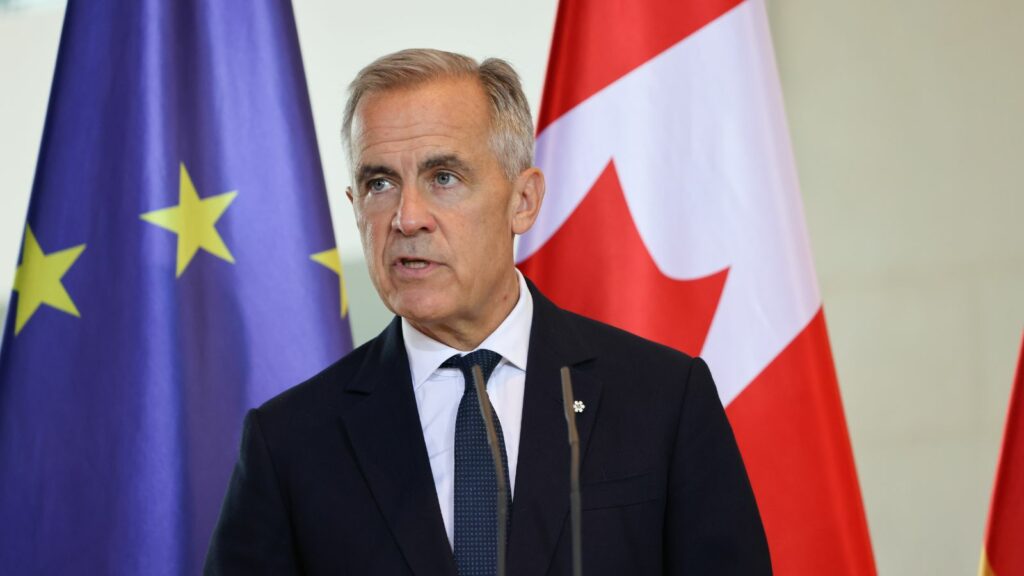
Prime Minister Mark Carney used one of Europe’s most prominent political stages to argue that Canada’s future prosperity and security will depend on building relationships that reach much further than traditional trade agreements. Speaking to the European Parliament in Strasbourg on September 17, Carney called for substantially deeper Canada–EU cooperation across defence, energy, critical minerals, artificial intelligence, finance and research.
The timing made the message especially significant. European Commission President Ursula von der Leyen had just proposed opening the door to an unprecedented form of “associate membership” for Canada, while U.S. President Donald Trump threatened additional trade action over the idea. With Ottawa and Washington already locked in a widening tariff dispute, Carney’s European push is becoming part of a broader effort to reduce Canada’s exposure to economic pressure from any single partner.
Carney Uses Strasbourg to Make the Case for a Much Bigger Partnership
Carney’s address went considerably beyond the familiar language of expanding exports or signing another trade agreement. He framed closer ties with Europe as a question of economic resilience and sovereignty, arguing that modern countries need reliable access to critical minerals, artificial intelligence infrastructure, energy, defence production, payment systems and advanced communications. His proposed relationship would bring Canadian resources and technological capabilities together with Europe’s enormous market, research institutions and industrial base. It was a pitch for integration in strategically important sectors rather than simply lower tariffs at the border.
That distinction matters because Canada and the EU already possess one of the world’s more comprehensive trade agreements. What Carney described in Strasbourg would instead layer industrial, technological, security and potentially financial integration on top of CETA. The government says the goal is a relationship that provides both sides with more alternatives when global supply chains are disrupted or economic relationships become politically contentious. Whether every element ultimately survives negotiations remains uncertain, but the breadth of the proposal illustrates how quickly Canada’s European strategy has expanded.
Europe Has Put an Unprecedented “Associate Member” Idea on the Table
The most attention-grabbing proposal actually came from European Commission President Ursula von der Leyen one day before Carney’s speech. During her September 16 State of the Union address, she said Europe should move beyond CETA toward what she called an “Alliance for the Future,” including cooperation on manufacturing, technology, defence, the Arctic, energy, batteries and critical minerals. She then proposed opening the door for Canada to become the EU’s first associate member.
The phrase sounds sweeping, but its practical meaning has not yet been settled. “Associate membership” is not an existing status established in EU treaties, and negotiations would have to determine what rights, market access and obligations Canada would actually receive. Carney welcomed the ambition behind von der Leyen’s offer without presenting Canada as seeking conventional EU membership. The difference is important: what is currently being discussed is a new relationship designed specifically for Canada rather than Ottawa joining the European Union on the same terms as France, Germany or other member states.
Trump’s Response Immediately Raised the Stakes
The European proposal almost instantly became entangled with Canada’s deteriorating relationship with Washington. Trump criticized the prospect of a closer Canada–EU arrangement and threatened additional tariffs or restrictions against Europe if the proposal developed in a way his administration considered hostile to U.S. interests. His intervention came only hours before Carney stood before European lawmakers, ensuring that a speech intended to promote transatlantic cooperation was also interpreted through the lens of Canada’s widening economic dispute with its largest trading partner.
Carney did not present the European strategy as an anti-American alliance. Instead, he argued that countries become more resilient when they have multiple dependable economic and strategic relationships. He also said Canada would determine its own international partnerships. That approach allows Ottawa to maintain that deeper European integration is primarily about diversification rather than choosing one side of the Atlantic over another. Yet Trump’s response demonstrated the diplomatic difficulty: even a Canadian strategy framed around reducing vulnerability can itself become another source of tension with Washington.
Canada’s Dependence on the U.S. Explains the Urgency
The economic arithmetic behind Carney’s diversification campaign is difficult to ignore. Statistics Canada reported that 71.7% of Canadian merchandise exports still went to the United States in 2025, although that was down from 75.9% one year earlier. Canadian exports to the U.S. fell 5.8% during 2025, while exports to countries outside the United States increased 17.2%. The shift suggests businesses were already finding alternative markets as tariff uncertainty reshaped established North American trading patterns.
Those figures also show why replacing the American market is unrealistic in the near term. No other destination approaches the scale of U.S. demand for Canadian products. Instead, Ottawa’s strategy appears aimed at reducing the degree of dependence rather than eliminating it. Statistics Canada found that Canadian exports to the United States remained below pre-tariff levels through late 2025 even as non-U.S. exports expanded. In that environment, every additional customer for Canadian energy, minerals, manufactured goods or technology can provide businesses with somewhat more flexibility when access to the American market becomes uncertain.
Europe Is Already Canada’s Largest Alternative Economic Partner
Carney is not trying to build the European relationship from scratch. The EU is already Canada’s second-largest global trading partner, and Canadian government figures put total two-way trade in goods and services at approximately $178 billion in 2025. European investment is also substantial: Ottawa estimates EU foreign direct investment stock in Canada at about $217 billion in 2025, while Canadian direct investment in the EU stood near $315 billion.
Trade has grown significantly under CETA, which began provisional application in 2017. European Commission figures show EU–Canada goods trade reached €81.5 billion in 2025, roughly 76% above its 2016 level. Services trade reached €49 billion, up 91% from 2016. Canadian government data separately show merchandise exports to the EU climbed 23.4% during 2025. Those numbers give Ottawa a practical reason to concentrate on Europe: unlike many potential diversification markets, an extensive commercial relationship, tariff framework and investment network are already in place. The challenge is turning that foundation into something substantially deeper.
Defence Integration Is Already Moving Faster Than Trade Diplomacy
One of the clearest examples of deeper integration has emerged in defence procurement. Canada formally joined the European Union’s Security Action for Europe initiative in February 2026, becoming the first non-European participant. SAFE is built around a €150 billion loan facility intended to support joint defence procurement and strengthen European military production. Canada’s participation gives eligible Canadian defence companies greater access to procurement opportunities linked to that spending.
That arrangement has already moved beyond diplomatic statements. In June, Montreal-based Marconi Technologies secured a contract worth more than $10 million to provide ORION tactical radios to Poland’s Cyber Command, which Ottawa described as the first contract awarded to a Canadian company through the SAFE framework. The company is expected to draw on nearly 100 Canadian suppliers, with deliveries scheduled to continue through 2030. The deal illustrates why defence has become a central part of Carney’s European strategy: cooperation can translate into contracts, production and supply-chain links while giving European governments additional sources of military equipment.
Critical Minerals Could Become One of the Most Important Links
Critical minerals occupy another major part of the proposed partnership. Europe is seeking to reduce vulnerabilities in supply chains for materials used in batteries, semiconductors, electric vehicles, clean technologies and defence equipment. Von der Leyen said the EU remains heavily dependent on China for several critical raw materials and announced plans for a European corporation designed to procure and stockpile strategic supplies. Canada, meanwhile, possesses deposits of dozens of minerals considered important to modern manufacturing and the energy transition.
Several partnerships are already emerging around that opportunity. At the 2026 G7 summit, Canada announced European involvement in Canadian mining and processing projects, including French company Schneider Electric’s partnership with Quebec-based Torngat Metals on rare-earth development. France, Germany and Italy also signalled plans to work with Canada on critical-mineral stockpiling. For Canadian mining projects that often require enormous amounts of capital before production begins, European processing expertise, financing and long-term customers could become as important as the resources underground.
Energy Security Gives Canada Another Opening in Europe
Carney also presented Canada as a potential energy-security partner. His Strasbourg proposals included greater cooperation on liquefied natural gas, hydrogen and clean-energy technologies, potentially supported by expanded infrastructure on Canada’s East Coast and in northern regions. Europe has spent years restructuring energy supply after reducing its dependence on Russian fossil fuels, while recent geopolitical disruptions have reinforced concerns about relying too heavily on individual suppliers or transportation corridors.
The opportunity should not be confused with an immediate surge in Canadian energy exports. Building LNG terminals, pipelines, ports or hydrogen facilities requires large investments, regulatory approvals and long-term commercial commitments. Europe is simultaneously pursuing electrification and domestic renewable and nuclear production to reduce fossil-fuel imports. That means Canada’s potential role is likely to involve a mix of conventional and low-carbon energy rather than simply replacing another supplier of oil and gas. Carney’s pitch is therefore as much about creating future infrastructure and investment links as selling additional Canadian energy today.
AI, Universities and Digital Trade Broaden the Partnership Beyond Resources
The proposed relationship is notably broader than minerals, defence and energy. Carney called for closer cooperation on artificial intelligence, computing infrastructure, cybersecurity standards, space and secure broadband connections. He also proposed moving toward more seamless digital trade for non-agricultural goods and a wide range of services. These areas matter increasingly because digital rules, data governance and computing capacity can influence where technology companies invest and how easily firms operate across borders.
People could become another major part of the strategy. Carney raised the possibility of Canadian participation in Erasmus+, the EU’s education and mobility program, along with participation in the next generation of Horizon, Europe’s major research framework. He also advocated making it easier for young Canadians and Europeans to study, live and work across the Atlantic. Such measures would be less dramatic than a new tariff agreement, but they could gradually connect universities, researchers, startups and skilled workers. Ottawa and European Parliament President Roberta Metsola specifically discussed expanding choices for citizens to travel, study, trade and work on either side of the Atlantic.
The Biggest Questions Still Have to Be Negotiated
For all the ambition in Strasbourg, substantial hurdles remain. The associate-member concept has no established EU legal framework, meaning Canada and the EU must still determine exactly what it would cover. Even the existing CETA relationship remains unfinished institutionally: as of March 2026, ten EU member states had still not completed national ratification. Greater Canadian access to European markets could also involve difficult negotiations over regulatory standards, procurement rules, agriculture and how closely Canada would align itself with EU policies.
The next major checkpoint is approaching quickly. Canada is scheduled to host the next Canada–EU Summit on October 29 and 30, when leaders are expected to continue developing the new partnership. Until detailed agreements emerge, “associate membership” remains more political ambition than finished institutional structure. What has already changed, however, is the scale of the conversation. Canada is no longer discussing Europe simply as an additional export destination. Carney’s government is exploring whether the EU can become a much deeper economic, technological and security partner at precisely the moment Canada’s traditionally dominant U.S. relationship is being tested by tariffs and political pressure.
