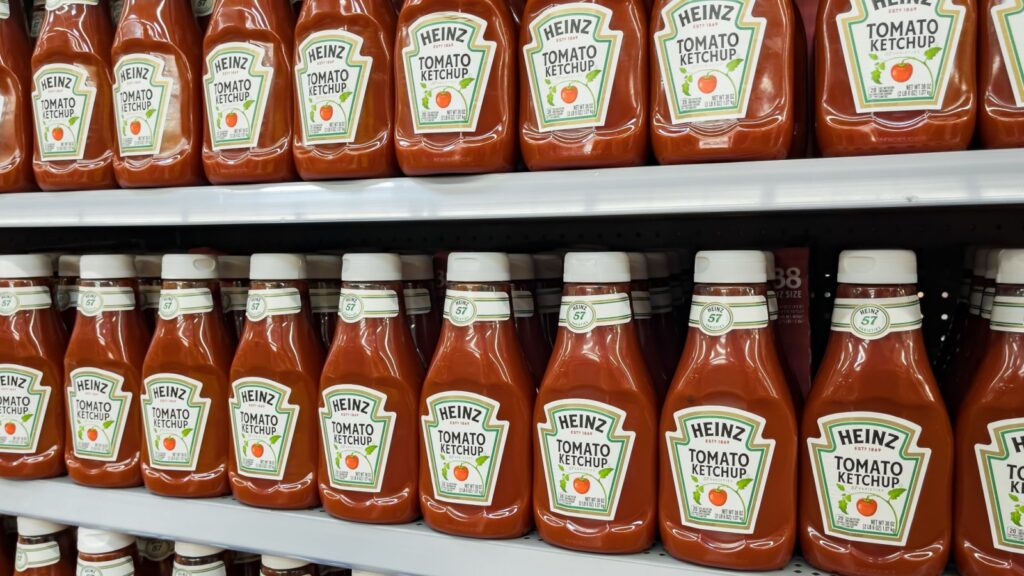
In a Canadian Press comparison published September 21, Heinz tomato ketchup received three noticeably different descriptions from popular shopping apps. Buy Beaver scored the bottle 70 out of 100, O SCANada classified it as “not Canadian-owned,” and Maple Scan described it as “prepared in Canada.” All three assessments can point to genuine characteristics of the same product because ownership, manufacturing, ingredients and employment are separate questions. That distinction has become more important as renewed Canada-U.S. trade tensions encourage shoppers to scrutinize labels and supply chains more closely. For Heinz, a familiar brand with American corporate ownership but substantial Canadian production, the result is a grocery-aisle identity that depends heavily on what “Canadian” is supposed to measure.
One Bottle Can Produce Three Different Answers
The Canadian Press tested more than a dozen Canadian-shopping apps before focusing on Buy Beaver, O SCANada and Maple Scan. Heinz ketchup provided perhaps the clearest example of how their methodologies can lead shoppers in different directions. Buy Beaver awarded the bottle 70 points out of 100, taking into account manufacturing location, ingredient sourcing and the headquarters of the parent company. Its findings included production in Quebec, mostly domestic ingredients and a U.S.-based corporate parent.
O SCANada approached the same bottle primarily through ownership and therefore called it “not Canadian-owned.” Maple Scan emphasized where the food itself was prepared and returned “prepared in Canada.” None of those statements necessarily cancels out the others. Instead, the comparison exposes the central problem with reducing an international supply chain to one flag, percentage or badge. A shopper interested in Canadian factory employment could reasonably reach a different conclusion from someone interested mainly in where corporate ownership and profits ultimately reside.
Heinz Has a Much Bigger Canadian Production Footprint Than Its Ownership Suggests
Heinz ketchup sold in Canada has a significant domestic manufacturing story. Kraft Heinz returned production of Heinz ketchup for the Canadian market to its Mont-Royal facility in Quebec in 2021, several years after the company had shifted production south of the border. The return followed an investment involving Kraft Heinz Canada and the Quebec government, with the new line initially expected to produce more than 45 million kilograms of ketchup for Canadian consumers during its first two years.
The supply chain has evolved since that production line opened. Heinz Canada now says bottles carrying its “Prepared in Canada” maple-leaf mark are produced at Mont-Royal. The company also says the tomatoes used in that ketchup are sourced from Leamington, Ontario, most ingredients are sourced locally and more than 1,000 Canadians work at the plant. Those are company-reported figures, rather than a measure of Canadian ownership, but they explain why an app measuring domestic economic activity can assign Heinz substantial Canadian content even though the ultimate parent company is based in the United States.
“Prepared in Canada” Does Not Mean the Same Thing as Canadian-Owned
The terminology on food packages can look deceptively simple. Under Canadian Food Inspection Agency guidance, a statement such as “Prepared in Canada” describes a particular activity that occurred domestically. CFIA gives it as an example of an acceptable claim for food that has been entirely prepared in Canada. The agency separately recognizes “Made in Canada” and “Product of Canada,” which communicate different levels of domestic production and ingredient content.
Most importantly, none of those production descriptions automatically establishes who owns the company. A multinational headquartered outside Canada can employ Canadian workers, operate Canadian factories and purchase Canadian agricultural inputs. Similarly, a Canadian-owned company can sell something manufactured partly or entirely elsewhere. CFIA also says country-of-origin claims such as “Product of Canada” and “Made in Canada” are voluntary and the federal government does not pre-approve individual food labels. That is why ownership-based apps and manufacturing-based apps can legitimately display different information beside the same familiar bottle.
The 70% Score Is an App Rating, Not a Federal Canadian-Content Standard
Seeing “70% Canadian” on a smartphone screen can easily sound as though someone has calculated that exactly seven-tenths of the ketchup is Canadian. That is not what the figure means. Buy Beaver’s score is its own assessment based on factors including manufacturing location, ingredient origins and the location of the product’s parent company. The Canadian Press test found that those inputs produced a score of 70 for Heinz ketchup.
There is no government system that officially certifies the bottle as “70% Canadian.” Federal food-labelling rules instead use defined descriptions and consider how a product is processed and where its ingredients originate. “Product of Canada” generally requires virtually all significant ingredients, processing and labour to be Canadian. “Made in Canada,” meanwhile, focuses on the product’s last substantial transformation and normally includes language identifying whether domestic or imported ingredients were used. A percentage produced by a shopping app therefore should be read as an interpretation of several factors, not as a regulatory finding about the product.
Ownership and Canadian Economic Activity Can Point in Opposite Directions
O SCANada’s “not Canadian-owned” designation focuses attention on a different part of the supply chain. The Kraft Heinz Company operates as a U.S.-based global food company, with Canada grouped within its North American business. On that ownership test, a Canadian-made bottle can still be attached to a foreign parent. O SCANada says its product information is intended to show shoppers details including ownership, manufacturing, materials and Canadian employment rather than assuming all of those factors should be treated as the same thing.
That creates a genuine trade-off in classification rather than an obvious error. Money spent on a domestically manufactured product can support Canadian factory wages, transportation, agriculture and other suppliers even when the parent company is foreign. At the same time, company ownership can influence where profits, strategic decisions and shareholder returns ultimately flow. University of Ottawa marketing professor Michael Mulvey told Canadian Press that shoppers concerned mainly about supporting workers might emphasize domestic manufacturing, while those concerned about where money ultimately goes could give more weight to ownership.
The Trade Fight Has Made Product Origin More Than Fine Print
The renewed attention to grocery labels is occurring against a much larger deterioration in Canada-U.S. trade relations. According to the federal government, Canada introduced additional counter-tariffs effective September 8, 2026, at rates of 15%, 25% and 50% on selected U.S. products. Ottawa said those measures covered $27.6 billion in imports and were a response to new U.S. tariffs affecting an equivalent value of Canadian goods. The targeted sectors include areas such as steel, dairy, appliances, agricultural equipment, pulp and paper, plastics and electronics.
That does not mean a Canadian-produced Heinz bottle is suddenly subject to a tariff simply because its parent company is American. Tariffs generally follow the legal origin and classification of goods crossing a border, not the nationality of a corporate logo. The broader trade dispute, however, has made corporate nationality unusually visible at the supermarket. A purchase once driven largely by price, flavour and familiarity can now prompt questions about who owns the brand, where the factory is located, where ingredients originate and which part of the economy benefits from the sale.
Canadians Have Actually Shifted Some Grocery Spending
The “Buy Canadian” response is not limited to social-media posts and flags placed beside supermarket shelves. Bank of Canada researchers examined transaction-level information from roughly 10,000 Canadian households participating in the NielsenIQ Homescan Consumer Panel. Their February 2026 analysis found a measurable shift in food purchases after trade tensions intensified in early 2025. Compared with January, the share of food spending associated with Canadian products increased by approximately two percentage points in March, while the U.S. share declined by about the same amount.
The researchers found that the shift persisted through the summer, although its magnitude differed between grocery categories. They also emphasized an important limitation: products were classified using the country in which their barcode was licensed through GS1, which is not necessarily the country where the product was manufactured. That caveat sounds remarkably similar to the problem now confronting scanner apps. Product nationality is difficult to compress into a single data point because brands, factories, ingredients, barcode registrations and corporate parents can all belong to different countries.
Scanner Apps Can Be Useful Without Being Infallible
Canadian Press testing found that the apps did more than disagree about philosophical definitions. In some cases, their underlying information was incomplete. Buy Beaver, for example, gave Kraft peanut butter a score of zero after recognizing Kraft Heinz’s U.S. headquarters but failing to identify its Canadian manufacturing location. O SCANada identified the product as not Canadian-owned while also recognizing that it is manufactured in Mont-Royal, Quebec. Maple Scan identified Canadian manufacturing as well.
Redpath sugar offered another complicated example. Its Toronto refining operations are Canadian, but the company belongs to U.S.-based American Sugar Refining and Canadian sugar refining depends heavily on imported raw cane because Canada’s climate is unsuitable for commercial sugar-cane production. Different weighting systems therefore produce different classifications. Canadian Press also reported that many origin apps use artificial intelligence to gather and organize information from the internet. That makes database quality, sourcing and updates important. The apps can reduce research time substantially, but their output is better understood as a starting point than an unquestionable certificate of origin.
Price Still Competes With the Desire to Buy Canadian
National-origin preferences are also colliding with household budgets. Statistics Canada reported that grocery prices were 2.8% higher in August 2026 than one year earlier. That was an improvement from July and marked the first time since July 2024 that grocery inflation was below overall inflation. The longer-term change remains substantial, however: Statistics Canada calculated that grocery prices had risen 29% between August 2021 and August 2026.
Bank of Canada consumer research shows why that matters for the Buy Canadian movement. In its fourth-quarter 2025 consumer expectations survey, the Bank found continued interest in Canadian-made goods, but three-quarters of respondents said they were unwilling to pay a premium greater than 10% for them. A household comparing two bottles of ketchup is therefore balancing several considerations at once. Domestic employment or Canadian tomatoes may matter, but so can the price difference at checkout. Economic nationalism has limits when food, housing and other household expenses are already consuming a large part of monthly income.
“Canadian” Makes More Sense When the Question Is Made More Specific
The Heinz example suggests that the most useful question may not be simply, “Is this Canadian?” A shopper interested in agriculture can look for information about ingredient origins. Someone focused on employment can check the manufacturing location. Those interested in domestic ownership can investigate the ultimate parent company. Consumers looking specifically for federally recognized origin language can distinguish among “Product of Canada,” qualified “Made in Canada” claims and narrower statements such as “Prepared in Canada.”
That approach turns what appears to be a contradiction between apps into several separate facts. Heinz can be produced in Quebec, use Canadian tomatoes, employ Canadian workers and still belong to a U.S.-based multinational. Buy Beaver’s 70-point rating emphasizes the mixture. O SCANada’s ownership classification emphasizes the corporate parent. Maple Scan’s result emphasizes preparation. In the increasingly politicized grocery aisle, the apps are not merely identifying products; they are revealing that “Canadian” has several economic meanings. Understanding which one is being measured is often more informative than the score itself.
