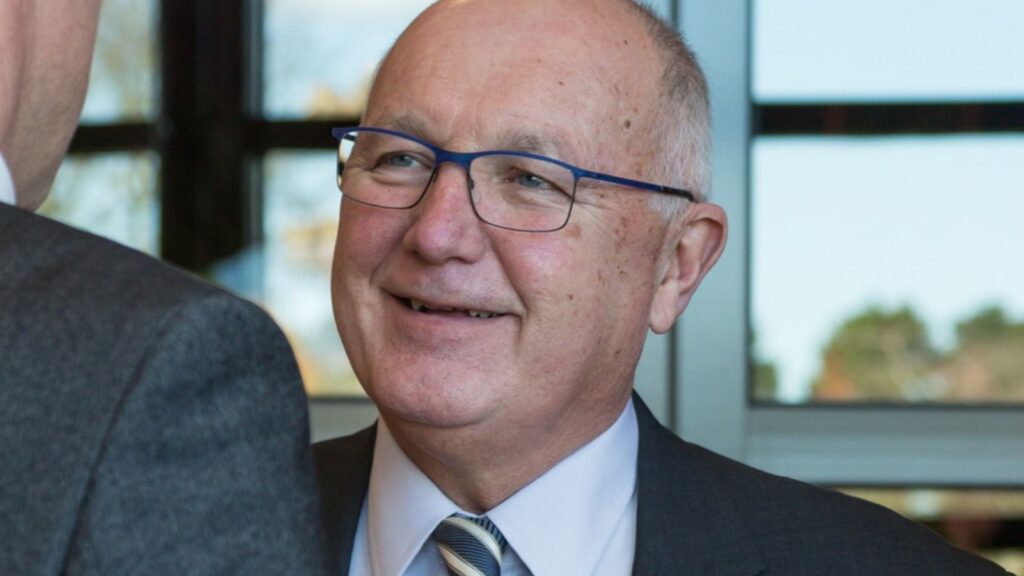
A growing backlash against Washington has reached Canada’s Parliament, where nearly 286,000 people have signed a petition demanding the removal of U.S. Ambassador Pete Hoekstra. The campaign, which closed on November 18, 2026, collected 285,921 validated signatures and accuses President Donald Trump’s representative of interfering in Canadian politics and undermining diplomatic relations.
The controversy comes amid heightened tensions over tariffs, Canadian sovereignty, and American political involvement in domestic affairs. From comments about Canada’s federal election to questions surrounding U.S. contacts with Alberta separatists, Hoekstra’s conduct has drawn increasing scrutiny.
Although the petition does not establish diplomatic wrongdoing or compel Ottawa to expel the ambassador, its remarkable level of support presents Prime Minister Mark Carney’s government with a politically sensitive question: how far should Canada go in challenging Washington while preserving one of its most important international relationships?
A Petition That Grew Into a National Political Flashpoint
The petition began on July 21, 2026, when Calgary resident Leanne Walker launched electronic petition e-7531 through the House of Commons. What started as a formal request to challenge the conduct of a foreign diplomat quickly attracted attention beyond Alberta. By August 13, the campaign had collected more than 104,000 signatures. Later that month, support had climbed beyond 225,000, demonstrating that dissatisfaction with the ambassador was not limited to a small circle of political activists.
When the signing period closed on November 18, the official total stood at 285,921 validated signatures. The campaign had operated for 120 days, giving Canadians and other eligible residents an opportunity to register their concerns through an established parliamentary process. Its significance extends beyond the number of names collected. An ambassador’s diplomatic conduct, normally discussed among political leaders and foreign affairs officials, had become a subject of public mobilization. The petition’s popularity illustrates how deeply disputes over Canadian sovereignty and relations with the Trump administration have entered domestic political debate.
What Nearly 286,000 Signatories Are Demanding From Ottawa
The petition goes beyond criticizing Hoekstra’s public statements. It makes three specific requests of the Canadian government, beginning with formally declaring the ambassador persona non grata and requesting his removal from Canada. Such a declaration is a recognized diplomatic mechanism through which a host country can reject a foreign representative. The petition also asks Ottawa to raise concerns directly with Washington about conduct it considers inconsistent with the Vienna Convention on Diplomatic Relations.
Its third demand is broader: a parliamentary committee review of alleged American diplomatic interference in Canada’s internal affairs. That request would move the controversy beyond Hoekstra’s personal conduct toward examining whether American officials or politically connected individuals have improperly involved themselves in Canadian political matters. The distinction is important because the document contains allegations, not independently established legal findings. Even with hundreds of thousands of signatures, it does not prove that diplomatic rules were broken. Nevertheless, supporters are asking Ottawa to examine the concerns formally rather than allowing them to remain unresolved political accusations.
Hoekstra’s Comments About Canada’s Election Sparked Controversy
One of the petition’s central complaints concerns how Hoekstra characterized Canada’s 2025 federal election campaign. During a September 18, 2025, appearance before the Halifax Chamber of Commerce, the ambassador expressed disappointment with what he considered anti-American political rhetoric. He particularly criticized the elbows up language that had become associated with resistance to Trump’s economic pressure and was frequently used by Prime Minister Mark Carney during the election campaign.
For many Canadians, that expression represented determination to protect the country’s interests during a difficult period in bilateral relations. The hockey-inspired phrase suggested standing firm rather than accepting American demands without challenge. Hoekstra, however, viewed the rhetoric as damaging to the relationship between two historically close neighbours. His comments created a disagreement over the distinction between criticizing American government policy and expressing hostility toward Americans themselves. The petition’s organizers believe his public characterization of Canadian political discourse crossed an important diplomatic boundary. Others may regard such remarks as legitimate advocacy by a representative defending his government’s interests, illustrating why the dispute cannot be resolved simply by pointing to unpopular statements.
Trump’s 51st-State Remarks Became Another Source of Anger
The petition also criticizes Hoekstra’s handling of Trump’s repeated suggestions that Canada could become America’s 51st state. Those remarks became a defining source of friction during the early months of Trump’s second presidency. During a May 6, 2025, Oval Office meeting, Carney explicitly rejected the idea that Canada could be acquired by the United States. Trump nevertheless continued to discuss the possibility, reinforcing Canadian concerns about how seriously Washington respected the country’s sovereignty.
The ambassador’s response subsequently attracted attention. During a June 30, 2025, interview with CBC News, Hoekstra suggested that Carney regarded Trump’s 51st-state comments as a term of endearment. That interpretation contrasted sharply with Carney’s public rejection of annexation. The controversy was especially notable because Hoekstra had previously acknowledged Canada’s sovereignty during his Senate confirmation hearing. For the petition’s supporters, the concern is not merely whether Trump’s remarks were intended as humour. It is whether America’s diplomatic representative should minimize language that many Canadians interpret as questioning their country’s independence. Hoekstra’s interpretation remains his own, rather than evidence that Carney accepted it.
Ontario’s Anti-Tariff Advertisement Added Another Layer to the Dispute
A separate dispute emerged from Ontario’s 2025 advertising campaign against American tariffs. Premier Doug Ford’s government aired a television advertisement in the United States featuring former president Ronald Reagan criticizing protectionist trade policies. The advertisement appeared during the World Series and angered Trump, who announced an end to trade negotiations with Canada and threatened an additional 10% tariff on Canadian imports. Ford subsequently withdrew the advertisement, but the incident left another source of friction between the governments.
The argument resurfaced in October 2026 when Hoekstra warned that American officials were monitoring Canadian political figures for possible interference in the November 3 U.S. midterm elections. During an interview with The Really Big Show, he suggested Ontario’s advertisement and comments from Canadian politicians, including Industry Minister Mélanie Joly and former prime minister Justin Trudeau, could be interpreted as interference. Joly responded that Canada would not involve itself in American domestic politics. The competing accusations highlighted a difficult diplomatic question: when does public criticism of another government’s policies become inappropriate political involvement? The petition’s supporters argue that the same standards Hoekstra invoked against Canadian politicians should also apply to his conduct in Canada.
Alberta Separatism Has Raised Sensitive Questions About U.S. Involvement
Perhaps the petition’s most politically sensitive allegations concern American connections to Alberta’s separatist movement. Leaders of the Alberta Prosperity Project, an organization advocating provincial independence, reportedly held three meetings with U.S. State Department officials in Washington during 2025. The contacts attracted national attention after being reported in January 2026. American officials characterized the meetings as routine engagements with civil society representatives and said no commitments had been made. Nevertheless, the discussions prompted Canadian leaders to question whether Washington was maintaining appropriate boundaries regarding Canada’s internal political affairs.
The petition also references Hoekstra’s connections to Republican political operatives associated with a voter-identification application used by Alberta’s Centurion Project. Separately, Elections Alberta obtained a court injunction in April 2026 restricting the project’s access to electoral information following concerns about unauthorized use of voter records. Hoekstra has denied knowing that the application was being used by separatists and has rejected suggestions that his political connections establish improper interference. The distinction matters: documented meetings and electoral-data investigations do not establish that the ambassador personally directed separatist activities. Supporters of the petition, however, argue that the circumstances warrant parliamentary scrutiny.
Ontario and British Columbia Account for the Largest Shares of Signatures
The geographical distribution of signatures demonstrates that the campaign attracted support well beyond Alberta, where it originated. According to the House of Commons petition record, Ontario contributed 123,386 validated signatures, making it the largest source of support. British Columbia followed with 57,372, while Alberta recorded 31,448 and Quebec contributed 30,709. Nova Scotia added 11,995 signatures, with thousands more coming from Manitoba, Saskatchewan, New Brunswick, and other provinces and territories.
These figures offer an interesting picture of public engagement. Ontario and British Columbia together account for a substantial majority of the signatures, but significant participation occurred in other regions as well. In Alberta, the petition’s popularity is particularly noteworthy because the allegations include concerns about provincial separatism and foreign political connections. Still, signing a parliamentary petition is voluntary, meaning the figures cannot be treated as a representative national opinion poll. They do not reveal how most Canadians would respond to a formal diplomatic expulsion. What they establish is that a considerable number of people were sufficiently concerned about the ambassador’s conduct to complete an official parliamentary petition.
Hoekstra Has Defended His Conduct While the U.S. Embassy Declines Further Comment
Hoekstra has previously dismissed the campaign against him and defended his responsibility to represent Trump’s administration. During an August 26, 2026, interview with iPolitics, he suggested that his continued service depended on the American president’s confidence in his performance. He also defended his connections with Republican political operatives who had reportedly worked with Alberta separatists, explaining that some previously supported his political campaigns in Michigan. The ambassador argued that sharing Trump’s public statements was part of his responsibility to explain Washington’s positions to Canadians.
The American diplomatic response to the petition’s conclusion has been restrained. Following its closure on November 18, a spokesperson for the U.S. Embassy in Ottawa told The Canadian Press that the embassy was aware of the petition but declined further comment. That response does not indicate whether Washington expects Ottawa to take formal action or anticipates additional diplomatic discussions. It does, however, highlight the competing expectations at the centre of the controversy. Hoekstra sees himself as communicating the policies of the elected American government, while petition supporters believe his interventions have sometimes exceeded the boundaries of acceptable diplomacy. Those conflicting interpretations remain unresolved.
Could Canada Legally Expel the American Ambassador?
International diplomatic law provides Canada with a mechanism to remove an ambassador it no longer considers acceptable. Article 9 of the Vienna Convention on Diplomatic Relations allows a receiving country to declare a foreign diplomat persona non grata without providing a formal explanation. The sending country must then recall the individual or terminate that person’s diplomatic functions. If it fails to act within a reasonable period, the host country may refuse to recognize the individual as a member of the diplomatic mission.
Article 41 of the same convention establishes that diplomats have a duty not to interfere in the internal affairs of their host country. Determining whether particular statements or political contacts constitute improper interference can be complicated, especially when diplomats are expected to explain and defend their own governments’ policies. Importantly, Article 9 does not require Canada to prove a violation of Article 41 before declaring an ambassador unacceptable. The legal authority therefore exists independently of the petition’s allegations. Whether to exercise that authority is a different matter. Expelling the American ambassador would be a consequential political decision, potentially generating retaliatory diplomatic measures at a time when Ottawa and Washington have significant unresolved economic and political differences.
Elizabeth May and Ottawa Face the Next Parliamentary Decision
The petition’s immediate future lies with Parliament rather than the diplomatic corps. Green Party MP Elizabeth May, who represents Saanich—Gulf Islands, is listed as its parliamentary sponsor. Canada’s electronic petition rules require at least 500 validated signatures before a petition can proceed to formal presentation, a threshold this campaign exceeded many times over. Once presented to the House of Commons, the government must provide a response within 45 calendar days, subject to parliamentary sitting rules. As of November 19, 2026, the official petition record did not show a presentation date, so that response period had not yet begun.
The broader challenge for Carney’s government is balancing public concern about sovereignty against the practical importance of the Canada-U.S. relationship. Statistics Canada reported that the United States received 71.7% of Canada’s merchandise exports in 2025, underscoring the economic dependence connecting the neighbours. Meanwhile, Canadian-resident return trips from the United States in August 2026 remained 23.2% below their August 2024 level, even after a year-over-year rebound. Such figures illustrate how political tensions can coexist with deep economic ties and changing travel behaviour. Ottawa’s eventual response may reject the petition’s requested measures, acknowledge concerns, or signal further examination. Whatever course it chooses, nearly 286,000 signatures have ensured that Hoekstra’s diplomatic conduct will remain difficult to dismiss as an isolated political complaint.
