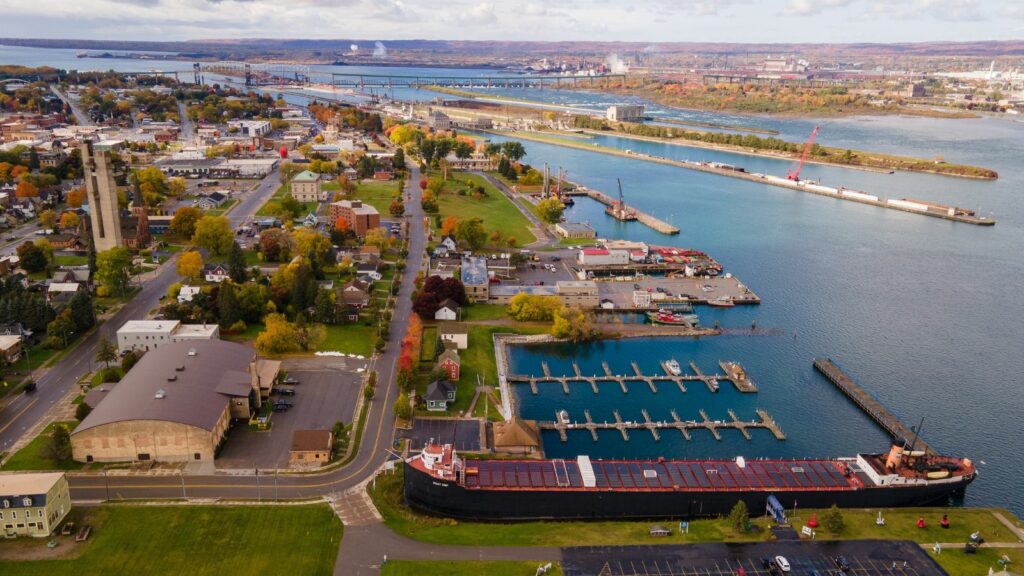
In Sault Ste. Marie, Ontario, one steelmaker is preparing to hire while another is rebuilding its business around a much smaller American market. Tenaris plans to support up to 200 new jobs through a C$306-million modernization program, and its local plant is already producing a specialized pipe grade for Western Canada’s energy industry. Nearby Algoma Steel has taken a different path, shifting toward Canadian customers after U.S. tariffs disrupted its traditional export business.
The contrast is more complicated than a tale of one winner and one loser. The companies manufacture different products, serve different customers and face different timetables. For the community, the promise of future hiring arrives against the painful reality of jobs already disrupted.
Two Steelmakers, Two Different Sets of Customers
Tenaris and Algoma Steel share Sault Ste. Marie’s industrial heritage, but they do not sell the same kind of steel. Tenaris manufactures seamless and welded pipes for drilling, energy production and transportation. Algoma specializes in plate and sheet steel, products that can become parts of bridges, buildings, equipment and other industrial structures. That distinction helps explain why the same city can be hearing about hiring at one plant and a difficult market retreat at another.
Reporting from Northern Ontario Business on October 15 highlighted Tenaris’s growing production of specialized pipe even as Algoma reduced jobs and redirected its strategy toward Canadian infrastructure and defence markets. Both companies depend on industrial investment, but their fortunes need not move together. An energy company ordering premium pipe does not necessarily increase demand for the flat steel that a neighbouring mill produces. The contrast illustrates how Canada’s tariff crisis is affecting different corners of manufacturing in very different ways.
A 200-Job Goal Stretches Through 2029
Tenaris’s expansion is expected to generate up to 200 skilled positions under a three-year investment plan running through 2029. Its Sault Ste. Marie workforce has been described as roughly 800 people, while the company says it employs more than 1,300 across Canada. Government announcements have characterized the investment as a way to create and maintain more than 1,000 jobs over the project’s life, including positions already supported by the operation.
But the 200 figure requires care. Tenaris’s own announcement refers to direct and indirect skilled jobs, so it should not be read as 200 confirmed new employees already on the plant payroll. Actual hiring will depend on equipment installation, demand and the abilities needed to operate upgraded lines. For someone looking for another manufacturing career after a layoff, the questions are practical: which jobs open first, what credentials are required, and whether training is available. The headline offers encouragement, not an immediate guarantee.
Public Money Is Supporting a C$306-Million Overhaul
The investment is substantial, and taxpayers have a stake in its success. Ottawa announced C$76.2 million through the Strategic Response Fund for a project officially valued at C$305.9 million. Invest Ontario separately outlined a conditional provincial loan of up to C$72 million, subject to a final funding agreement. Those public commitments are components of the overall modernization plan, not additional projects that should be added to the C$306-million headline.
The work extends across the factory. Tenaris has identified improvements to hot rolling, stretch reduction, heat treatment, testing and finishing, along with a new threading line for pipe connections. Better automation is intended to increase productivity while widening the products made locally. The company has separately reported more than C$355 million in Canadian investments since 2020, alongside the newly announced modernization program. Historical spending figures should not be confused with completed delivery of every upgrade in the new plan. Execution, not just allocated financing, will determine its eventual impact.
A New Pipe Grade Shows What the Factory Can Make
The clearest immediate sign of progress is a product, not a job forecast. On September 30, Tenaris announced that its Sault Ste. Marie centre had started producing TN 95EY, a proprietary steel grade for demanding oil and gas wells. It is designed for challenging pressure and temperature conditions, including sour-service applications where materials must withstand potentially corrosive operating environments. The company identified the Montney and Duvernay formations in Western Canada as important target markets.
Producing the grade locally required more than adjusting a furnace setting. Tenaris described cooperation among metallurgy, operations, laboratory testing and information-technology teams to adapt processes, document specifications and track individual pipes. That work helps explain the specialized skills involved in modern steel manufacturing, from shop-floor controls to quality assurance. It also provides a tangible benchmark against which the wider modernization can be judged. A successful product launch demonstrates capability; it does not prove that all new capacity has been installed or all planned positions filled.
Western Canada’s Energy Fields Are Central to the Bet
Tenaris is building around demand for pipes used in oil and gas production rather than relying primarily on traditional exports of commodity steel. Its product range includes oil country tubular goods, which go into wells, and line pipe, which carries hydrocarbons through transportation systems. The Sault Ste. Marie site has an unusual advantage: Tenaris says it is the only North American manufacturing centre producing both seamless and welded steel pipe under one roof. Its Rig Direct service connects Canadian production with energy operators.
Invest Ontario has said the modernization could lift annual domestic production of the relevant seamless and welded pipe products by roughly 80%. That is a projected result, not an increase already measured in shipments. Future orders will depend on drilling activity, infrastructure construction and whether domestic pipe can meet customers’ technical specifications and price expectations. The investment offers a way for Ontario manufacturers to participate in Western Canadian energy projects without requiring every finished product to cross the U.S. border first.
Algoma’s American Sales Have Fallen, Not Vanished
Across town, Algoma’s former reliance on American customers has become a vulnerability. The company says the 50% U.S. Section 232 tariff disrupted sales channels that had supported its business for generations. In the second quarter of 2026, shipments to the United States made up 23% of its total steel shipments, down from 54% in the same quarter of 2025. Those percentages show a major retreat, though not a complete withdrawal from the U.S. market.
Algoma reported C$18.7 million in direct tariff costs for the quarter, down from C$64.1 million one year earlier. That improvement was partly the result of shipping less steel south, not evidence that tariff barriers had disappeared. It also warned that steel displaced from U.S. buyers was adding to domestic oversupply and putting pressure on Canadian coil prices. Selling at home can limit exposure to customs charges, but a smaller market with many competing sellers presents problems of its own.
The Blast Furnace Closure Came With a Human Cost
Algoma permanently stopped production at its blast furnace and associated coke batteries on January 18, 2026, ending roughly 125 years of coal-based integrated steelmaking in Sault Ste. Marie. The company had already planned a shift to electric arc furnaces, but said the tariff shock forced it to accelerate a change that was originally expected to unfold more gradually. A piece of the city’s industrial identity disappeared alongside the old production process.
The workforce consequences were serious. Algoma issued layoff notices to approximately 1,005 unionized employees in December 2025, with a March 23, 2026 effective date. Local reporting found that some workers received extensions for training and transition needs, meaning the notices should not be treated as proof that every person left on the same day. In a community where industrial work supports households and local businesses, replacement opportunities matter. Tenaris’s possible 200 jobs are welcome, but cannot simply be subtracted from Algoma’s much larger layoff figure.
Electric Furnaces Promise Change but Face Operational Risks
Algoma’s new strategy depends on electric arc furnace technology, which can offer greater production flexibility than the old blast-furnace system. The company expects an eventual raw-steel capacity of about 3.7 million tons annually and projects a roughly 70% reduction in annual carbon emissions compared with its previous operation. Those are intended long-term outcomes, not a claim that the entire redesigned operation has already reached full production.
The transition has encountered practical problems. An August outage at Algoma’s Lake Superior Power facility interrupted furnace production, although the company reported in early October that a replacement turbine had restored full power. Its second electric arc furnace was being commissioned, with production and shipments expected during the fourth quarter. Algoma also projected about 145,000 tons of third-quarter shipments and adjusted EBITDA between negative C$10 million and negative C$20 million. Those numbers were guidance, not reported final results, and underline the difficulty of rebuilding capacity while preserving cash.
Canadian Plate and Defence Work Offer a New Direction
Algoma’s response is to focus increasingly on discrete steel plate, a product category in which the company describes itself as Canada’s only domestic producer. Management reported a second consecutive quarter of record plate sales in July and pointed to infrastructure, construction and defence as promising sources of demand. Concentrating on a specialized product may provide better pricing opportunities than competing for buyers in an oversupplied market for steel coil.
The company is also attempting to build new business beyond ordinary plate sales. In April, it joined Canadian armoured-vehicle manufacturer Roshel to form a venture aimed at producing ballistic steel solutions, including fabrication, forming, welding and machining. Those plans connect steelmaking with national defence procurement, but partnerships are not equivalent to booked government orders. Another proposed initiative, involving South Korea’s Hanwha Ocean and a possible structural beam mill, was suspended after a submarine procurement decision. New markets may provide a path forward, although not every proposal becomes a paying contract.
Financial Figures Show How Expensive the Reset Has Been
Algoma’s second-quarter results put numbers on the disruption. Revenue fell to C$267.5 million from C$589.7 million a year earlier, while steel shipments dropped to 181,473 tons from 472,056 tons. The company reported a C$96-million net loss and a C$134.2-million operating loss. Comparisons with 2025 are complicated by the change from blast-furnace production to its still-ramping electric furnace, but the scale of the contraction is unmistakable.
Management highlighted C$13.8 million in positive adjusted EBITDA, a measure of earnings before certain expenses and adjustments. That figure included a C$45-million insurance settlement, however, so it cannot be read as clear evidence that everyday steel production had become profitable. The results also recorded C$79.4 million in cash used by operations. Higher average selling prices for its changing product mix offered encouragement, but sustainable recovery will require steadier output, reliable equipment and sufficient customers for Canadian plate.
Government Protections Cannot Replace Paying Customers
Ottawa has imposed tariff-rate quotas on steel from countries outside CUSMA and applies a 50% surtax to quantities exceeding the relevant limits. Those policies aim to reduce the risk that metal displaced by American trade barriers floods Canada’s market. The federal government has also supported individual investments, including Tenaris’s modernization, and established broader financing programs for metals manufacturers. Yet import restrictions and funding alone cannot create orders for every steel grade made in Ontario.
The next milestones will offer more concrete evidence. Tenaris needs to show how its planned positions materialize through 2029 and how new pipe capacity translates into customer deliveries. Algoma has scheduled its third-quarter earnings for October 28, when investors and workers will get a fuller accounting of the difficult summer and its electric-furnace transition. For Sault Ste. Marie, the central issue is not whether one company’s growth cancels another’s pain. It is whether both can support durable work in an altered Canadian steel economy.
