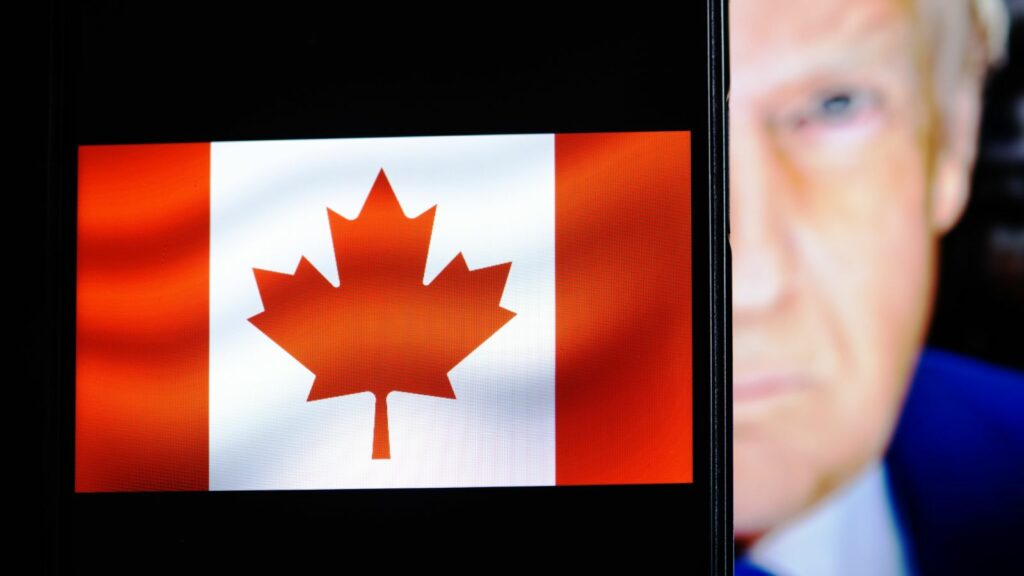
Canada’s newest counter-tariffs are not being chosen only by looking at customs codes, factory output or the value of American goods crossing the border. Ottawa has openly acknowledged a political calculation as well. Industry Minister Mélanie Joly says some products were selected because they are tied to particular U.S. states, giving Canada a way to create pressure inside the United States ahead of the November midterm elections. The strategy sits alongside a more conventional goal: protecting Canadian producers from U.S. tariffs and preventing American competitors from gaining an advantage in Canada. With C$27.6 billion in U.S. imports set to face new duties beginning September 8, the dispute is becoming a test of whether carefully targeted economic pain can influence Washington without creating too much damage at home.
Ottawa Is Openly Adding Politics to the Tariff Calculation
Ottawa’s most revealing explanation came when Joly described the counter-tariffs as serving two purposes. The first is economic: Canadian companies facing U.S. duties should not have to compete at home against American goods that can enter Canada on better terms. The second is political. Joly said Canada was selecting products linked to particular states so the measures would create pressure inside the U.S. political system before Americans vote on November 3. That is a notable shift from treating retaliation as a simple accounting exercise. Matching Washington “dollar for dollar” may determine the overall size of the response, but product selection determines where the pain is felt. In practice, that means Ottawa can choose a tariff list that is national on paper while producing much more concentrated effects in certain communities.
That approach has leverage because Canada is not a marginal customer for many parts of the United States. U.S. Trade Representative data show American goods exports to Canada totaled $333.6 billion in 2025, while Prime Minister Mark Carney has said Canada is the largest customer for 26 U.S. states and a top-three customer for 45. Those figures explain why a tariff imposed in Ottawa can quickly become a local issue hundreds of kilometres south of the border. A factory that sells machinery into Ontario, a dairy processor shipping cheese north, or a manufacturer supplying Canadian retailers does not experience the dispute as an abstract argument between national governments. It shows up as a lost order, a thinner margin or a customer asking for a cheaper alternative. Ottawa’s strategy depends on those local consequences eventually reaching governors, senators, representatives and the White House.
The C$27.6-Billion Package Is Selective by Design
The new package is substantial but deliberately selective. Finance Canada says the countermeasures will cover C$27.6 billion in U.S. imports and take effect at 12:01 a.m. on September 8. Rates are set at 15, 25 and 50 per cent, with individual products generally matched to the corresponding U.S. tariff rate. The government’s updated list is concentrated in steel and aluminum, dairy, appliances, agricultural equipment, pulp and paper, plastics and electronics. Some items carry especially visible rates: many steel and aluminum products face 50 per cent duties, cheese is generally listed at 25 per cent, and motorcycles with engines larger than 800 cubic centimetres face 50 per cent. Smartphones also appear on the list at 50 per cent. The result is a mix of industrial inputs, consumer goods and recognizable finished products.
The composition matters as much as the headline value. A broad tariff on every U.S. import would spread costs across the Canadian economy and make it harder to direct pressure toward politically useful industries. Ottawa instead kept the retaliation focused, while leaving existing counter-tariffs on autos in place and preserving a remission process for exceptional cases. That gives the government room to shield a Canadian company if a particular U.S. input proves difficult to replace. It also makes the tariff schedule adjustable as economic conditions change. The strategy therefore has three moving parts: raise the cost of selected American goods, improve the relative position of Canadian competitors where possible, and avoid creating shortages or excessive costs in sectors where Canada remains dependent on cross-border supply. The next few months will show how well those goals can coexist.
Maine Lobster Shows Both the Strategy and Its Limits
Maine provides the clearest example of both the political logic and its limits. Early reporting on Canada’s retaliation identified seafood, including lobster, as part of the proposed tariff package, a move that would have landed in a state where Canada is an unusually important customer. U.S. Trade Representative data show Maine exported about $1.3 billion in goods to Canada in 2025, equal to 41 per cent of the state’s total goods exports. Seafood alone accounted for more than $378 million in Maine exports that year, while the state’s lobster harvest was valued at roughly $461 million. Those numbers made lobster an obvious candidate for a highly visible retaliatory measure: it is economically important, geographically concentrated and closely associated with Maine’s identity. It was also politically sensitive because Maine is home to a closely watched Senate contest.
But Ottawa then pulled fish and seafood from the final list after industry feedback, sparing American lobster from the planned tariff. That reversal is just as important as the original targeting decision. Canada and the United States have deeply connected seafood supply chains, and a tariff aimed at Maine can also raise costs for Canadian processors, wholesalers, restaurants and consumers. Fisheries and Oceans Canada reported that Canada imported more than C$5.2 billion in fish and seafood in 2025, including about C$343 million in lobster from all sources. Removing seafood showed that political symbolism is not enough when domestic collateral damage becomes too large. It also demonstrated that the retaliation is not fixed. Ottawa can add pressure, withdraw it or redirect it as industries make their case. For businesses on both sides of the border, that flexibility creates relief in some sectors but also continuing uncertainty.
Wisconsin’s Dairy and Manufacturing Base Fits the Strategy
Wisconsin is a stronger example of how the final tariff list still intersects with state-level economic exposure. Canada was Wisconsin’s largest export market in 2025, buying about $7.6 billion in goods, or 28 per cent of everything the state exported. Dairy is especially important: Wisconsin shipped an estimated $1.1 billion in dairy products abroad in 2024, ranking second among U.S. states. Canada’s new tariff schedule places 25 per cent duties on many cheeses and 50 per cent duties on several milk and whey products. The measures do not mean every Wisconsin dairy export will suddenly face the same barrier, but the product overlap is politically obvious. A tariff on cheese is easier for voters and local businesses to understand than an obscure industrial classification, particularly in a state where dairy farming and food processing are highly visible parts of the economy.
The industrial side of Wisconsin is exposed as well. Machinery was the state’s largest manufacturing export category in 2025 at $5.1 billion, while transportation equipment accounted for another $2.7 billion. Canada’s list includes hand tools, machinery, electrical equipment, appliances and large-engine motorcycles, among other manufactured goods. Reporting on the retaliation has highlighted the potential relevance of companies and industries associated with Wisconsin and neighbouring Midwestern states, including motorcycle and farm-equipment manufacturing. That is the point of geographic targeting: Ottawa does not need to damage an entire state economy to get attention. It needs enough firms, workers and suppliers to see Canada as a market they could lose. If a Canadian buyer delays an equipment order or switches to a non-U.S. supplier because a tariff changes the price, the commercial decision can become a political complaint long before it becomes a dramatic macroeconomic statistic.
Ohio and Pennsylvania Show How Local Trade Exposure Becomes Leverage
Ohio illustrates why the industrial Midwest matters so much to Canada’s strategy. In 2025, Ohio exported $18.3 billion in goods to Canada, equal to 32 per cent of the state’s total goods exports and more than twice its shipments to Mexico. The state is heavily manufacturing-oriented: transportation equipment accounted for $18.8 billion in exports, machinery for $6.3 billion, fabricated metal products for $3.7 billion and primary metals for $3.4 billion. Canada’s tariff list reaches into many of those broad industrial categories through steel and aluminum products, tools, machinery, electrical equipment, rail equipment and furniture. At the same time, Ohio is one of the states where the Canada trade fight is already intersecting with a competitive Senate race. That combination of large commercial exposure and political competition is precisely the environment in which targeted retaliation is intended to generate pressure.
Pennsylvania offers a similar economic picture even without the same electoral storyline. Canada bought about $14 billion in Pennsylvania goods in 2025, or 27 per cent of the state’s exports, making it the state’s largest foreign market. Pennsylvania also exported roughly $4.7 billion in primary metal products and $4.5 billion in machinery. For communities built around mills, fabrication plants and industrial suppliers, a 50 per cent Canadian duty on selected metal products is not merely a diplomatic gesture. It can affect bidding decisions, inventory plans and whether a Canadian customer looks elsewhere. Ottawa’s wager is that these concentrated effects travel upward through the political system. A national government in Washington may absorb criticism of “Canadian tariffs” in the abstract. It is harder to ignore employers, unions, farm groups and local officials arguing that a specific trade policy is costing business in their own state.
There Is Evidence Politically Targeted Tariffs Can Work
There is historical precedent for using retaliation this way. During the 2018 trade conflict, U.S. trading partners chose products such as bourbon, motorcycles, agricultural goods and other exports associated with politically important regions. The Peterson Institute for International Economics noted at the time that retaliating governments had discretion over which products to target and could use that discretion to impose costs on constituencies with influence over U.S. policymakers. Canada’s current strategy follows the same basic logic, but with unusually explicit public acknowledgment from a cabinet minister. The political theory is straightforward: tariffs create concentrated losers, concentrated losers organize faster than the broader public, and elected officials hear from employers and workers who can point to a specific lost market. The economic effect does not have to be enormous nationally if it is sharp enough locally to become politically uncomfortable.
Research suggests that this mechanism can matter, although the evidence is not one-directional. An NBER study of the 2018 U.S.-China trade war found Republican House candidates lost support in counties more exposed to foreign retaliatory tariffs; its counterfactual analysis estimated Republicans might have lost ten fewer House seats without the trade war. A later NBER study found retaliatory tariffs had clear negative employment effects, especially in agriculture, but concluded they only modestly weakened broader political support for Republicans in heavily exposed areas. That difference is an important warning for Ottawa. Economic pain does not automatically translate into votes against the government that started a trade conflict. Voters can blame foreign governments, rally around domestic leaders or prioritize other issues. Targeted tariffs may therefore increase bargaining pressure without delivering a predictable electoral result. They are a political instrument, not a guaranteed political outcome.
The Risk Is That Canadians Pay Part of the Price Too
The biggest constraint on Ottawa’s strategy is that Canadians pay part of the bill too. Bank of Canada research on the 2025 counter-tariffs found prices of tariffed U.S. products rose about 6 per cent more than comparable untariffed goods after three months, meaning roughly one-quarter of a 25 per cent tariff was passed through to retail prices. The Bank estimated that episode added about 0.3 percentage points to consumer price inflation. Carney has also acknowledged that retaliation can raise costs and reduce choice. To cushion the latest shock, Ottawa announced C$7.5 billion in new and enhanced support, including C$1.5 billion for regional tariff-response programs, C$500 million in new BDC liquidity, C$2 billion for diversification projects and C$3.5 billion in rapid-response support for workers and employers. Those programs are effectively the domestic insurance policy behind the tougher trade stance.
For now, the key date is September 8, when the new duties are scheduled to begin. Trade talks were suspended after the latest negotiations broke down, and reporting through August 29 continued to describe negotiations over major auto tariffs as stalled. Yet the seafood reversal shows the tariff package can be modified before or after implementation, while Canada’s remission framework provides another pressure valve for exceptional cases. That makes the counter-tariffs both a punishment and a negotiating tool. Ottawa is trying to send a message to Washington through factories, farms and businesses in states that depend heavily on Canadian customers, while keeping enough flexibility to limit damage at home. Whether that strategy works will depend less on the number of products on the list than on what happens next in those communities: cancelled orders, lobbying calls, price increases and, ultimately, political pressure.
