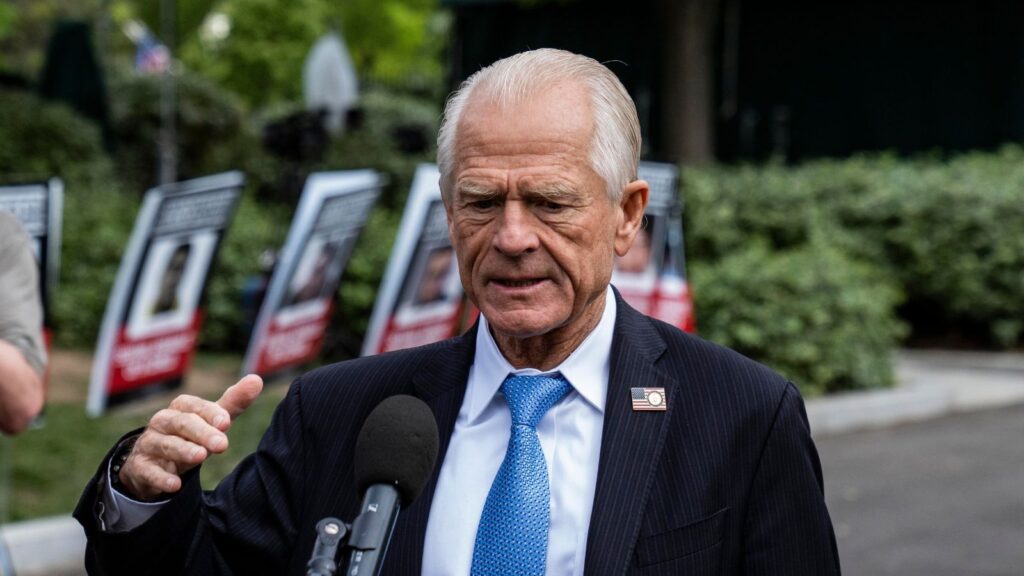
A Canada-U.S. trade dispute already defined by tariffs, import restrictions and stalled negotiations is now colliding directly with the American political calendar. White House trade adviser Peter Navarro warned Ottawa against interfering in the U.S. midterm elections and sharply criticized Canadian lobbying in Washington, specifically invoking Maine and Michigan. Prime Minister Mark Carney responded by saying Canada has no plans to increase trade pressure simply because Americans are approaching an election, while Canada-U.S. Trade Minister Dominic LeBlanc rejected President Donald Trump’s suggestion that Ottawa would eventually return to Washington with an apology. The result is an unusually delicate Canadian position: defending retaliatory measures already imposed, refusing to apologize for them, but signalling that Ottawa does not intend to deliberately escalate the dispute around the U.S. campaign calendar.
Navarro Turns the Trade Dispute Into a Midterm Warning
Peter Navarro brought the U.S. midterm elections squarely into the Canada-U.S. trade confrontation during an appearance at the American Growth Summit in Washington on September 29. Navarro, who serves as a senior White House adviser on trade and manufacturing, criticized Canadians working to influence Washington through lobbying and told those on K Street to “get the hell out of our country.” He argued that Canadian lobbying had succeeded in the past but said Ottawa should not expect that strategy to keep working under the Trump administration.
Navarro then singled out Maine and Michigan when warning Canada against what he described as interference in American elections, saying further consequences could follow. The reported remarks did not identify a specific covert or unlawful Canadian election-interference operation. Instead, they came against the backdrop of Canadian retaliatory tariffs deliberately structured partly to create pressure in U.S. states affected by the trade fight. That distinction is important because political lobbying, government-to-government advocacy, targeted tariffs and unlawful election interference are not automatically the same activity under U.S. law.
Carney Says Canada Will Not Escalate Because Americans Are Voting
Speaking in Vancouver later Tuesday, Carney said Canada did not intend to add new trade pressure simply because the United States was approaching its midterm elections. “Our timing isn’t dictated by any specific aspect of the U.S. calendar,” he said, while stopping short of permanently ruling out additional Canadian measures if circumstances change. His message effectively separated Canada’s existing retaliation from any future decision specifically timed to influence the American political cycle.
Carney also kept the door open to negotiations, saying Canada remained prepared to deal with Washington in good faith. Rather than directly match Navarro’s language, he argued that both economies would benefit from a functioning commercial relationship, particularly at a time when affordability remains a major concern. The approach reflects the balancing act facing Ottawa: Canadian counter-tariffs remain in place, but the government is publicly signalling that it does not intend to pile on measures merely because American politicians are campaigning. The Canadian position therefore remains firm without amounting to a pledge of unconditional restraint if Washington introduces additional trade restrictions.
LeBlanc Rejects Trump’s Call for an Apology
The dispute over tone intensified after Trump predicted that Canada would eventually return to Washington and say, “sir we are sorry,” suggesting that an accommodation could emerge within several weeks. LeBlanc dismissed that prospect on September 29. He said Ottawa was not considering apologizing for defending Canadian workers, businesses and the broader economy, while arguing that the U.S. tariff measures violated the North American trade framework previously negotiated by the same U.S. administration. The assertion that Washington violated the agreement represents the Canadian government’s position in the dispute.
LeBlanc’s response did not amount to closing the negotiating channel. He said Canadian and American officials continued to communicate, even though the detailed negotiations underway several weeks earlier had stopped. Ottawa would be prepared to re-enter substantive negotiations if Carney concluded that an agreement could protect Canadian sovereignty and serve the country’s economic interests, LeBlanc said. That leaves a substantial gap between Trump’s description of an approaching Canadian climbdown and Ottawa’s stated position: Canada is willing to talk, but it is not presenting renewed negotiations as an apology or an acceptance of Washington’s demands.
New U.S. Import Bans Have Added Another Layer of Pressure
The political confrontation coincided with a tangible change at the border. Beginning at 12:01 a.m. Eastern Time on September 29, the United States excluded specified Canadian products from entry under a series of presidential proclamations covering alcoholic beverages, dairy-related goods and certain motor vehicles. The White House has characterized those actions as responses to Canadian policies it considers discriminatory toward American producers. Those allegations are Washington’s stated justification for the measures rather than an uncontested finding shared by both governments.
The affected goods include substantial categories of Canadian alcohol as well as products such as whey and certain motorcycles. The Associated Press reported that the measures cover nearly US$1 billion in annual imports, citing an American Action Forum estimate based on 2025 trade data, with alcoholic beverages representing about 87 per cent of the value. The figure is relatively small beside roughly US$880 billion in annual two-way trade in goods and services reported during the recent dispute, but the impact is heavily concentrated among particular manufacturers, distillers, distributors and communities rather than evenly spread across both economies.
For Some Canadian Businesses, the Fight Is Already Very Personal
The aggregate numbers can obscure what an import restriction means for a company that spent years developing American customers. The Associated Press highlighted Wolfhead Distillery in Amherstburg, Ontario, which halted whisky shipments to nearby Michigan as the trade restrictions tightened. The company sits in a region where the border is part of everyday commercial life, making the disruption more immediate than national trade totals suggest. Smaller alcohol producers can have fewer alternative distribution networks and less financial capacity to redirect exports quickly than multinational companies.
Quebec-based BRP provides another example of the highly specific nature of the new measures. Its Can-Am Spyder and Canyon three-wheeled vehicles are among Canadian products caught by the U.S. motor-vehicle import restrictions. Because much of the current riding season’s inventory had already moved through distribution channels, some effects may take longer to become visible at dealerships. These cases demonstrate why a measure covering a modest fraction of overall bilateral commerce can nevertheless generate significant disruption in particular plants, border communities and supply chains. The economic burden depends less on the headline value of bilateral trade than on which products suddenly lose market access.
Ottawa Has Acknowledged That Its Tariffs Were Designed to Create U.S. Pressure
Navarro’s focus on American politics did not emerge in a vacuum. Canada announced retaliatory tariffs in August covering C$27.6 billion in U.S. imports, with rates of 15, 25 and 50 per cent taking effect on September 8. Finance Canada said the measures were designed to match the value and rates of recent U.S. actions, with products spanning steel, dairy, appliances, agricultural equipment, pulp and paper, electronics and other categories. Ottawa presented the measures primarily as economic protection for industries affected by American tariffs.
Canadian officials also acknowledged a political dimension. Industry Minister Mélanie Joly said in August that the product selection was intended partly to put “political pressure” on U.S. states ahead of the November midterms. Reuters subsequently reported that industries in states including Michigan and Maine were feeling the effects of the escalating tariff exchange. That public strategy helps explain why Navarro connected trade retaliation with American electoral politics. It does not, on its own, establish that Canada engaged in unlawful election interference; it shows that Ottawa expected geographically targeted economic pressure to affect the political environment surrounding the dispute.
Lobbying Washington Is Not New for Canadian Governments
Canadian politicians and officials have spent decades making their case directly to U.S. lawmakers, governors, business associations and federal officials when cross-border economic interests are threatened. During the NAFTA renegotiation in 2017, for example, a Canadian parliamentary delegation travelled to Washington and reported meeting with 57 senators, House members and congressional staff. Its primary focus was Canada-U.S. trade and the ongoing negotiations. Similar outreach has traditionally been treated as part of the diplomatic and political effort surrounding one of the world’s largest bilateral commercial relationships.
U.S. law also establishes formal rules governing certain work performed on behalf of foreign principals. The Justice Department says the Foreign Agents Registration Act requires specified agents involved in political activities, public relations, political consulting or representation before U.S. officials to register and disclose their relationships and activities, subject to statutory exemptions. FARA is fundamentally a transparency regime; whether any particular activity triggers its requirements depends on the facts and applicable exemptions. Navarro’s remarks placed Canadian lobbying and his warning about electoral interference in the same political argument, but the available reports did not identify a specific Canadian lobbying activity that had been found unlawful under FARA.
Maine and Michigan Were Not Random States for Navarro to Mention
Canada’s economic connections with Maine and Michigan help explain why both names have repeatedly surfaced during the dispute. Maine Public reported that 40 per cent of Maine’s US$3.2 billion in goods exports went to Canada in 2025, while Canada supplied nearly 70 per cent of the state’s imports. Forestry, seafood, energy and agriculture all involve substantial cross-border activity. An originally proposed Canadian seafood tariff prompted particular concern because Canadian processors normally handle a large share of Maine’s fall lobster harvest, although Ottawa ultimately removed seafood from the tariff list before the September 8 measures took effect.
Michigan’s exposure is similarly substantial but rooted heavily in manufacturing. U.S. Trade Representative data show Michigan exported US$23.2 billion in goods to Canada in 2025, equal to roughly 39 per cent of the state’s worldwide goods exports. The automotive supply chain is especially integrated, with components routinely moving across the border during the production process. Reuters has reported that the tariff dispute has consequently become part of political debate in both Michigan and Maine. That makes the states natural pressure points for governments attempting to create economic leverage, without determining how voters in either state will ultimately respond.
The Formal Talks Are Stalled, but Communication Has Not Stopped
The negotiating picture remains considerably colder than it was earlier in the summer. Detailed Canada-U.S. trade negotiations were suspended after talks broke down in August, and LeBlanc said on September 29 that the two sides were no longer exchanging the kind of detailed negotiating text they had worked on several weeks earlier. At the same time, he stressed that officials remained in contact. Ottawa therefore distinguishes between the absence of active negotiations on a comprehensive agreement and the continued existence of diplomatic and government-to-government communication.
Washington has also signalled little urgency. U.S. Trade Representative Jamieson Greer said on September 25 that Trump was comfortable with the existing situation and did not see an immediate need for a Canadian deal. That position makes Trump’s separate suggestion of a Canadian return within several weeks harder to interpret as a negotiated timetable. The public positions instead show two governments maintaining leverage while leaving room to resume talks. Neither the continuing contact described by LeBlanc nor Trump’s statements establish that a settlement is imminent, and current reporting provides no signed framework setting out the terms of a new agreement.
Ottawa’s Current Strategy Is Resistance Without a New Election-Timed Escalation
Taken together, the latest statements reveal a narrower Canadian strategy than some of the rhetoric surrounding the dispute might suggest. Ottawa has not withdrawn the retaliatory tariffs already imposed and LeBlanc says there will be no apology for defending Canadian economic interests. At the same time, Carney says Canada does not plan to introduce additional pressure simply to coincide with the American midterms. Those positions can coexist: one preserves measures Ottawa considers reciprocal, while the other attempts to prevent the U.S. electoral calendar from becoming the stated trigger for another round of escalation.
Navarro’s warning illustrates how difficult separating trade policy from electoral politics has become. Canada has openly acknowledged that state-level political pressure was one consideration when designing its tariffs, while the White House is simultaneously using market-access restrictions to pursue its trade objectives. Yet officials on both sides continue to leave space for negotiations. For businesses caught in the middle, that means the immediate reality is less dramatic but more consequential than the political exchanges: tariffs and import bans are operating now, detailed negotiations remain stalled, and there is still no agreed timetable for ending the dispute.
