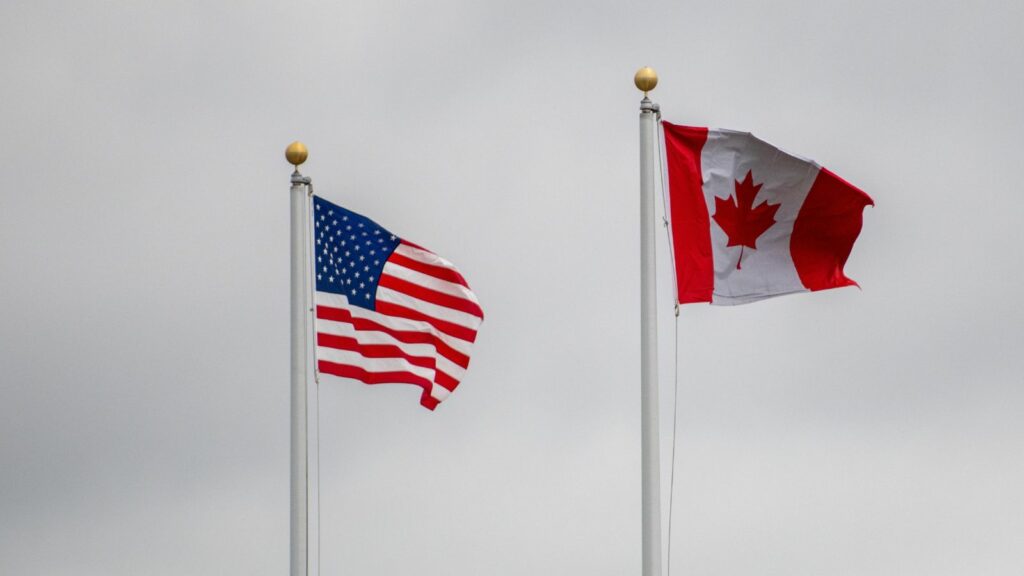
Donald Trump has again raised expectations of a breakthrough in the increasingly costly U.S.-Canada trade fight, telling a rally in Port Huron, Michigan, that the dispute would be resolved “pretty soon” and claiming Canada is “willing to give us anything at this moment.” The comments came just over a week before the November 3 U.S. midterm elections, in a border state where tariffs and the auto industry are politically sensitive.
There is evidence that talks have accelerated. Senior White House economic adviser Kevin Hassett said negotiations were “gathering steam,” while Canadian officials have continued to say Ottawa is prepared to negotiate a mutually beneficial agreement. What remains missing is the most important part: a public deal text, agreed tariff schedule, or confirmed list of Canadian concessions.
A Border-State Promise With Election Stakes
Trump’s latest promise landed in a place where the trade dispute is unusually tangible. Port Huron is a Michigan border city with close Canadian ties. At the October 25 rally, Trump defended higher tariffs and repeated his argument that Canada has taken advantage of the United States. He then predicted the dispute would be settled “pretty soon,” without describing what Ottawa had offered or what Washington would remove in return.
The political setting matters. Trump was campaigning for Republican candidates ahead of the November 3 midterms, and Michigan’s auto industry makes Canada policy sensitive. Republican Senate candidate Mike Rogers has praised parts of Trump’s tariff strategy while warning about its automobile provisions. That tension captures the central challenge: tariffs can be presented as leverage against a foreign country, yet Canadian factories are also customers, suppliers and corporate partners of U.S. plants operating inside one deeply connected North American production system.
How the Trade Talks Collapsed in August
The latest optimism follows a breakdown two months ago. On August 18, Prime Minister Mark Carney said Canada and the United States had made “substantial progress,” and Washington postponed threatened Section 338 tariffs while negotiations continued. By August 21, however, Carney suspended the talks and ordered Canadian negotiators home. He said last-minute changes to the U.S. proposal were unfair, uneconomic and called the reliability of any agreement into question.
That sequence explains why Ottawa may treat predictions cautiously. Canada had pursued an agreement that would preserve broad tariff-free access, reduce U.S. duties on strategic industries and provide businesses with greater stability. Carney also said Canada would not accept a deal at any price or on any deadline. The failed August round remains a benchmark: encouraging statements can signal genuine movement, but a political understanding is not durable until both governments agree on the terms and how they will be implemented.
Tariffs Have Kept Moving Since the Breakdown
The collapse quickly produced new costs on both sides. Washington imposed targeted 50% duties under Section 338 of the Tariff Act of 1930 on specified Canadian goods. Canada responded with counter-tariffs covering C$27.6 billion in annual U.S. imports, using rates of 15%, 25% and 50%. Ottawa targeted categories including steel, dairy, appliances, agricultural equipment, pulp and paper, and electronics, while separate Canadian counter-tariffs on certain U.S. vehicles remained in force.
The rules have continued to shift. On October 23, Trump signed another proclamation removing some Canadian goods from the Section 338 tariff list and adding others, with changes scheduled for October 30. The White House said adjustments covered products such as plywood, some paper goods, machinery and refrigeration equipment, while adding other categories. For importers and manufacturers, that moving scope matters as much as the headline rate because sourcing decisions depend on exactly which products are covered in practice today.
The Trade Numbers Are Bigger Than the Rhetoric
Trump has repeatedly described Canada as the party benefiting overwhelmingly from the relationship, recently citing annual figures between US$80 billion and US$100 billion. Official U.S. data provide context. The U.S. Trade Representative estimates that two-way goods and services trade with Canada totaled US$872.3 billion in 2025. The United States recorded a US$48.3 billion goods deficit, but also a US$27.7 billion services surplus, producing a smaller overall imbalance than Trump’s rhetoric suggests.
Canada is nevertheless more dependent on the U.S. market. Statistics Canada reported that 71.7% of Canadian merchandise exports went to the United States in 2025, down from 75.9% in 2024. Exports to non-U.S. destinations rose 17.2% during the year, showing some diversification. Still, neither side is insulated. The United States sells hundreds of billions of dollars of goods and services to Canada, while Canadian businesses rely heavily on access to American consumers and industrial customers. Scale matters enormously here.
Autos Make the Dispute a Two-Country Problem
Autos show why tariffs can create pain on both sides of the border. Canada’s automotive industry contributed about C$16.8 billion to GDP in 2024 and directly employed more than 125,000 people, while supporting roughly 427,000 additional jobs. Statistics Canada found that more than 93% of Canadian motor-vehicle exports went to the United States in 2025, and those U.S.-bound vehicle exports fell 9.6% from the previous year.
The dependence is clearer in employment data. In 2024, U.S. demand accounted for 76.4% of payroll jobs in Canadian automobile and light-duty vehicle manufacturing, or roughly 27,000 jobs. That gives Washington considerable leverage, but Canadian and U.S. production is tightly integrated through parts, engines and assembly operations. The political concern is visible in Michigan, where Rogers has said the automobile portion of the Canadian tariffs worries him. For factory communities, trade policy can become a question of shifts, orders, investment plans and job security.
Energy Gives Canada Some Counter-Leverage
Canada’s dependence on the U.S. market does not mean Washington can replace every Canadian input easily. Energy is the clearest example. The Canada Energy Regulator reported that Canada supplied 63.4% of U.S. crude-oil imports in 2025 and close to 100% of imported natural gas. It also supplied 81.3% of electricity imported by the United States, reflecting pipelines and 86 power lines connecting the economies.
Those flows do not erase the bargaining advantage created by the size of the U.S. economy, but they complicate the idea that only Canada faces disruption. Refineries, utilities and industrial users in parts of the United States are built around longstanding Canadian supply routes. Substituting those flows can involve transportation constraints, different crude grades, infrastructure limitations or higher costs. That is why a prolonged tariff fight can produce regional consequences that look very different from the national political rhetoric surrounding it, especially in energy-intensive border states.
Potash Shows How the Fight Reaches U.S. Farms
The same interdependence appears in agriculture through potash, a mineral used in fertilizer. The U.S. Geological Survey estimated that the United States was 92% reliant on net potash imports in 2025. During 2021–2024, Canada supplied 79% of U.S. potash imports, far ahead of Russia at 12% and Israel at 3%. That makes Canadian supply relevant not only to trade officials, but also to farm input markets.
Potash illustrates how a dispute that begins with tariffs on manufactured goods can ripple into sectors far from the border. Fertilizer costs feed into planting decisions and influence the economics of producing crops. Canada remains more vulnerable overall because much of its export economy points south, yet the United States also relies on Canadian commodities embedded in domestic supply chains. These reciprocal dependencies do not guarantee compromise, but they raise the cost of prolonged escalation and give negotiators practical reasons to resolve sensitive products.
Dairy Remains One of the Hardest Issues
Agriculture remains difficult because Washington and Ottawa describe Canada’s supply-management system differently. The United States has objected to Canadian dairy, poultry and egg policies, especially high tariffs on imports above quota levels and the administration of dairy tariff-rate quotas. Some over-quota Canadian dairy rates exceed 200%, and some products are higher. Ottawa emphasizes that those headline rates do not apply to every American shipment entering the market.
CUSMA already expanded U.S. agricultural access. Canada created duty-free tariff-rate quotas for American dairy, poultry and egg products, while the agreement provided for tariffs on whey products to be eliminated over 10 years. Canada’s system therefore combines protected domestic production with import access. The dispute is about how much access American producers receive, how quotas are allocated and whether supply management should change. Ottawa treats that structure as a core domestic policy, making dairy one of the toughest areas for negotiators to bridge.
USMCA Is Still in Force — but Its Future Is Unsettled
The North American trade pact adds another layer of uncertainty. USMCA, known in Canada as CUSMA, entered into force in July 2020 with a six-year joint review. At the July 1, 2026 review, Canada and Mexico supported extending the agreement for another 16 years, but the United States declined to renew it in its current form. Crucially, that decision did not terminate the pact, which remains in force.
The three countries have instead moved into annual reviews, and U.S. trade officials have opened consultations for the 2027 review. If no extension is agreed, the agreement can continue until 2036. That matters because a bilateral Canada-U.S. tariff arrangement would not necessarily equal USMCA renewal. A near-term deal could resolve selected duties or sector disputes while broader North American trade questions remain open. Businesses therefore face two layers of uncertainty: immediate tariffs and the longer-term framework governing continental investment and market access.
What Would Count as a Real Breakthrough
There are stronger signs of momentum than after the August breakdown. On October 25, White House adviser Kevin Hassett said the United States and Canada were “very close to finally having a deal” and talks were “gathering steam.” He said Commerce Secretary Howard Lutnick had spoken with Canadian counterparts throughout the week. Trump told Detroit’s Fox 2 an agreement could take “probably a couple of months,” while adding it could come sooner.
For now, documentation matters more than optimism. A substantive breakthrough would normally appear through written tariff changes, effective dates, Canadian measures and treatment of disputed sectors such as autos and agriculture. Canadian officials frame their objective as a mutually beneficial arrangement protecting Canadian interests, while U.S. officials emphasize favorable American terms. Until both sides publish matching terms, Trump’s statement that Canada is willing to give Washington “anything” remains his characterization of the negotiations, not a documented Canadian concession.
