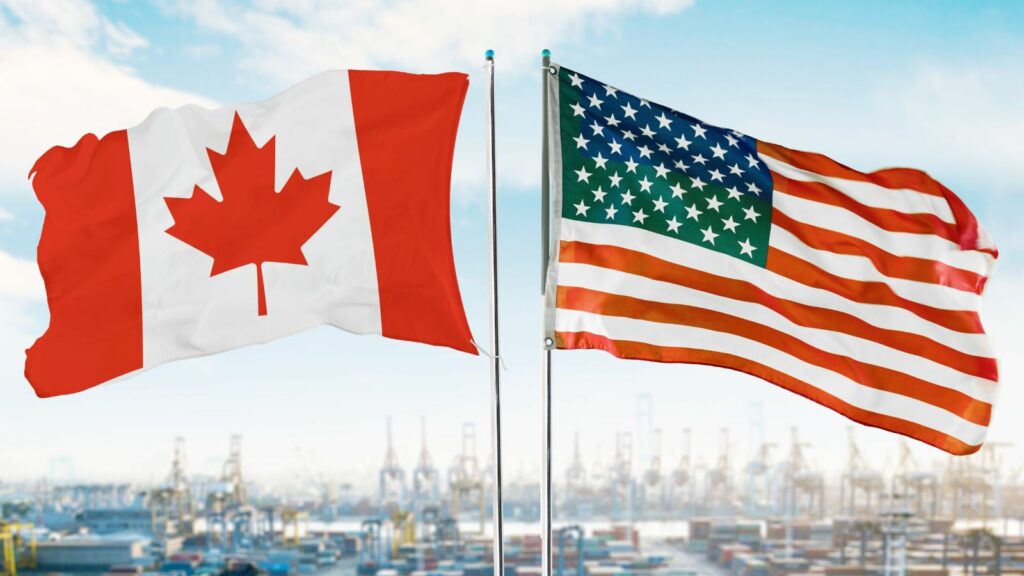
Twenty-five years ago, Canada’s response to the September 11 attacks became one of the defining demonstrations of friendship between the two countries. Thousands of stranded travellers were welcomed into Canadian communities, tens of thousands gathered in Ottawa to mourn, and Canadian forces later joined the U.S. and other allies in Afghanistan.
That history now sits beside a remarkably different reality. U.S. Consul General Baxter Hunt is recalling the compassion he witnessed after 9/11 just as tariffs, retaliatory measures, sovereignty disputes and increasingly hostile political rhetoric have driven Canada-U.S. relations to one of their lowest points in generations. The institutions connecting the countries remain formidable, but the contrast between the solidarity of 2001 and the confrontation of 2026 illustrates how dramatically the relationship has changed.
The Diplomat Still Remembers the Flowers
Baxter Hunt was working at the U.S. Embassy in Ottawa when the September 11 attacks occurred. Returning to work the next morning, he encountered what he described as a “mountain of flowers” outside the embassy. The gesture became one of his enduring memories of how Canadians responded to an American catastrophe. Three days after the attacks, an estimated 80,000 people packed Parliament Hill for Canada’s national day of mourning.
The symbolism mattered because Canada was grieving too. Twenty-four Canadians were among the nearly 3,000 people killed in New York, at the Pentagon and in Pennsylvania. Hunt, now the U.S. consul general in Toronto, has said the period reinforced his belief that Canadians and Americans functioned almost like an extended North American family. His recollections arrive at an awkward moment: the historical language is about neighbours standing together, while today’s political vocabulary revolves around tariffs, retaliation and sovereignty.
Gander Became the Clearest Symbol of Canadian Help
When U.S. airspace closed on September 11, Transport Canada helped redirect hundreds of aircraft carrying more than 33,000 passengers to Canadian airports. Gander, Newfoundland and Labrador, became the best-known destination. A community of roughly 10,000 people suddenly received 38 aircraft carrying more than 6,500 passengers and crew, an extraordinary logistical challenge for a town that had never expected such an influx.
Residents responded with food, beds, clothing, transportation and, in many cases, their own homes. Schools, churches and community centres became temporary accommodations. Some local bus drivers interrupted a labour dispute to help move stranded travellers. The relationships formed during those few days endured for decades and eventually inspired the musical “Come From Away.” Americans are returning to Gander for the 25th anniversary in 2026, making the commemoration especially poignant as the governments of the two countries fight over trade and the future of their economic partnership.
Canada’s Response Went Far Beyond Hospitality
The assistance after 9/11 was not limited to stranded airline passengers. NATO invoked Article 5 of the North Atlantic Treaty for the first and, so far, only time in its history, treating the attacks on the United States as an attack on the alliance. Canada subsequently became deeply involved in Afghanistan alongside American and allied forces as efforts shifted from counterterrorism toward combat, security, reconstruction and training operations.
More than 40,000 Canadian Armed Forces members served in Afghanistan and supporting locations between 2001 and 2014, Canada’s largest military deployment since the Second World War. The campaign also came at a considerable human cost. A total of 158 Canadian military personnel died, while many more returned with physical or psychological injuries. That history gives Hunt’s appeal to remember 9/11 solidarity added weight. Canada did not simply express sympathy for its neighbour; thousands of Canadians spent the next decade serving in a conflict born directly from those attacks.
A 25th Anniversary Arrives During a Trade War
The anniversary could hardly come at a more uncomfortable diplomatic moment. Canada-U.S. trade negotiations collapsed in August after Prime Minister Mark Carney said last-minute American demands were unfair, economically damaging and inconsistent with Canadian sovereignty. The United States subsequently moved ahead with tariffs reaching 50 per cent on targeted Canadian products, using authorities that include Section 338 of the Tariff Act of 1930.
Ottawa responded in kind. Beginning September 8, Canada is imposing counter-tariffs of 15, 25 and 50 per cent on $27.6 billion worth of American imports, matching affected U.S. measures dollar for dollar. The targeted categories include steel, dairy products, appliances, agricultural equipment, electronics, plastics and pulp and paper. Canada has also announced billions of dollars in assistance for businesses and workers affected by the dispute. The contrast with September 2001 is stark: cooperation once meant managing an emergency together; today, both governments are deliberately raising economic barriers against the other.
Tariffs Are Now Entangled With Questions of Sovereignty
Trade disputes between Canada and the United States are hardly new. Softwood lumber, agriculture, dairy and procurement rules have produced decades of arguments. What distinguishes the current confrontation is how closely commercial negotiations have become connected to sovereignty and political rhetoric. Carney has said Canada rejected terms that would have constrained its independence and has repeatedly argued that the country cannot accept an agreement at any price.
Trump’s broader treatment of Canada has intensified that anxiety. His recurring 51st-state rhetoric and the U.S. government’s move to rename Lake Ontario “Lake America” for American federal purposes transformed what could have remained a technical tariff dispute into something more emotionally charged. Carney has said the decades-long movement toward ever-deeper economic integration has ended and that Canada will not simply return to its previous relationship with Washington. That represents a fundamental shift: Canadian leaders are now openly planning for a future in which dependence on the U.S. must be reduced.
Economic Integration Makes Every Escalation More Painful
Untangling the relationship is easier to describe than accomplish. Statistics Canada reported that 71.7 per cent of Canadian merchandise exports still went to the United States in 2025, despite the share falling from 75.9 per cent a year earlier. U.S. Census Bureau figures show more than US$715 billion in two-way goods trade between the countries during 2025 alone.
Some industries are even more tightly connected. Canadian officials have noted that automobile components can cross the border repeatedly before a finished vehicle reaches a dealership. Canada sends roughly 90 per cent of its finished vehicle exports to the United States, making tariffs especially disruptive for Ontario manufacturing communities. This is why the present dispute is different from an ordinary disagreement between distant trading partners. Factories, transportation networks and supply chains were designed around predictable border access. When political relations deteriorate, businesses cannot simply reconstruct decades of continental integration overnight.
CUSMA No Longer Provides the Same Political Comfort
The Canada-U.S.-Mexico Agreement was supposed to provide businesses with predictable rules after replacing NAFTA in 2020. Trade among the three countries expanded substantially after the agreement entered into force, and Canadian government figures indicate Canada and the United States exchanged nearly $3.5 billion in goods and services every day in 2025. Yet CUSMA itself has now become another source of uncertainty.
At the mandatory July 1, 2026 joint review, the United States declined to approve a new 16-year extension of the agreement in its current form. That decision does not mean CUSMA has expired. The agreement remains legally in force until 2036, and its terms provide for annual reviews when all three governments have not agreed to extend it. Still, Washington’s refusal to renew it immediately removed an important psychological guarantee for companies making long-term investments. A trade agreement can establish rules, but it cannot by itself restore political trust between governments increasingly suspicious of each other’s intentions.
Security Cooperation Is Still Much Deeper Than the Political Feud
For all the hostility surrounding trade, Canada and the United States remain connected through security arrangements that are far harder to dismantle. NORAD, the binational command responsible for aerospace warning, aerospace control and maritime warning for North America, remains one of the most integrated defence relationships anywhere in the world. Roughly 1,000 Canadian Armed Forces personnel contribute to NORAD operations.
Canada is also in the middle of a $38.6-billion, 20-year modernization of its NORAD capabilities. Planned investments include new northern radar systems, communications networks, military infrastructure and weapons capable of responding to increasingly sophisticated aerospace threats. That machinery operates largely outside the daily political drama. The two militaries still have the same geography to defend, the same Arctic approaches to monitor and many of the same external threats to evaluate. It explains why the relationship can simultaneously experience a severe diplomatic crisis and retain an extraordinarily deep level of practical defence cooperation.
The Post-9/11 Border Was Built on Cooperation, Too
September 11 also transformed the physical border between Canada and the United States. In December 2001, the governments adopted the Smart Border Declaration and an action plan designed to improve security while keeping legitimate trade and travel moving. Information sharing, coordinated law enforcement, infrastructure investment and trusted-traveller and cargo programs became central parts of the post-9/11 border architecture.
The underlying idea was that economic security and national security did not have to compete. Canada and the United States could identify higher-risk traffic while moving lower-risk people and goods more efficiently. That principle helped support increasingly integrated supply chains during the decades that followed. The present tariff conflict therefore challenges more than commerce. It challenges an approach built after one of America’s darkest days: that both countries were generally safer and more prosperous when they solved continental problems together. The mechanisms remain, but the political assumptions that sustained them are under much greater stress.
Public Opinion Suggests the Relationship May Still Be Repairable
Government rhetoric does not necessarily reflect how Americans view Canada. A Reuters/Ipsos poll released September 1 found 57 per cent of U.S. adults opposed additional tariffs on Canada, while only 20 per cent supported them. Sixty-eight per cent said Washington should be willing to make trade-offs with Canada rather than insist on getting most of what it wants. Most respondents also opposed renaming Lake Ontario.
That divide between government policy and public sentiment matters as the 9/11 anniversary approaches. Americans who were stranded in Newfoundland are returning to commemorate the people who cared for them, while Gander is preparing events for passengers, crew members, first responders and residents. Hunt’s memories therefore carry a message larger than nostalgia. The alliance has suffered a significant loss of trust, and Canada is already restructuring parts of its economy around that reality. Yet military cooperation, personal relationships and public attitudes suggest that a political breaking point does not have to become a permanent separation.
