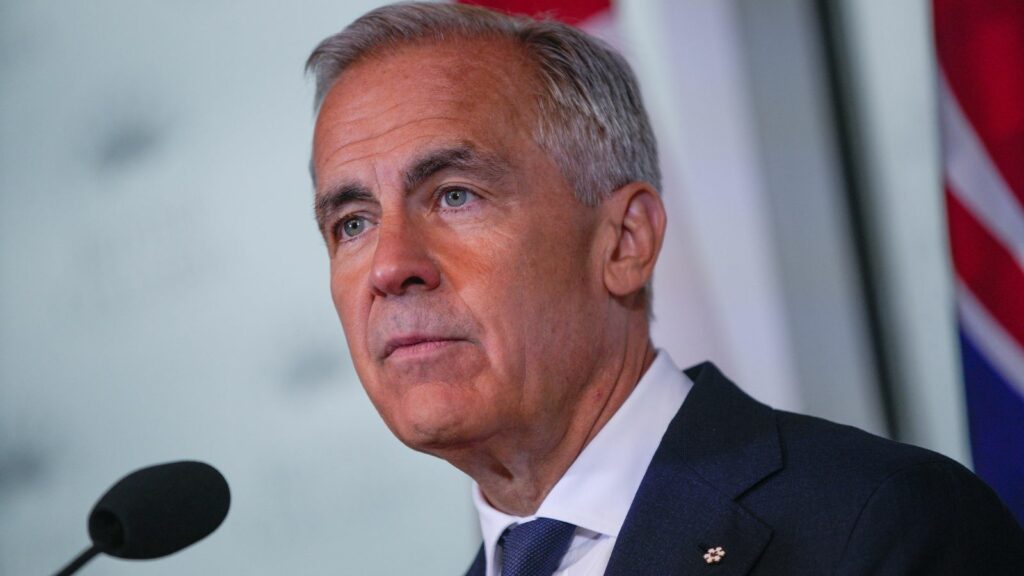
For generations, Canada’s economic geography has pointed south. The United States remains by far the country’s largest customer, connected to Canadian factories, energy producers, farms and service companies through supply chains that cannot simply be redirected overnight. But Prime Minister Mark Carney’s government is trying to change the balance.
The shift is already visible. Canada sent a smaller share of its exports to the United States in 2025, while shipments to other markets rose sharply. More recently, Ottawa has intensified economic ties with Europe and the Indo-Pacific while pushing new ports, trade corridors and internal-market reforms at home. The objective is not to eliminate Canada-U.S. trade. It is to make the Canadian economy less vulnerable when access to its biggest market becomes uncertain.
The 70% Figure Still Shows Just How Deep the Relationship Runs
The headline number is best understood as an approximation rather than a fixed percentage. Statistics Canada reported that 71.7% of Canadian merchandise exports went to the United States in 2025, down substantially from 75.9% in 2024. Global Affairs Canada, using a somewhat different trade-data basis, calculated that roughly 72% of Canadian goods exports and 67% of combined goods-and-services exports went to the U.S. in 2025. Either way, the conclusion is similar: roughly seven out of every 10 export dollars remain connected to the American market.
The concentration has nevertheless been declining. In July 2026, Canadian merchandise exports totalled $76.1 billion, with $50.5 billion going to the United States. That works out to about 66.3% for the month. Exports to non-U.S. destinations simultaneously climbed 7.4% to a record $25.6 billion and represented 33.7% of the monthly total. One month does not establish a permanent new trade pattern, particularly because commodity shipments such as oil and gold can make monthly data volatile. But the figures demonstrate that Canada’s export mix can move meaningfully when businesses have alternative buyers and transportation capacity available.
Canada Cannot Simply Replace the American Market
Canada’s reliance on the U.S. is not merely the result of government policy. Geography, infrastructure and decades of corporate investment have built a continental production system in which goods frequently cross the border before reaching consumers. Ottawa has estimated that roughly 70% of Canadian goods exported to the United States are used in producing other goods there. More than 35 major electricity transmission lines and approximately 70 oil and gas pipelines also cross the border, illustrating how physical infrastructure reinforces the economic relationship.
That integration is especially visible in automotive manufacturing, energy and agriculture. A Canadian component can enter a U.S. assembly plant as part of a larger North American manufacturing process rather than as a finished product seeking an unrelated overseas buyer. The American market is also unusually attractive to smaller Canadian exporters because it is close, enormous and comparatively familiar. Global Affairs Canada’s research notes that the U.S. is often the first foreign market Canadian small and medium-sized businesses enter. For a manufacturer in southern Ontario or an agricultural business on the Prairies, finding an equivalent customer thousands of kilometres away can require new shipping arrangements, financing, regulatory approvals and sales networks.
Diversification Is No Longer Just a Government Talking Point
The strongest evidence that Canada’s trade patterns are changing comes from actual exports outside the United States. Statistics Canada reported that non-U.S. merchandise exports rose 17.2% in 2025 even as exports to the U.S. fell 5.8%. Global Affairs Canada’s broader goods-and-services measure showed non-U.S. exports increasing 11.1%, or $33.3 billion, with their share of total Canadian exports reaching 32.8% — the highest level in more than four decades.
Those gains require some caution in interpretation. Gold exports contributed heavily to the increase, meaning the headline growth rate does not represent a uniform surge across every Canadian industry. Still, the direction continued into 2026. The Bank of Canada said non-energy exports jumped 14.5% in the second quarter and reached their highest level since early 2025. Governor Tiff Macklem said on September 21 that businesses were deliberately adjusting supply chains and broadening customer relationships to reduce tariff exposure. He also noted that more than two-thirds of Canadian exporters surveyed said they planned to expand into new markets during the next two years, with Europe and the Asia-Pacific among the destinations drawing attention.
Europe Has Become Central to Carney’s Strategy
Europe is emerging as one of the clearest alternatives for expanding Canadian trade without abandoning North America. The European Union was Canada’s second-largest global trading partner for goods and services in 2025. Canadian goods-and-services exports to the EU reached $67.7 billion that year, up 16.4%, while official Canadian figures put total two-way goods and services trade with the bloc at $178.6 billion. The relationship already rests on the Comprehensive Economic and Trade Agreement, but Ottawa and Brussels are now discussing cooperation that extends further into energy, defence, critical minerals, artificial intelligence, digital trade and financial services.
Carney’s September 2026 visit to Europe made that strategy unusually visible. He met European Commission President Ursula von der Leyen and proposed a more integrated Canada-EU relationship built around strategic capabilities rather than simply lower tariffs. European leaders have also discussed new forms of association with Canada, although their exact legal and institutional shape remains unsettled. That uncertainty is important: political declarations do not automatically translate into billions of dollars of new exports. Yet the economic base is substantial enough to matter. Canadian merchandise exports to the EU rose more than 23% in 2025, with gains in energy, aluminum, oilseeds and other products, giving exporters an existing commercial network on which to build.
The Pacific Is Showing Why Infrastructure Matters
Canada has spent years signing trade agreements with overseas economies, but trade deals have limited value when exporters cannot move products competitively to foreign customers. The Trans Mountain pipeline expansion provides a clear example of infrastructure changing the destination of Canadian exports. Statistics Canada reported that crude-oil exports to countries other than the United States surged 132.6% in 2025 to 27.2 million cubic metres. Non-U.S. destinations took 10.9% of Canadian crude exports, more than triple the average share recorded between 2016 and 2024.
The effect was particularly visible in Asia. Canada’s merchandise exports to the Indo-Pacific increased 6.4% to $83.4 billion in 2025. Crude-oil exports to China rose by $4 billion, or 165.1%, while Singapore also recorded a large increase partly tied to new oil shipments. Ottawa is trying to extend that diversification beyond commodities: Canada has pursued closer economic arrangements with India, Japan, Australia and the Philippines, while negotiations toward Canada-Philippines and Canada-ASEAN trade agreements have also been part of the government’s agenda. The challenge is turning diplomatic access into recurring business relationships across agriculture, technology, manufacturing and services rather than relying predominantly on additional resource exports.
Diversification Also Requires Rebuilding Canada’s Trade Plumbing
Selling more abroad means Canadian mines, factories, farms and energy projects need efficient routes to tidewater. Ottawa’s current economic strategy therefore connects trade diversification to ports, railways, highways and energy corridors. The Port of Vancouver illustrates the scale involved. The federal government says the port handles about 40% of Canada’s goods trade outside North America, facilitates roughly $350 billion in trade with 170 countries and accounts for about one-third of the country’s non-U.S. trade. A federal gateway strategy launched in 2026 is intended to increase capacity and reduce transportation bottlenecks.
A similar approach is being applied in eastern Canada. The planned Contrecœur terminal expansion is expected to increase the Port of Montréal’s capacity by approximately 60%, supported by new road, rail and marine infrastructure. Ottawa has paired these projects with efforts to make the Canadian domestic market function more smoothly. The Free Trade and Labour Mobility in Canada Act came into force in January 2026, creating a framework to recognize comparable provincial requirements in areas covered by federal rules. Removing internal barriers does not directly generate overseas customers, but a more integrated home market can help companies scale before competing internationally — one reason domestic reform and export diversification have become connected parts of the government’s economic program.
Services May Offer Canada a Faster Route to a Broader Customer Base
Canada’s trade debate often revolves around cars, oil, lumber, steel and agricultural products, but services are already considerably less dependent on the United States. Canadian services exports reached approximately $240 billion in 2025 and accounted for nearly one-quarter of total exports. Only about 53% went to the U.S., compared with roughly 72% of goods exports. India, the United Kingdom, China, France and a long list of smaller markets absorb much of the remainder.
That difference matters because services such as software, financial expertise, research, engineering and other digitally enabled work can sometimes reach foreign customers without the transportation infrastructure required for oil, automobiles or grain. Services exports have tripled since 2010 and, according to Global Affairs Canada, accounted for all of Canada’s roughly $50 billion increase in exports since 2022. Investment is another part of the picture. Foreign direct investment flowing into Canada reached $93 billion in 2025, the second-highest level recorded in the government’s series. Yet diversification remains incomplete even here: the United States provided 56.9% of those FDI inflows. A less concentrated Canadian economy therefore involves not only where goods are sold, but also where companies obtain capital and how Canadian expertise reaches global customers.
Less Dependent Does Not Mean Economically Divorced
There are practical limits to how rapidly Canada can redirect its economic relationships. Bank of Canada business surveys earlier in 2026 found that most exporters serving the United States had not shifted significantly toward non-U.S. customers. Businesses cited transportation expenses, foreign regulations and the cost of modifying specialized equipment among the barriers. The central bank has consistently described trade diversification as a gradual and potentially costly adjustment rather than a quick substitution of European or Asian buyers for American ones.
The latest evidence nevertheless suggests that adjustment is underway. On September 21, Macklem said exporters were increasingly looking beyond the U.S., generally by expanding existing overseas relationships before entering completely new markets. He also emphasized that Canada’s geography means the United States is likely to remain the country’s largest trading partner. That captures the economic choice more precisely than the language of separation. Canada’s strategy is not realistically about replacing the American economy. It is about reducing the consequences when one trading relationship dominates too much of the country’s prosperity. With roughly 70% of exports still tied to the U.S., even a relatively modest increase in Canada’s European, Asian and other international business could materially change how exposed Canadian workers and companies are to the next disruption across the border.
