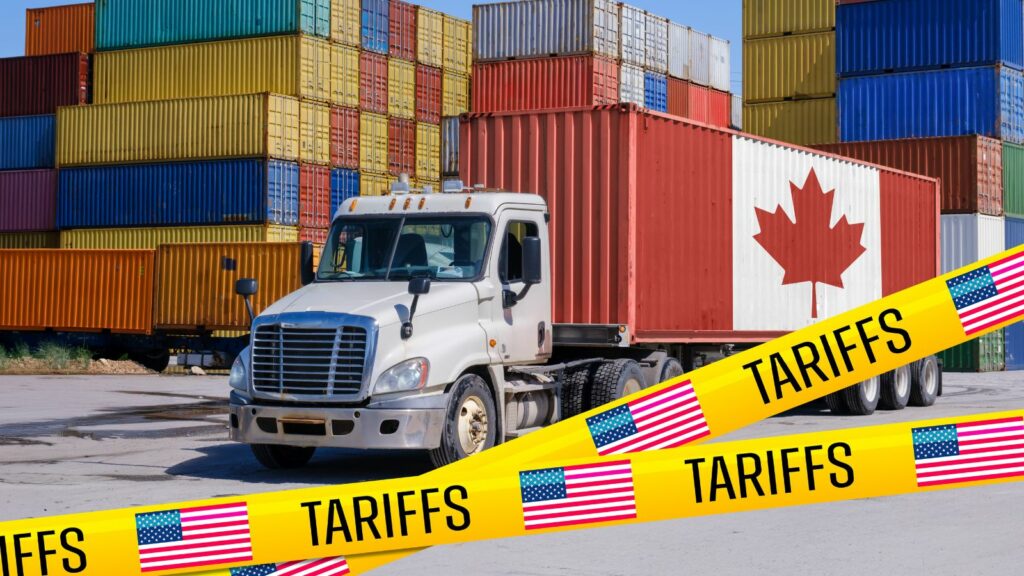
An equipment dealership in Iowa, Michigan or Wisconsin can feel far removed from a trade confrontation between Washington and Ottawa, but the border runs straight through its inventory, parts counter and customer base. That is the message Associated Equipment Distributors is taking to U.S. governors as it pushes for an end to escalating Canada-U.S. trade friction.
The industry group says tariffs and retaliation are adding costs to highly integrated equipment supply chains while creating uncertainty for dealerships, manufacturers, farmers and contractors. The stakes extend well beyond Canada: U.S. goods and services trade with its northern neighbour totalled an estimated $872.3 billion in 2025. AED’s warning is that prolonged disruption could eventually translate into delayed investment and pressure on American jobs.
Dealers Are Taking the Trade Fight to State Capitals
Associated Equipment Distributors escalated its lobbying effort in September by sending letters to governors in states with significant exposure to Canadian trade. President and CEO Brian McGuire asked state leaders to use their influence to help restore a stable, tariff-free commercial relationship between the two countries. The message was aimed particularly at places where agriculture, construction, forestry, mining, energy and manufacturing depend heavily on machinery sales and cross-border commerce.
The governors are not AED’s only audience. McGuire also travelled to Washington, where he met officials at the Canadian Embassy and senior lawmakers, including members of the House Ways and Means Committee’s trade subcommittee. Taken together, the effort shows how the dispute has moved from an abstract argument over trade policy into the everyday calculations of equipment businesses. For a dealership, uncertainty can mean deciding whether to order another excavator, stock an expensive replacement component or postpone hiring for a service department until customer demand becomes clearer.
Canada Is Too Important to Many States to Treat This as a Distant Dispute
Canada remains one of the United States’ largest commercial partners. U.S. Trade Representative data put total bilateral goods and services trade at an estimated $872.3 billion in 2025. American goods exports to Canada alone were worth $333.6 billion. Machinery is among the leading categories the United States sells north of the border, making the relationship particularly important to the businesses AED represents.
The dependence becomes even clearer at the state level. An analysis using U.S. Commerce Department TradeStats Express data found Canada was the leading export market for 27 states in 2025. Canadian customers accounted for about 41% of Maine’s exports, 39% of Michigan’s and 31% of Wisconsin’s. That helps explain AED’s strategy. The association is not asking governors to personally rewrite federal tariff schedules; it wants them to carry the economic concerns of local employers to Washington. When Canadian demand weakens, the consequences can show up at American loading docks, factories, dealerships and rural service centres long before they appear in national economic statistics.
The Machinery Supply Chain Rarely Stops at the Border
Heavy equipment is particularly vulnerable to trade friction because a machine is rarely the product of a single factory operating in isolation. AED says heavy machinery, agricultural equipment, industrial components and service parts can cross the Canada-U.S. border multiple times during production and distribution. A loader sold in Canada, for example, may contain globally sourced inputs assembled in the United States, while replacement components can move through American distribution centres before arriving at a Canadian dealership.
Separate testimony from the North American Equipment Dealers Association illustrates that integration. Appearing before a Canadian parliamentary committee in June, vice-president Nancy Malone said the organization represented about 1,000 farm, industrial and outdoor-power dealers operating approximately 2,500 locations in the United States and Canada. She told lawmakers that much of the large agricultural machinery Canadian dealers purchase is manufactured in the United States, while Canadian equipment manufacturers also rely heavily on American buyers. During planting, harvest or a major construction project, a tariff-related delay is not simply a paperwork problem; an unavailable component can leave a high-value machine sitting idle when it is needed most.
Retaliation Is Now Reaching Equipment and Machinery Categories
The latest Canadian countermeasures make the equipment industry’s concern more concrete. Effective September 8, Ottawa imposed tariffs of 15%, 25% and 50% on products covering C$27.6 billion of U.S. imports. Canada said the measures were designed to match U.S. tariffs imposed on an equivalent value of Canadian goods. Agricultural equipment was specifically identified as one of the sectors covered, alongside steel and aluminum, dairy, appliances, pulp and paper, plastics and electronics.
Canada’s tariff schedule reaches equipment categories that dealers can encounter in normal business. It lists a 25% tariff on tower cranes, 15% duties on certain forklifts and several machinery parts, and rates of 15% or 25% on several mower categories. Parts for certain harvesting and threshing machinery carry a 15% rate. The effect will not be identical for every dealer because tariff classification, product origin and exemptions matter. Still, the list demonstrates why distributors fear escalation. Retaliation no longer exists only at the level of speeches between governments; it can appear as an additional cost attached to a specific machine or replacement part crossing the border.
The American Jobs Warning Is Serious — but It Is Not a Job-Loss Forecast
AED’s most politically significant warning is that prolonged trade uncertainty could directly threaten local jobs. The association links that risk to weaker investment, higher equipment prices and pressure on the businesses that sell, rent, repair and manufacture machinery. What AED has not published, however, is a numerical estimate of how many American workers would lose their jobs because of the current Canada dispute. Its warning should therefore be understood as an industry risk assessment rather than a measured employment forecast.
That distinction matters because equipment dealerships already face significant workforce constraints. A September 2026 report from the AED Foundation estimated that agriculture and construction equipment dealers across North America face an annual shortage of roughly 10,000 diesel technicians, costing the industry about $7 billion a year in lost shop and parts revenue. Among dealers surveyed, 77% said the technician shortage hindered growth, 72% reported higher costs or operational inefficiencies and 80% said staffing shortages prevented them from meeting customer demand. A dealership already struggling to staff service bays has less room to absorb another shock from weaker sales, higher parts costs or delayed capital spending.
Previous Tariff Research Helps Explain the Industry’s Concern
There is economic evidence for the mechanism equipment dealers are worried about, although earlier tariff episodes should not be treated as a precise forecast of what will happen in the current Canada dispute. Federal Reserve researchers studying the 2018-19 tariff increases found that U.S. manufacturing industries more exposed to tariffs experienced relative reductions in employment. Their analysis concluded that benefits from protection against imports were outweighed in more exposed industries by higher input costs and the effects of foreign retaliation. Producer prices also rose as imported inputs became more expensive.
More recent research points in a similar direction on costs. A 2026 National Bureau of Economic Research analysis by Gita Gopinath and Brent Neiman examined the large U.S. tariff increases of 2025 and found that tariffs were passed through almost entirely to tariff-inclusive import prices in their estimates. Those findings do not establish that equipment jobs will disappear because of the Canada dispute. They do help explain why a dealer association can oppose tariffs even when tariffs are presented as a tool for strengthening domestic production: a company protected in one part of its business may simultaneously pay more for components, equipment or materials somewhere else in its supply chain.
USMCA Is Still Operating, but the Failed Renewal Raised the Stakes
The equipment industry’s appeal also reflects uncertainty surrounding the United States-Mexico-Canada Agreement. On July 1, U.S. Trade Representative Jamieson Greer announced that the United States had declined to renew USMCA in its current form during the agreement’s scheduled joint review. That did not terminate the trade pact. USTR explicitly stated that USMCA remains in force while the three governments continue dealing with the outstanding issues.
That distinction is especially important for companies that built their businesses around predictable North American commerce. AED argues that the agreement’s framework is essential to keeping operating costs down for dealers, manufacturers, farmers, contractors and builders. The dispute has therefore created an unusual situation: the underlying free-trade agreement continues to operate while governments layer additional tariff actions and other trade measures around portions of bilateral commerce. For a business planning a fleet order or a multi-year dealership expansion, the question is not merely what duty applies this week. It is whether the rules will remain stable enough to justify a major investment several years into the future.
Another September Deadline Could Keep Pressure on Both Governments
The dispute remained unresolved as of September 21. Ottawa’s C$27.6 billion package of counter-tariffs has been in effect since September 8, while the Trump administration has announced additional restrictions on selected Canadian products. U.S. proclamations issued September 8 call for import bans on certain Canadian products beginning September 29, including specified products in the motor-vehicle and alcoholic-beverage categories. USTR has also announced targeted restrictions involving dairy.
The two governments sharply disagree over how negotiations reached this point. USTR says Canada walked away from a near-final agreement and describes the new American measures as responses to Canadian discrimination and retaliation. Ottawa says the concessions Washington demanded were neither fair nor economically sound and says its countermeasures are a proportional response to U.S. tariffs. AED’s intervention adds another perspective: an American business constituency arguing that escalation itself carries domestic costs. For equipment dealers, the desired outcome is practical rather than diplomatic — predictable prices, dependable supply chains and enough certainty for businesses and customers to make long-term investments without having to guess what the next border charge will be.
