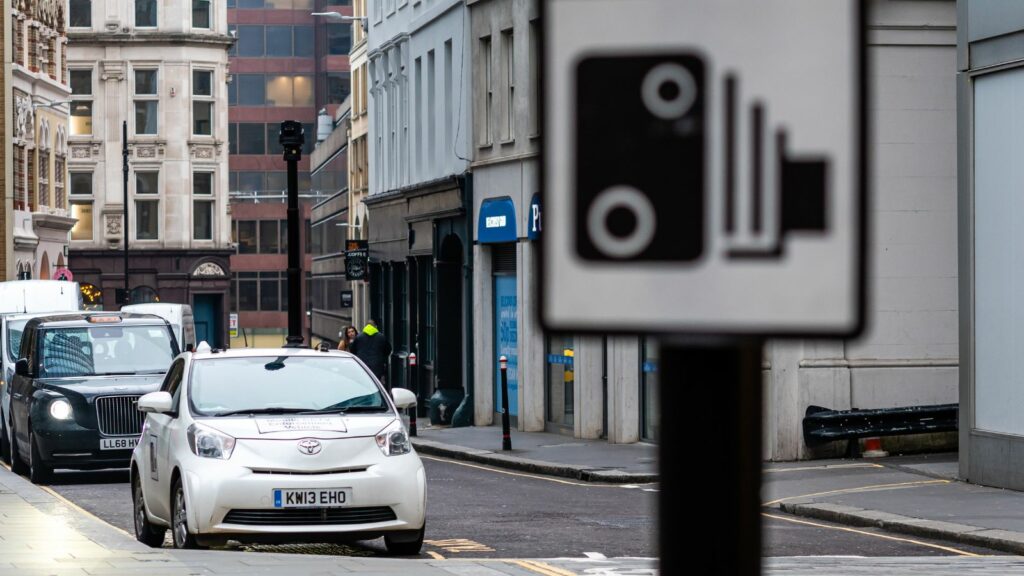
Toronto’s former speed-camera locations are telling a stark story. Roughly seven months after Ontario ended municipal automated speed enforcement, city staff found that the share of vehicles travelling at least 16 km/h over the limit had climbed by 380% across 104 monitored sites. The rise was especially concerning on 30 km/h neighbourhood roads, where children, pedestrians and cyclists are more likely to be present.
The finding does not mean every Toronto driver is travelling nearly four times faster. It means the most serious category of speeding became far more common after the cameras were switched off. The early data has reopened a political fight over whether road safety is better served by automated enforcement, permanent street redesign, police patrols—or a combination of all three.
What the 380% Figure Really Measures
The headline number comes from a comparison of vehicle behaviour while automated speed enforcement was operating and after the devices were removed. Across all 104 locations, 0.6% of vehicles had been recorded travelling at least 16 km/h above the posted limit during camera operation. After removal, that share rose to 2.9%. That is a 380% relative increase, rounded by city staff, even though the absolute change was 2.3 percentage points.
Less extreme speeding also rose sharply. The proportion of vehicles travelling one to 10 km/h over the limit increased from 18.4% to 35.7%, a 94% jump. Vehicles travelling 11 to 15 km/h over increased from 1.4% to 5.2%, up 270%. Together, the numbers show that the change was not confined to a small group of unusually aggressive motorists. Speeding became more common across every measured category, while the largest percentage increase appeared among drivers furthest above the limit.
Speeds Rose Almost Everywhere Staff Looked
The city’s analysis found higher operating speeds at 101 of the 104 former camera locations studied. Transportation staff focused on the 85th-percentile speed, a standard measure showing the speed at or below which 85% of vehicles travel. That figure increased by an average of 4.8 km/h after the cameras were deactivated. At a location designed for slow neighbourhood traffic, an extra four or five kilometres per hour can materially change how much time a driver has to react.
The comparison was built from short, three-day speed studies scheduled at 147 locations in fall 2025 or spring 2026. At the time of the report, 104 had been completed and validated. Staff also checked whether the short-term studies were reasonably comparable with data gathered by the cameras and estimated that the overall bias across multiple speed indicators was less than one kilometre per hour. The results are preliminary, but the pattern was widespread rather than driven by only a few outliers.
Neighbourhood Streets Took the Sharpest Hit
Some of the most troubling changes appeared on 30 km/h roads, the streets most likely to run through residential areas, school zones and places where people cross on foot. At 13 such locations, the share of vehicles travelling at least 16 km/h over the limit rose from 1.4% during camera operation to 7.2% after removal—a 410% increase. Even lower-level speeding became routine: 51.8% of vehicles were travelling one to 10 km/h over, compared with 32.7% before.
Higher-speed roads also recorded steep increases. At the 38 studied locations posted at 50 km/h or more, the share of vehicles travelling at least 16 km/h over the limit rose from 0.5% to 2.9%, a 480% increase. The city nevertheless found that the overall rise in speeding was generally more prominent on 30 km/h streets. For families walking to school, the concern is less about abstract percentages than the growing frequency of vehicles entering child-heavy spaces at speeds those streets were designed to discourage.
Why a Few Extra Kilometres Matter
Speed changes both the chance of avoiding a collision and the damage caused when one occurs. A faster vehicle travels farther while a driver notices danger, decides how to respond and begins braking. It also needs more distance to stop. Toronto transportation staff note that higher speeds are especially consequential for pedestrians, cyclists and motorcyclists because they do not have the protection available to people inside a vehicle.
International evidence shows why modest increases deserve attention. The World Health Organization reports that every 1% increase in mean speed is associated with about a 4% increase in fatal-crash risk and a 3% increase in serious-crash risk. It also estimates that a pedestrian’s risk of death is 4.5 times higher when struck at 65 km/h rather than 50 km/h. Those figures do not predict the outcome of any individual Toronto collision, but they explain why road-safety planners treat average speed as a central measure rather than a minor traffic statistic.
The Cameras Had Already Shown a Measurable Effect
Before the provincial ban, Toronto’s camera program had been examined in a SickKids- and Toronto Metropolitan University-led study covering 250 school zones between July 2020 and December 2022. Researchers found that the proportion of speeding vehicles fell by 45% when cameras were operating. The 85th-percentile speed dropped by 10.7 km/h, while the number of vehicles travelling more than 20 km/h over the limit fell by about 88%.
The research was especially relevant because it measured speeds before, during and after cameras were placed at the sites. Once cameras were removed, speeding rates returned to earlier levels. The study period overlapped with pandemic-related traffic disruptions, which the researchers acknowledged, but they reported that the range of conditions captured still pointed strongly to the cameras as the main cause of the change. Importantly, the study measured vehicle speeds rather than injuries. It supports the claim that cameras changed driving behaviour, but it does not by itself prove how many collisions or deaths they prevented.
Why Ford’s Government Banned Them Anyway
The Ford government framed automated speed enforcement as a fairness and accountability problem. Provincial officials repeatedly argued that some municipalities were using cameras as a “cash grab” rather than a safety tool. Under Toronto’s former system, the registered owner received the penalty regardless of who was driving. The violation did not add demerit points or affect the owner’s driving record, a structure critics said punished a licence plate without directly holding the driver accountable.
Bill 56 repealed the part of Ontario’s Highway Traffic Act that authorized municipal automated speed enforcement, ending the programs on November 14, 2025. The province’s position is that measures such as speed humps, raised crossings, curb extensions, roundabouts, signs and police enforcement reduce or deter speeding in real time, rather than mailing a penalty after the event. Supporters of cameras counter that automated enforcement can operate continuously and at many more locations than police officers can cover. The disagreement is therefore partly about effectiveness and partly about what kind of enforcement the public considers legitimate.
The Alternatives Are Slower and More Expensive to Scale
Ontario created a $210-million Road Safety Initiatives Fund to help municipalities replace cameras with physical traffic-calming and enforcement measures. The province says Toronto received more than $10 million in an initial allocation and can seek additional funding. Toronto staff, however, estimate that installing speed humps or cushions on all eligible local and collector roads within school zones would cost roughly $52 million and take about 13 years, even with a moderate increase in annual construction capacity.
The physical limits are just as important as the price. Toronto identified about 612 kilometres of local roads and 163 kilometres of collector roads in school zones that could potentially receive humps or cushions. Another 244 kilometres are arterial roads, where that form of traffic calming is generally not considered suitable. Roundabouts can slow vehicles, but neighbourhood versions typically cost $50,000 to $150,000 each, while larger single-lane designs can reach $750,000 to $3 million. Permanent street design can be highly effective, but it cannot be deployed as quickly or flexibly as a rotating camera.
Fatal Collisions Raise Concern but Do Not Yet Prove Causation
Toronto recorded 25 fatal collisions between December 1, 2025, and May 31, 2026, the first six-month period after the camera program ended. Two occurred within 100 metres of former automated-enforcement locations. That proximity is concerning, but it does not establish that the absence of a camera caused either collision. A camera may influence speed at a site, yet fatal crashes are also shaped by traffic volume, weather, road design, impairment, distraction and many other factors.
The longer comparison reinforces the need for caution. During the same December-to-May window, Toronto recorded 25 fatal collisions in 2021–22, 16 in 2022–23, 21 in 2023–24 and 17 in 2024–25. The latest total is at the top of that range, but not outside it. City staff said fatal collisions are relatively infrequent and fluctuate enough that a longer period is needed to identify a reliable trend. Serious-injury data is also incomplete because many records are not finalized until about six months after a collision. The speed increase is clear; the long-term injury impact remains under study.
Toronto and Queen’s Park Are Now in a Policy Standoff
Mayor Olivia Chow has called for automated speed cameras to return to school and community safety zones, describing the new speeding figures as horrifying. Ontario Transportation Minister Prabmeet Sarkaria has defended the ban and urged Toronto to move faster on physical infrastructure such as speed humps. Because the authority to operate the cameras was removed from provincial law, Toronto cannot simply switch its former network back on, even though the city had expanded it to 150 devices before the ban.
That leaves residents between two governments promoting different safety strategies. Toronto is continuing to monitor speeds, collisions and injuries, and staff plan to share data with academic researchers for longer-term analysis. Physical traffic calming, better crossings, police enforcement, lower limits and street redesign all remain available, but each has cost, staffing or design constraints. The strongest lesson from the first post-camera data may be that no single tool is sufficient. The debate now is whether Ontario will reconsider automated enforcement as one part of a broader system—or require municipalities to manage the surge without it.
