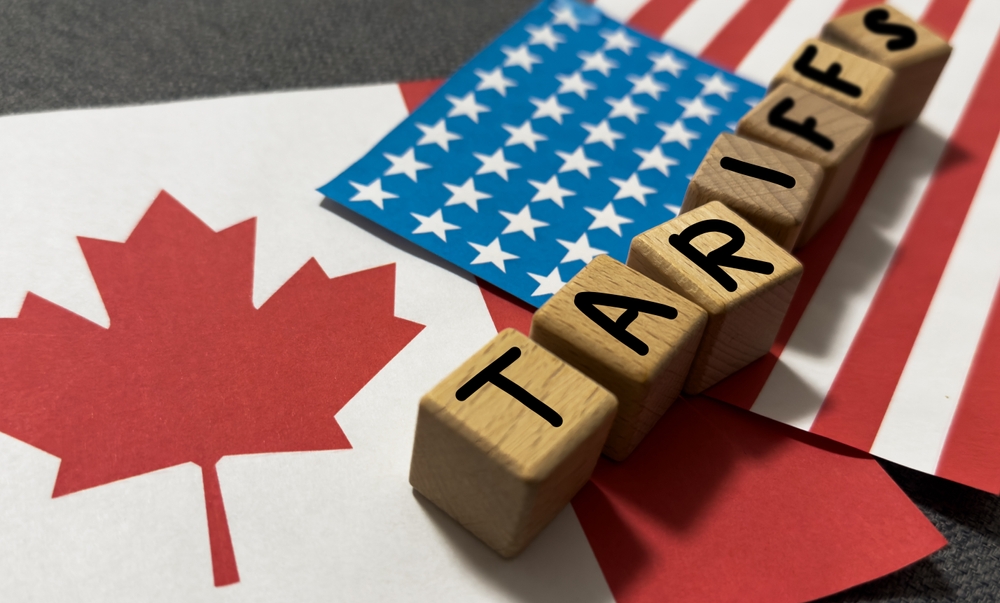
One of the central promises of CUSMA—that qualifying North American goods receive preferential access across the continent—is about to face a sharp new test. Unless Washington changes course, President Donald Trump’s additional 50% duties are scheduled to take effect on August 19, targeting nearly US$20 billion worth of Canadian imports. The measure is narrower than an across-the-board tariff, covering roughly 5.2% of the goods the United States imported from Canada in 2025. Yet its significance goes well beyond the dollar figure. Unlike many earlier U.S. tariff actions, these duties are explicitly designed to reach covered goods even when they meet CUSMA rules of origin. For manufacturers that spent years building supply chains around tariff-free North American trade, that distinction could turn a familiar border into a much more expensive one almost overnight.
A US$20 Billion Target With an Unusually Wide Reach
The list of products caught in the new tariff regime stretches well beyond the politically sensitive industries at the centre of the dispute. U.S. officials say the additional 50% duties will cover products ranging from Canadian wine and dairy goods to furniture, cement, clothing, fishing rods and hockey equipment. Reuters calculated that the nearly US$20 billion targeted represents about 5.2% of the US$383 billion in goods the United States imported from Canada during 2025.
That makes the measure relatively contained compared with a universal tariff, but potentially severe for companies concentrated in the affected categories. A custom cabinet manufacturer selling heavily into the American renovation market, for example, could suddenly be competing against U.S.-made products with a substantial price disadvantage. The White House has carved out major exemptions, including energy, potash and goods already subject to Section 232 tariffs, along with certain fish and critical-mineral products. The result is not a blanket wall against Canadian trade, but a highly targeted one capable of hitting particular industries hard.
CUSMA Compliance Would No Longer Guarantee Protection
For Canadian exporters, the most consequential part of the plan may be buried in how the tariff is applied. The White House says the new Section 338 duties will apply to covered goods regardless of whether they qualify as originating products under CUSMA. That removes a protection many Canadian businesses have relied upon while navigating successive rounds of U.S. tariffs. Until now, proving that a product satisfied the trade agreement’s rules of origin could often determine whether it crossed the border with preferential treatment.
That certification process can involve documenting where materials were sourced, how goods were manufactured and whether enough North American content exists to meet CUSMA requirements. Businesses have invested time and money structuring supply chains around those rules. For affected tariff lines, compliance would no longer prevent the new 50% charge. Trump is using Section 338 of the Tariff Act of 1930, which permits duties of up to 50% when a president determines another country has discriminated against American commerce. It is an unusually powerful tool because it targets the alleged discrimination rather than simply withdrawing normal trade preferences.
Washington Says Cars, Alcohol and Dairy Triggered the Fight
The Trump administration has organized its case around three longstanding or recently intensified disputes: automobiles, alcohol and dairy. On vehicles, Washington argues Canadian measures have unfairly restricted American exports and encouraged U.S. automakers to maintain production north of the border. White House figures show Canadian imports of U.S. motor vehicles fell by about 22%, or US$5.6 billion, between April 2025 and March 2026 compared with the equivalent previous period.
Alcohol became another flashpoint after Canadian provinces pulled American products from shelves in response to earlier U.S. tariffs. The White House says imports of U.S. alcoholic beverages dropped approximately 81%, or US$582 million, between March 2025 and February 2026. Dairy remains particularly contentious because Washington argues Canada gives U.S. cheese exporters less favourable access to tariff-rate quotas than some European suppliers receive under Canada’s trade agreement with the EU. Ottawa rejects Washington’s broader characterization of the dispute. Prime Minister Mark Carney has argued that earlier American tariffs violated CUSMA and that Canada’s auto measures were retaliatory responses rather than the original provocation.
Small Exporters Could Feel the Shock First
The national trade numbers can make US$20 billion look manageable. For a business that earns half its revenue from American customers, however, the calculation is entirely different. Research released by the Canadian Federation of Independent Business in August found that two in five Canadian exporters to the United States participating in its polling said they sold products potentially affected by the proposed tariffs. Among affected firms, 77% expected revenues to decline if the tariffs took effect, while 35% anticipated losing at least half their revenue.
The affected businesses are not confined to one industrial cluster. CFIB identified machinery and equipment, forestry and building products, plastics and packaging, food and beverages, and creative products among the prominent categories. The group highlighted the contrasting examples of a small Ontario art studio shipping paintings to New York and a British Columbia sawmill supplying panels to a Seattle builder. Both illustrate the same vulnerability: smaller firms rarely have enough margin to absorb a 50% border charge. Passing it entirely to an American customer can be equally difficult when a domestic competitor is available without the added tariff.
Companies Aren’t Necessarily Racing Goods Across the Border
Past tariff deadlines have occasionally produced a rush of trucks and containers as businesses tried to move inventory into the United States before higher duties took effect. This time, the response has been noticeably more restrained. Canadian customs and transportation executives have described companies as engaging in “watchful waiting,” assessing tariff classifications and financial exposure rather than universally accelerating shipments. TFI International chief executive Alain Bédard said his trucking company had not seen the exceptional pre-buying or pre-shipping activity that occurred ahead of earlier tariff changes.
There are exceptions. A Vancouver customs broker told The Canadian Press that roughly one-fifth of his clients were trying to move cargo ahead of the August 19 deadline. The rest were largely waiting to see whether negotiations changed the outcome. Customs specialists have meanwhile been reviewing product codes and supply chains to determine which shipments are exposed. The irony is difficult to miss: some companies only recently completed the work needed to certify their products under CUSMA, only to discover that qualification may offer no protection from this particular tariff.
The National Number Looks Small—Until It Hits a Trade-Dependent Town
At approximately 5.2% of U.S. goods imports from Canada, the threatened tariffs do not cover most bilateral commerce. That distinction matters when assessing the national economic impact. Canada still ships hundreds of billions of dollars in products south every year, and major categories are outside the new Section 338 action. University of Toronto economist Joseph Steinberg told Reuters that the direct macroeconomic impact could therefore be limited compared with the broader risks surrounding the Canada-U.S. trading relationship.
Geography tells a different story. Statistics Canada reported that 71.7% of Canadian merchandise exports went to the United States in 2025, down from 75.9% a year earlier but still demonstrating how deeply Canadian producers depend on American demand. A tariff covering a small share of national exports can therefore be devastating when it is concentrated in one company, plant or community. A Quebec cabinet producer, Ontario manufacturer or British Columbia wood-products firm does not experience the tariff as 5.2% of national trade. If most of its American orders become uneconomic, the relevant number can quickly approach 100% of its U.S. business.
August 19 Has Become a High-Stakes Negotiating Deadline
With the tariff deadline approaching, Canadian officials have been spending increasing amounts of time in Washington. Trade Minister Dominic LeBlanc and chief trade negotiator Janice Charette remained engaged with their American counterparts through the weekend before the deadline. Reuters reported on August 17 that Canada and the United States were still far from a draft agreement despite frequent discussions. LeBlanc had met U.S. Trade Representative Jamieson Greer five times in four weeks, including virtually on August 16.
The dispute is larger than this one tariff package. Washington continues to press Canada on dairy access, provincial treatment of American alcohol and automotive measures. Ottawa, meanwhile, has been seeking relief from existing U.S. tariffs affecting sectors including Canadian steel and aluminum. That has turned the August 19 implementation date into leverage for both sides. A late compromise could still change the outcome, but no agreement had been announced as negotiations continued on August 17. For exposed businesses, that leaves an uncomfortable choice between preparing for a 50% tariff and betting that political negotiations make those preparations unnecessary.
The Bigger Question Is What This Means for CUSMA
The fight is unfolding at an especially sensitive moment for North American trade. At the formal CUSMA joint review on July 1, the United States declined to extend the agreement in its current form for another 16 years. That does not mean CUSMA has disappeared. The Canadian government says the agreement remains fully in force until 2036, and the three countries can still agree at a later review to extend it for another 16-year period. Without consensus, however, joint reviews can occur annually until an extension is reached or the agreement ultimately expires.
That distinction makes tariffs on CUSMA-compliant goods particularly important. CUSMA was built not only to lower tariffs but to give businesses predictable rules for deciding where to build factories, source inputs and sell finished products. The Section 338 action does not abolish those rules, and most Canadian trade remains outside this specific 50% measure. But it demonstrates that compliance with the agreement does not necessarily insulate a product from every new U.S. trade action. For Canadian exporters, the immediate question is whether the August 19 tariffs survive negotiations. The longer-lasting question is whether tariff-free access can still be treated as a dependable foundation for North American business planning.
