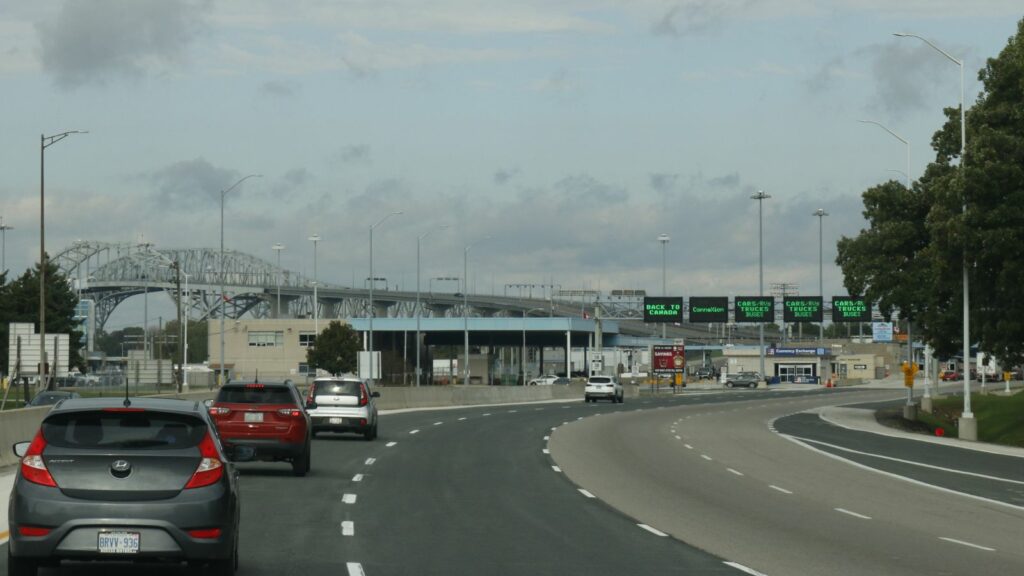
For generations, a weekend in New York, a winter escape to Florida or a road trip through Vermont barely felt like international travel for many Canadians. That familiarity has been shaken by the political and trade confrontation between Ottawa and Washington.
Canadian-resident return border crossings from the United States fell 25.4% in 2025 compared with 2024, Statistics Canada found, an unusually deep pullback outside the pandemic era. Some traffic has begun recovering in 2026, but it remains far below 2024 levels. The economic consequences are now visible south of the border. Tourism organizations and businesses from New York to Las Vegas are responding with discounts, Canadian-dollar promotions and unusually direct messages of welcome, creating a striking contrast between worsening relations at the federal level and local efforts to bring Canadian visitors back.
The 25% Drop Is Bigger Than a Normal Travel Slump
The scale of the change becomes clearer when compared with what came before it. Canadian residents recorded roughly 39 million return border crossings from the United States in 2024, accounting for about three-quarters of their return crossings from foreign destinations. In 2025, the U.S. total fell 25.4%. Statistics Canada said the decline intensified through the first half of the year, with volumes nearly one-third lower year over year at the summer low point. By late 2025, crossings had stabilized, but at levels roughly one-quarter below those of 2024.
What made the decline especially notable was its persistence. Excluding the COVID-19 period, Statistics Canada described the 11-month run of year-over-year declines as the deepest and most sustained in its digital border-crossing records, which date to 1972. Declines exceeding 30% had otherwise appeared only in September 2001 following the 9/11 attacks. That comparison does not make the events equivalent, but it illustrates just how unusual the tourism pullback became. This was not simply a weak vacation season or a temporary exchange-rate wobble.
New York Is Trying to Buy Back Canadian Goodwill
Few places have responded as visibly as New York. New York City Tourism + Conventions launched its “Northern Neighbour Deal,” giving Canadian visitors 30% off at more than 85 participating hotels, Broadway productions, attractions, restaurants, museums and other businesses for eligible travel from August 18 through September 7. Porter Airlines also joined the initiative with a separate promotion offering up to 20% off qualifying New York itineraries booked during its promotional window. The city explicitly said the discounts were intended partly to soften the impact of the currency exchange rate.
There is a strong financial reason for the outreach. Canada remains New York City’s second-largest international visitor market, with more than 800,000 Canadian arrivals expected in 2026. City tourism officials said Canadian visitors spent more than $1 billion in New York City in 2024. Beyond the five boroughs, New York State is running a broader “New York Loves Canada” effort featuring special offers on accommodations, restaurants, attractions and outdoor activities. In practical terms, a Canadian family reconsidering a Manhattan weekend is now being courted not merely with advertising, but with discounts substantial enough to alter the cost of the trip.
Vermont Is Making the Message Personal
Vermont’s response has taken a particularly neighbourly tone. Its tourism campaign, “100% Love for Canada,” acknowledges the uncomfortable political environment while stressing the state’s longstanding connections with communities north of the border. Vermont Tourism maintains a dedicated collection of Canadian offers and describes the state as ready to welcome Canadians when they feel comfortable returning. That approach makes sense for a state whose northern communities, ski areas and small businesses have traditionally been closely connected with Quebec and other Canadian markets.
Some individual operators have gone further than conventional percentage discounts. Jay Peak Resort maintains an at-par policy for Canadian residents on qualifying products purchased under specified conditions, including lift tickets, waterpark admission, golf, tram rides and other activities. Killington has advertised Canadian-specific savings including 25% off online pricing for certain lift tickets, rentals and tubing, plus discounts on lessons. These promotions turn an abstract diplomatic dispute into something much more local: empty restaurant tables, fewer ski customers and quieter shops in communities where Canadian licence plates have long been a familiar sight.
Las Vegas Is Attacking the Exchange Rate Directly
Las Vegas has taken one of the most aggressive approaches to the affordability problem. The “Vegas At Par” program at Circa Resort & Casino, The D Las Vegas and Golden Gate Hotel & Casino treats one Canadian dollar as one U.S. dollar for selected spending through August 31. Eligible Canadian guests can receive the at-par treatment on participating hotel rates, selected bar purchases and as much as C$500 in promotional slot play. Valid Canadian identification is required, and restrictions differ depending on the purchase.
The strategy goes directly after one of the biggest practical deterrents facing Canadians even before politics enters the calculation: conversion costs. A room advertised at US$200 normally becomes substantially more expensive in Canadian dollars before taxes and fees are considered. An at-par offer changes that calculation immediately. Las Vegas has broader reasons to experiment with aggressive promotions as well. The Las Vegas Convention and Visitors Authority reported 38.5 million visitors in 2025, down 7.5% from 2024, while Forbes reported that Canadian visitation specifically fell about 17%. In a destination built around filling enormous hotel, restaurant and entertainment capacity, losing hundreds of thousands of repeat visitors is difficult to ignore.
Myrtle Beach and Graceland Are Offering Canadians Deep Savings
The push is not limited to border states or major financial centres. Myrtle Beach, South Carolina, has multiple accommodation promotions aimed specifically at Canadians, with participating resorts advertising savings of up to 50% for qualifying stays of seven nights or longer. Several offers run through December 31, 2026 and require Canadian identification. For snowbirds or families accustomed to extended coastal stays, the difference can represent hundreds or even thousands of dollars rather than a token incentive.
Graceland in Memphis is making a similar appeal to a very different type of traveller. Canadian residents can receive 25% savings on eligible Ultimate VIP tour options or a package combining Graceland experiences with a two-night stay at The Guest House at Graceland. The current offer extends to qualifying dates through the end of 2026 and requires advance booking and proof of Canadian residency. The promotion is especially notable because Graceland highlights a historic connection: Canada was the only country outside the United States where Elvis Presley performed live. It is a reminder that tourism marketers are increasingly leaning on cultural relationships as well as price.
Billions of Dollars Are at Stake for the U.S. Visitor Economy
Before the downturn, Canadians were not a niche international market. The U.S. Travel Association estimated that Canada generated 20.4 million visits to the United States in 2024, producing US$20.5 billion in visitor spending and supporting approximately 140,000 American jobs. When trade tensions first intensified, the organization calculated that even a 10% reduction in Canadian travel could mean about two million fewer visits, US$2.1 billion less spending and roughly 14,000 fewer supported jobs.
The actual retreat ultimately became much larger than that 10% scenario. Statistics Canada, using its own Canadian travel-spending methodology, found expenditures during Canadian visits to the United States declined by C$3.3 billion in 2025, reaching C$18.8 billion. Leisure spending accounted for most of that fall, dropping C$2.2 billion to C$12.1 billion. That matters because tourism money spreads rapidly through local economies. A cancelled road trip affects more than a hotel: fuel stations, restaurants, attractions, retailers, parking operators and entertainment workers all lose potential spending. The growing collection of Canadian-only promotions is therefore less surprising when viewed as an effort to protect an unusually valuable customer base.
Canadians Did Not Stop Travelling — They Changed Destinations
One of the most important findings in the Canadian data is that the decline in U.S. travel was not simply the result of Canadians abandoning vacations. National Travel Survey figures show U.S. visits fell by about 7.1 million, or 23.5%, in 2025 compared with 2024. Yet that loss was almost entirely offset by roughly five million additional domestic visits and 1.3 million more visits to overseas destinations. Europe recorded a 13.6% increase in Canadian visits, while visits to Asia climbed 16.7%.
Spending moved with those travellers. Domestic tourism expenditures increased 8.7% to C$81.3 billion in 2025. Canadian leisure spending on overseas trips rose by C$3.6 billion to C$22.8 billion, while leisure-related visits to the United States fell 21.5%. The substitution is significant because holiday travel is more flexible than trips made to see relatives. Canadians with family in Michigan or New York may still cross the border, while someone choosing between California, France and British Columbia can redirect a vacation much more easily. Once travellers discover alternatives and build new routines around them, winning those trips back can become harder than simply waiting for political tensions to fade.
The 2026 Recovery Comes With a Big Base-Effect Warning
Recent numbers initially look encouraging for U.S. destinations. In June 2026, Canadian-resident return trips from the United States increased 5% from the deeply depressed level recorded a year earlier. July’s preliminary air-and-automobile count rose 10.2% year over year, marking a fourth consecutive month of increases. Automobile crossings in July were up 12.8% compared with July 2025, suggesting at least some Canadians are again willing to make shorter cross-border trips.
The problem is the comparison point. June 2026 remained 24.6% below June 2024. In July, automobile returns were still 28.9% below the July 2024 level, while air returns were 26.8% lower. The first quarter of 2026 told a similar story: Canadians made 5.5 million trips involving a U.S. visit, 10.6% fewer than a year earlier, and spending on those visits fell 13.6% to C$5 billion. In other words, improving against a very weak 2025 does not mean the market has returned to normal. The gap that U.S. tourism operators are trying to close remains enormous.
Discounts Can Fix the Price — but Politics Is Harder to Discount
The latest sentiment data illustrates the challenge. A July 2026 Longwoods International study of 1,000 Canadian adults found that 49% intended to visit the United States during the next 12 months, an improvement from 43% in April. Yet 56% said U.S. government policies, trade practices and political statements made them less likely to visit. Meanwhile, 51% had neither travelled to the United States during the previous six months nor planned to do so, although that was an improvement from 60% a year earlier.
The political environment has also become more volatile since that study was conducted. In late August, President Donald Trump imposed new 50% tariffs on roughly US$20 billion of Canadian imports after bilateral negotiations collapsed, while Canada announced retaliatory measures covering a similar value of U.S. goods. An April forecast from the U.S. National Travel and Tourism Office had projected Canadian arrivals would grow 3.8% in 2026, from about 16 million to 16.6 million. That forecast preceded the latest escalation. New York can discount a Broadway ticket, Vegas can neutralize part of the currency gap and Vermont can emphasize neighbourly ties. Whether those incentives can overcome a political dispute that has already changed millions of travel decisions is a much bigger test.
