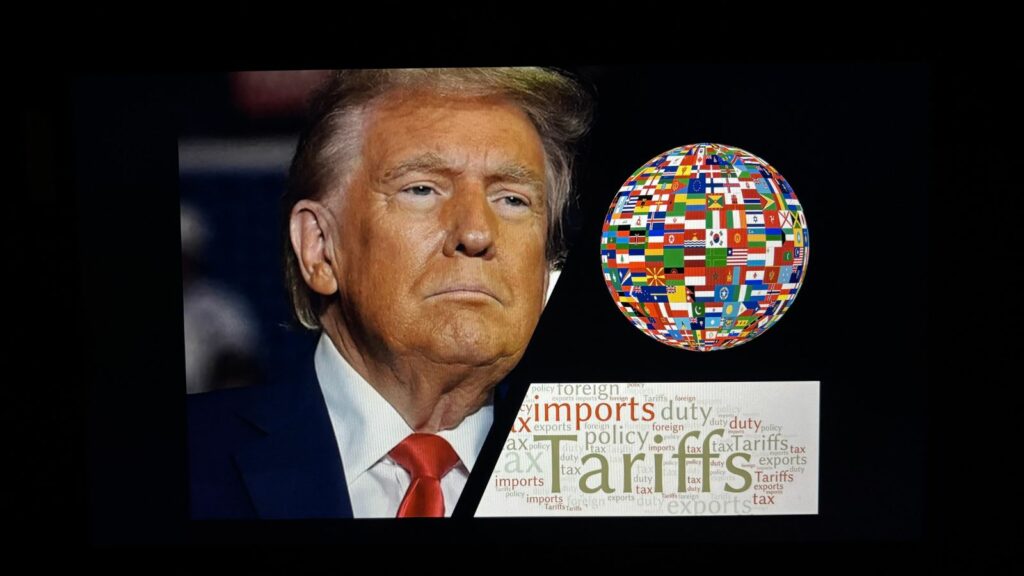
The U.S.-Canada trade fight has moved from negotiating rooms into the heart of the 2026 midterm campaign. President Donald Trump’s latest 50% duties on selected Canadian goods took effect August 22 after talks collapsed, and Ottawa is preparing matching counter-tariffs for September 8. That timing matters: Americans vote November 3, and several Senate races most likely to determine control of the chamber are in states tied closely to Canadian trade.
For Republicans, the danger is less about abstract trade theory than local prices, jobs and supply chains. Maine, Michigan, Ohio, Alaska and New Hampshire all have competitive Senate contests, while other northern states depend heavily on Canada as an export market. The result is an uncomfortable political split: Trump is defending tariffs as leverage, but some Republicans closest to the border are warning that the costs may land at home before any deal arrives.
A Trade Fight Arrives at the Worst Possible Time
Trump’s new Section 338 tariffs took effect on August 22 after a three-day delay intended to give negotiators more time. Canada says the U.S. measures cover C$27.6 billion of Canadian goods and include duties as high as 50%. Ottawa responded with plans to match them dollar for dollar, imposing tariffs of 15%, 25% and 50% on a similarly valued basket of U.S. products beginning September 8.
That leaves about eight weeks between Canada’s retaliation and the November 3 midterms. Every House seat is on the ballot, while Senate control depends on a small group of competitive races. Reuters reported September 7 that Democrats need three net House seats to take the chamber and four Republican-held Senate seats to win the Senate. Tariffs are landing during a campaign already dominated by affordability, giving Democrats an argument that trade policy is raising costs while Republicans defend narrow majorities.
Maine Makes the Political Risk Easy to See
Few Republicans have been as explicit as Maine Senator Susan Collins. After talks failed, Collins called new tariffs on Canada a mistake and warned that Maine products such as blueberries, potatoes, lobster and lumber routinely cross the border for processing. Her office says Maine imports about $2 billion in non-petroleum goods from Canada, meaning even targeted duties can reach ordinary business operations.
The broader numbers explain her urgency. U.S. Trade Representative data show Canada bought about $1.3 billion of Maine goods in 2025, roughly 41% of the state’s exports. Collins is seeking a sixth Senate term in one of the country’s most competitive races, and Reuters reporting has shown Democrat Troy Jackson narrowly ahead in polling. When Canada later removed seafood from its planned retaliation list, Collins welcomed the move and again urged Washington to return to negotiations. In Maine, tariff policy is now inseparable from constituent economics.
North Dakota Shows How Dependent Border Economies Can Be
North Dakota is not one of this year’s marquee Senate battlegrounds, but its trade exposure illustrates why border-state Republicans are uneasy. U.S. Trade Representative data show the state exported about $7 billion in goods to Canada in 2025. That represented roughly four-fifths of all North Dakota goods exports, a reminder that the Canadian market is woven into local agriculture, manufacturing and energy commerce.
Republican Senator Kevin Cramer has warned that worsening relations with Canada would be painful for North Dakotans. His argument does not reject Trump’s goal of defending U.S. interests; instead, it draws a line between strategic competitors and a neighboring ally. North Dakota also shipped billions of dollars in agricultural products abroad in 2024, including soybeans and wheat. For farmers and exporters, uncertainty can matter almost as much as the tariff rate because contracts, inventories and planting decisions are made months before political disputes are settled.
New Hampshire Republicans Are Linking Tariffs to Housing Costs
In New Hampshire, the trade fight is colliding with another voter concern: housing. Republican Senate contender John Sununu has said a trade war with Canada makes no sense and argued against tariffs on building materials, saying they add pressure to construction costs. That gives the issue a practical frame in a state where affordability, rather than trade policy alone, is likely to drive votes.
Canada is also a market for New Hampshire businesses. U.S. Trade Representative figures show the state exported about $859 million in goods to Canada in 2025, making Canada its second-largest foreign market. The state’s manufacturing base includes transportation equipment, electronics and machinery, sectors sensitive to higher input costs or interrupted sourcing. New Hampshire’s Senate race is open, with Sununu competing for the Republican nomination and Democrats favored by nonpartisan analysts. A tariff debate can become a local argument over the cost of building a home.
Michigan Turns the Trade War Into an Auto-Sector Test
Michigan shows clearly how tariffs can become campaign material. Canada was the state’s largest export market in 2025, buying roughly $23 billion in Michigan goods, according to U.S. Trade Representative data. The state sits at the center of a North American auto system in which vehicles and parts routinely cross borders during production. New U.S. duties on Canadian vehicles and auto parts are closely watched by manufacturers, unions and suppliers.
The politics are visible. Republican Senate nominee Mike Rogers has defended some tariffs, arguing that trade policy should encourage vehicle production in Michigan and protect American autoworkers. Democrat Abdul El-Sayed has attacked the approach as chaotic and costly. Reuters describes their Senate race as a toss-up. That creates a difficult balance for Rogers: criticizing Trump risks alienating the Republican base, while embracing the tariffs gives Democrats an opening to connect trade policy with manufacturing uncertainty and household costs.
Ohio and Alaska Widen the Republican Exposure
The pressure is not limited to Maine and Michigan. Ohio, which shares a Great Lakes boundary with Canada, exported about $18.3 billion in goods there in 2025, one-third of its goods exports. Transportation equipment alone accounted for almost $19 billion of Ohio exports worldwide. Republican Senator Jon Husted is defending the seat against former Democratic Senator Sherrod Brown, and Reuters rates the contest a toss-up, with polls showing Brown modestly ahead.
Alaska adds a different vulnerability. The state shares a land border with Canada and exported roughly $635 million in goods there in 2025. Republican Senator Dan Sullivan faces Democrat Mary Peltola in a race Reuters classifies as a toss-up. Peltola finished ahead of Sullivan in the state’s August primary vote, adding urgency to the campaign. Neither state will vote solely on Canada, but when close races meet cross-border industries, even a narrow tariff dispute can become politically expensive.
Canada Is Openly Trying to Apply Political Pressure
Ottawa is not hiding the logic behind its retaliation. Canada’s counter-tariffs are scheduled to take effect September 8 on hundreds of U.S. products, with rates from 15% to 50%. Government documents list steel and aluminum, dairy, appliances, agricultural equipment, pulp and paper, plastics and electronics among targeted sectors. The package covers C$27.6 billion in U.S. imports, matching the value Canada assigns to the American measures.
Industry Minister Mélanie Joly has said the product choices are intended not only to protect Canadian businesses but also to pressure U.S. states before the November elections. That makes the retaliation political as well as economic. The tactic follows a familiar trade-war pattern: governments choose products whose producers have geographic or political influence. Here, the calendar magnifies the effect. Businesses facing Canadian duties will be calling lawmakers during the campaign stretch, when vulnerable Republicans would prefer to discuss other issues.
Affordability Is the Weak Point in the Tariff Argument
Tariffs are collected from importers, and research has found that much of the burden can pass through into domestic prices. A National Bureau of Economic Research study of the 2018 trade war found essentially complete pass-through of tariffs into U.S. import prices and estimated a substantial loss in real income. Yale’s Budget Lab has likewise estimated that the U.S. tariff regime raises consumer prices, although the effect depends on which duties remain and how much businesses absorb.
That matters politically because the cost of living is a key issue for U.S. voters. Reuters/Ipsos polling says Americans rank affordability as the top factor shaping their November vote. Republicans can argue that tariffs protect production or create negotiating leverage, but those benefits are harder to communicate when voters see higher costs for materials, equipment or consumer goods. The midterm risk is therefore about timing as much as economics.
The Damage Can Spread Beyond Goods Subject to Tariffs
Cross-border tension can reduce spending even where no tariff is charged. Canadian travel to the United States offers an example. Statistics Canada reported that Canadian return trips from the U.S. rose year over year in July 2026, but that comparison was against a depressed 2025 base. Automobile return trips were still about 29% below July 2024 levels, while air returns were roughly 27% lower than two years earlier.
That matters for border regions built around shopping, tourism, hotels, restaurants and seasonal traffic. Reuters has also reported a decline in foreign travel to the United States and a fall in Canadian tourism amid political tensions. The effect is difficult to assign to tariffs alone because exchange rates, immigration policies and other factors influence travel. Still, deteriorating sentiment creates another problem for lawmakers representing northern states: local businesses can lose Canadian customers even if products never appear on a tariff schedule.
The Polling Explains Why Republicans Are Nervous
The warning for the White House comes from public opinion. A Reuters/Ipsos poll released September 1 found only 20% of Americans supported higher tariffs on Canadian goods, while 57% opposed them. Ipsos also found 68% believed the United States should make tradeoffs with Canada rather than insist on getting most of what it wants. Forty percent expected the dispute to have a negative effect on their finances.
Those numbers do not guarantee an electoral backlash. Midterm votes will turn on the economy, the Iran war, health care, immigration and candidate quality. But Republicans have little room for error. Reuters counts nine competitive Senate races, including Maine, Michigan, Ohio, Alaska and New Hampshire, and Democrats need four Republican-held seats to take control. In the House, Democrats need three net gains. The Canada tariffs may not decide the midterms alone, but they have become another costly issue vulnerable Republicans must explain.
