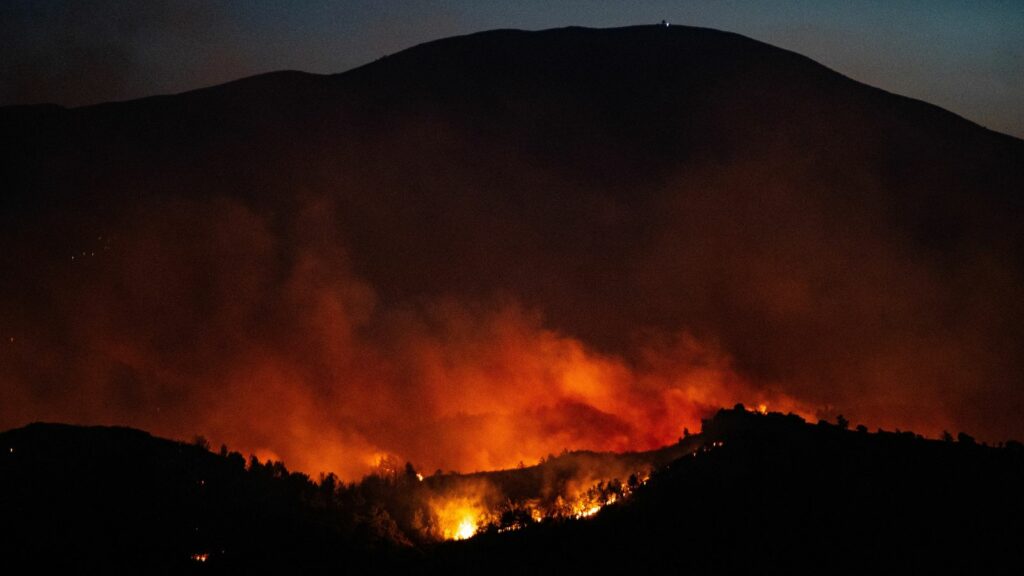
Smoke has become one of the most far-reaching consequences of Canada’s wildfire seasons, capable of turning distant city skylines hazy even when flames are hundreds or thousands of kilometres away. That risk remains firmly in view as September begins with more than 500 active wildfires across Canada and millions of hectares already burned in 2026.
At the same time, the World Meteorological Organization is warning that extreme fire-smoke events have tripled globally since the 1990s. Its latest air-quality assessment places Canada inside a much larger public-health story: cleaner vehicle and industrial emissions in many regions are increasingly being offset by episodic smoke, while a warming climate is extending the conditions that can support severe fire weather.
Canada Still Has More Than 500 Active Fires
Canada entered the first full week of September with wildfire activity still spread across the country. The Canadian Interagency Forest Fire Centre reported 522 active fires on the morning of September 7, along with 5,297 fires recorded so far in 2026 and roughly 4.48 million hectares burned. National preparedness remained at Level 3, meaning significant activity was continuing and some jurisdictions still depended on shared resources.
Those totals need context. An “active” fire is not necessarily a fast-moving blaze threatening a community. Federal fire data for September 6 included fires that were out of control, being held, under control, under modified response or simply being monitored. That distinction matters for families seeing a national total above 500: the number signals how much fire remains on the landscape, but the immediate danger varies sharply by location, weather, fuel conditions and suppression status. The latest count still represented a substantial nationwide operational footprint.
The UN Warning Goes Far Beyond One Bad Fire Season
The most striking warning came from the World Meteorological Organization’s new Air Quality and Climate Bulletin. The UN agency said a study cited in the report found that extreme fire-smoke events have tripled globally since the 1990s. Those events were associated with an estimated nearly 100,000 additional deaths per year between 2010 and 2018, and WMO cautioned that the true burden may be higher.
Canada is not a distant example in that assessment. WMO found that PM2.5 concentrations in northern Canada during 2025 were above the long-term average because of increased fire activity. The significance is broader than a single smoky summer. Industrial and transport pollution has declined in many developed regions, but wildfire-related fine-particle exposure is rising, making it harder for communities to hold onto air-quality gains achieved through cleaner vehicles, fuels and factories. For residents, that means smoke can become a recurring exposure problem even where flames never approach homes.
Tiny Particles Carry an Outsized Health Risk
Wildfire smoke is dangerous largely because of what cannot be seen. Health Canada identifies fine particulate matter, or PM2.5, as the main health risk in smoke. These microscopic particles are small enough to penetrate deep into the lungs, while wildfire smoke can also contain carbon monoxide, volatile organic compounds and polycyclic aromatic hydrocarbons. Exposure can aggravate asthma and other respiratory conditions and is associated with premature death.
WMO’s latest bulletin adds an important complication: smoke particles from fires may be more harmful than conventional air-quality models assume. It cited epidemiological research indicating that models based on total PM2.5 concentrations may underestimate wildfire-attributable mortality by as much as 93 percent. That does not mean every smoky day carries the same danger. It means public-health systems increasingly need to know not only how much particulate pollution is present, but also where it came from and how long people are exposed. That distinction matters.
July Showed How Canadian Smoke Can Become a Continental Problem
Canada’s July smoke episode showed how quickly a regional fire emergency can become a continental air-quality event. United Nations University researchers estimated that from July 15 to 17, wildfire smoke exposed people in Canada and the United States to unhealthy, very unhealthy or hazardous air for nearly 106 million person-days. During the broader July 13–18 peak, moderate-or-worse air quality accounted for more than 769 million person-days.
Satellite observations made the movement visible. NASA tracked smoke from Canadian fires travelling into the United States between July 14 and 20, while NOAA described smoke spreading from Canada across the Great Lakes, Midwest, Northeast and Atlantic. Toronto temporarily recorded exceptionally poor air quality, and smoke reached major U.S. cities far from the burn zones. The episode illustrated a basic reality of wildfire pollution: evacuation maps are local, but smoke plumes follow winds and upper-level circulation rather than borders. Distance offers only partial protection.
The Hardest Impacts Have Fallen on Communities Near the Flames
For communities closest to the flames, 2026 has involved much more than hazy skies. During the July surge in Ontario, United Nations University researchers reported that more than 3,500 First Nations residents had been displaced nationally by mid-month, with as many as 11 Ontario First Nations under evacuation because of wildfire impacts. Some remote residents had to leave by boat, while federal assistance was requested for communities accessible mainly by air or water.
British Columbia faced another major escalation in August. The federal government said more than 10,000 people were still under evacuation orders as of August 18 after intense fires in the province’s south. B.C. later ended its provincial state of emergency on August 27, though local alerts and wildfire risks continued in some areas. The human impact therefore changes faster than the national fire count: a season can be easing overall while individual communities still face disruptive, costly and stressful emergencies.
September Is Not the Automatic End of Wildfire Season
September can feel like the end of summer, but it is not the automatic end of Canada’s wildfire season. Health Canada says wildfire season typically runs from early April through October. In its August outlook, the federal government warned that above-average temperatures and lingering drought or dryness could keep wildfire risk elevated into September, with higher-than-normal fire danger forecast across most of Canada except Alberta and Saskatchewan.
Conditions have nevertheless begun to quiet in many regions. Natural Resources Canada’s September 2 weekly summary said agencies were generally reporting easing fall conditions, even as Canada remained at National Preparedness Level 3. That combination explains why hundreds of fires can remain active without producing the same crisis level seen during a midsummer surge. Cooler nights, precipitation and shorter days can reduce fire behaviour, but long-lived fires may continue burning or smouldering, and a spell of dry, windy weather can still revive local concerns.
Canada’s Response Has Relied on International Reinforcements
A nationwide fire season is also a logistics problem. Canada’s response system depends on provinces, territories and federal agencies sharing crews, aircraft and equipment when one region’s needs exceed its own capacity. By September 6, CIFFC still classified the country at National Preparedness Level 3, even though there were no outstanding interagency requests at that moment. International personnel were also beginning to demobilize as conditions eased.
The scale of outside help earlier in the season was substantial. The federal government said more than 500 firefighters from Mexico, Costa Rica, New Zealand and Australia had assisted Ontario and British Columbia over the summer. International resources were still in Canada in early September. That cooperation is easy to overlook when smoke becomes the public face of a fire season, but it is central to managing simultaneous emergencies across a country as large as Canada, where aircraft, specialized crews and incident-management capacity may need to move long distances.
Canada’s Climate Evidence Points to Longer Fire Seasons
The broader climate signal is becoming harder to separate from wildfire planning. Canada’s newly released Changing Climate Report says the fire season has lengthened in most parts of the country and is projected to keep lengthening as global temperatures rise. It also concludes with high confidence that the frequency and intensity of extreme fire-weather conditions are expected to increase across most Canadian regions.
The record 2023 season provides a useful benchmark without suggesting that every year will look the same. Peer-reviewed research found that human-caused climate change increased the likelihood of the record area burned, the long fire season and widespread extreme fire weather seen that year. Canada’s 2026 burned area remains far below 2023’s record, but the lesson for emergency managers is about probability, not repetition: warmer conditions can raise the odds of longer windows for dangerous fire weather, while precipitation, ignition patterns and regional fuel conditions still determine how each season unfolds.
Smoke Preparedness Is Becoming Part of Everyday Public Health
For the public, smoke protection increasingly resembles heat-wave preparedness: it works best before conditions become severe. Canada’s Air Quality Health Index runs from 1 to 10+, with higher values indicating greater health risk. During wildfire smoke events, the federal calculation can be adjusted to respond more directly to rapid changes in PM2.5, helping communities recognize a deteriorating situation even when a smoke plume shifts within hours.
Health Canada recommends checking the AQHI or local alerts, reducing strenuous outdoor activity during heavy smoke and keeping indoor air as clean as possible. For people who must spend time outdoors, a well-fitting NIOSH-certified N95 or equivalent respirator can reduce exposure to fine particles, although it does not filter the gases in smoke. Portable air cleaners and properly maintained ventilation filters can also help indoors. These measures are especially important for children, older adults, pregnant people and those with heart or lung conditions. Preparation matters.
The 2026 Totals Are Serious Without Being Another 2023
The 2026 numbers are serious, but they should not be mistaken for a repeat of Canada’s record 2023 disaster. As of September 6, federal data put the season’s burned area at about 4.48 million hectares. That was close to the 10-year historical average shown for the date, above longer-term 15-, 20- and 25-year averages, but well below the recent five-year average, which has been heavily influenced by exceptional fire seasons.
The same dataset showed why a single statistic can mislead. Canada had roughly 5,293 fires by September 6, close to its 10-year average, yet area burned can swing dramatically because a small share of very large fires accounts for most of the land burned in Canada. The enduring concern is therefore not simply whether the active-fire count rises or falls. It is whether dangerous fire weather, large fires and dense smoke overlap with populated areas—and how prepared communities are when they do.
