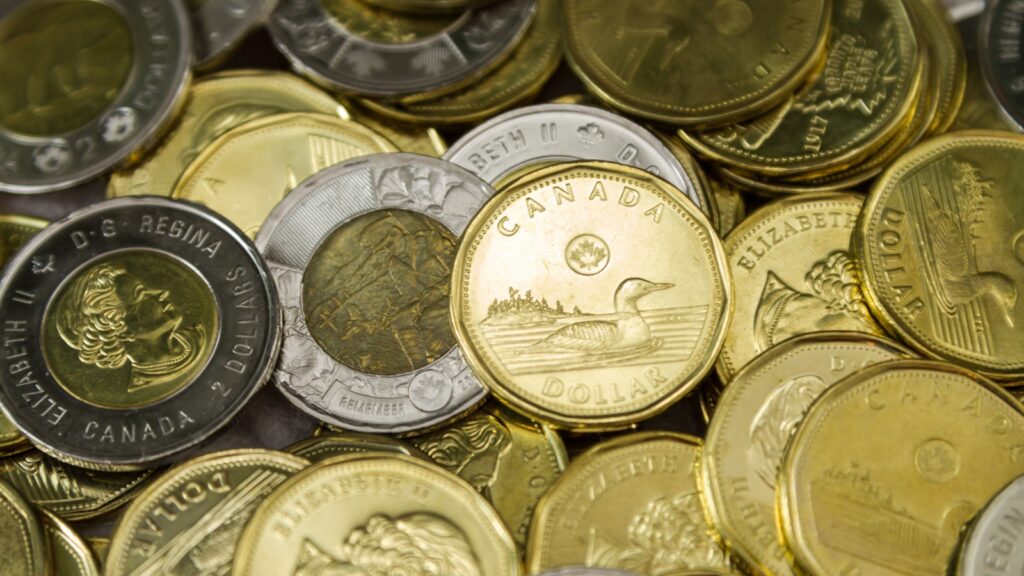
Canada’s dollar is being squeezed from two directions at once. The loonie weakened to roughly 72 U.S. cents as markets absorbed renewed U.S. inflation concerns while investors continued to assess the economic damage from an increasingly difficult Canada–U.S. trade relationship.
Neither pressure operates in isolation. Persistent American inflation can keep U.S. interest rates higher than markets expect, making U.S.-dollar assets more attractive. At the same time, tariffs and uncertainty surrounding cross-border investment threaten a Canadian economy deeply integrated with its largest trading partner. For households, exporters and manufacturers, a softer currency has consequences far beyond trading screens. It can raise the Canadian-dollar cost of imported goods while offering only partial relief to exporters facing tariffs at the border.
The Loonie Slips Back Toward 72 U.S. Cents
The Canadian dollar was trading at roughly US$0.7215 early on September 12, putting it back near the weaker end of its recent range. Moves of a fraction of a cent can appear minor, but foreign-exchange markets deal in enormous volumes. A decline from 73 U.S. cents toward 72 cents can materially change the Canadian-dollar cost of large purchases denominated in U.S. currency.
The effects eventually reach ordinary transactions. A Canadian company paying US$1 million for machinery must spend more Canadian dollars when the loonie weakens. The same arithmetic affects imported equipment, computer hardware, vacations and cross-border purchases. Currency moves can therefore become another source of cost pressure at precisely the moment businesses are already dealing with tariffs and unpredictable trade rules. The nine-day-low description matters less because of the record itself than because it shows investors are again demanding a lower price to hold Canadian dollars amid several overlapping risks.
U.S. Inflation Has Become a Currency Problem for Canada
Inflation in the United States matters to Canadians even when the prices being measured are thousands of kilometres away. When American inflation proves stubborn, investors tend to reduce expectations for rapid Federal Reserve interest-rate cuts. U.S. bond yields can consequently become more attractive, creating additional demand for dollars and putting currencies such as the loonie under pressure.
That relationship gives each major American inflation release unusual importance for Canadian markets. Traders are not simply asking whether U.S. groceries or housing costs increased; they are trying to estimate what those numbers mean for Federal Reserve policy months ahead. A prolonged period of comparatively high U.S. rates can encourage global capital to remain in dollar-denominated assets. Canada then faces an uncomfortable combination: weaker domestic momentum could favour easier Canadian monetary policy while persistent U.S. inflation works in the opposite direction south of the border. That potential interest-rate gap can become another reason for investors to favour the U.S. dollar.
The Trade War Adds a Second Layer of Risk
Currency traders are also trying to price a problem that traditional economic models handle poorly: political uncertainty. Canada and the United States have spent decades building supply chains around relatively predictable access to each other’s markets. Tariffs, threats of additional duties and changing product rules make future revenues and investment returns much harder to forecast.
The exposure is enormous. Roughly three-quarters of Canadian merchandise exports have historically gone to the United States, making the American market unusually important compared with the export dependence of many other advanced economies. Ontario auto factories can ship components across the border multiple times before a completed vehicle reaches a dealership. Quebec aluminum, Prairie energy and Canadian lumber similarly depend heavily on American buyers. When tariffs interrupt those flows, the consequences extend beyond individual exporters. Lower investment, weaker hiring and reduced production can affect the economic outlook that ultimately helps determine the value of the Canadian dollar.
Canada’s U.S. Dependence Is Difficult to Replace Quickly
Calls to diversify Canadian trade have grown louder as tensions with Washington deepen, but geography is difficult to overcome. Canada shares the world’s longest international land border with the United States, while highways, pipelines, rail networks and electricity connections have been developed over generations specifically to serve the continental economy.
That infrastructure helps explain why alternatives cannot be created overnight. An Ontario parts supplier can put components on a truck and deliver them to an American assembly plant far more easily than it can build a comparable customer base in Europe or Asia. Energy illustrates the same challenge: the overwhelming majority of Canadian crude-oil exports have traditionally gone south to U.S. refineries. New trade agreements, ports and overseas customers can reduce dependence over time, but they cannot instantly reproduce existing North American supply chains. For currency markets, that means deterioration in Canada–U.S. relations carries a larger potential economic penalty than an ordinary diplomatic disagreement.
A Weaker Dollar Does Not Automatically Rescue Exporters
Normally, a weaker currency gives exporters an advantage. A Canadian product priced in Canadian dollars becomes cheaper to an American buyer when the loonie falls, while exporters earning U.S. dollars receive more Canadian currency when they convert their revenue. That mechanism has often cushioned Canadian manufacturers during periods of economic weakness.
Tariffs complicate the equation. A company might gain several percentage points from exchange-rate movements only to face a much larger duty when its product crosses the border. Manufacturers that import American machinery or components can also lose part of the currency benefit because those inputs become more expensive in Canadian dollars. The auto industry provides a particularly clear example: vehicles contain thousands of parts, and North American components routinely move through integrated supply chains before final assembly. Exchange rates therefore cannot be considered separately from tariffs. For some businesses, a weaker loonie provides useful protection; for others, it merely offsets a fraction of the new cost.
Importers and Consumers Feel the Other Side of the Move
Currency depreciation becomes more visible when Canadian businesses need to replenish imported inventory. Many commodities, industrial products and technology goods are priced internationally in U.S. dollars. Even when the underlying supplier leaves its U.S.-dollar price unchanged, a Canadian importer can face a higher bill simply because more loonies are required to buy each dollar.
Companies do not always pass that increase to consumers immediately. Retailers may hedge currencies months in advance, suppliers can absorb some costs, and businesses sometimes accept thinner profit margins rather than raise prices. Over time, however, sustained currency weakness increases the likelihood that part of the expense reaches customers. A Canadian retailer ordering U.S.-priced electronics offers an everyday example: the exchange rate can change replacement costs even before tariffs or shipping expenses are considered. That makes the loonie another piece of Canada’s inflation puzzle, particularly if trade restrictions simultaneously raise the cost of imported materials and finished products.
Oil Still Matters, but It Is No Longer the Whole Story
Canada’s status as a major energy exporter has historically given the loonie a reputation as a commodity currency. Strong oil prices can improve Canada’s trade income, support investment in producing provinces and create demand for Canadian dollars. That relationship remains relevant because energy continues to represent one of the country’s largest export categories.
Yet oil alone cannot explain the currency’s present pressure. The expansion of Canadian export capacity, including the Trans Mountain system, has given producers more flexibility, but the United States remains the dominant destination for Canadian crude. Investors must therefore weigh energy prices alongside tariffs, growth expectations and relative interest rates. A period of strong oil can support the loonie while trade fears pull in the opposite direction. That helps explain why the currency can sometimes fail to rally as much as commodity prices might traditionally suggest. Today’s Canadian dollar reflects the entire economic relationship with Washington, not merely the price of a barrel of crude.
Interest-Rate Expectations Could Decide What Happens Next
Foreign-exchange markets are forward-looking. What the Federal Reserve and Bank of Canada might do over the coming months can matter more for the loonie than the interest rates already in place. If investors conclude that American inflation will force U.S. rates to remain comparatively high, holding U.S.-dollar assets becomes more attractive.
Canada faces a different set of pressures. Tariffs can raise some prices while simultaneously weakening business investment, exports and employment. That creates an awkward policy dilemma because slower growth can argue for lower borrowing costs even as trade-related price increases complicate the inflation picture. A widening expectation gap between Canadian and American monetary policy would normally favour the U.S. dollar. Conversely, convincing evidence that U.S. inflation is cooling, or that Canada’s economy is proving more resilient than feared, could help the loonie recover. That is why investors increasingly treat inflation releases, labour-market reports and central-bank speeches as interconnected pieces of the same currency story.
The Exchange Rate Is Becoming a Measure of Trade-War Confidence
Currencies often function as real-time confidence indicators. Unlike quarterly economic statistics, the Canadian dollar trades continuously as investors update their expectations about growth, inflation, commodities and political risk. New tariff threats can therefore affect the loonie before factories have reduced production or official trade data show any damage.
That does not mean every daily currency movement can be blamed on Washington. The U.S. dollar itself rises and falls against many currencies, while global risk sentiment, oil and bond yields all influence the Canadian exchange rate. Still, Canada’s unusually close economic connection to the United States makes trade policy particularly significant. A company considering a multimillion-dollar Canadian factory expansion needs to know whether its products can enter the U.S. market competitively several years from now. If that certainty disappears, postponed investment becomes a genuine economic risk. Currency traders attempt to price that uncertainty long before Statistics Canada can measure its ultimate effect.
The Next Move Depends on Inflation and Washington
For the loonie, the immediate question is whether the forces pushing it down begin to ease or reinforce one another. Softer U.S. inflation would reduce one important source of support for the American dollar, particularly if it revived expectations for easier Federal Reserve policy. A reduction in Canada–U.S. trade tensions could simultaneously improve the outlook for Canadian investment and exports.
The opposite scenario would be more difficult. Persistent U.S. inflation combined with additional tariffs or failed trade negotiations could leave Canada facing softer growth, elevated import costs and weaker investor confidence at the same time. For businesses, that would make currency hedging and supply-chain planning increasingly important. For households, the effects could appear gradually through travel costs and prices for imported goods rather than as one dramatic shock. The loonie’s retreat toward 72 U.S. cents is therefore more than a market statistic. It is a compact reflection of two questions now hanging over Canada: where U.S. interest rates are headed and how costly the trade confrontation with its biggest customer will become.
