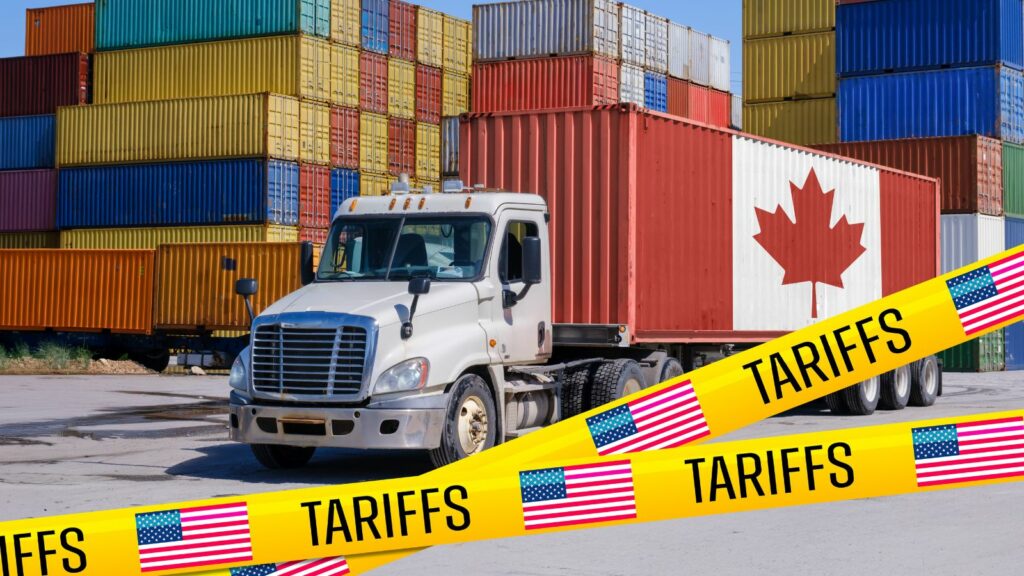
The tariff fight between Canada and the United States is no longer confined to a handful of politically sensitive products. A new U.S. trade analysis estimates that Canadian retaliatory tariffs now cover roughly US$52 billion worth of American exports, after Ottawa expanded its countermeasures in September. The figure captures just how much of the deeply integrated cross-border economy has become exposed to higher duties, even though it should not be confused with US$52 billion in automatically lost sales.
The latest measures reach into machinery, electronics, metals, plastics, appliances and other goods that move through North American supply chains every day. They also arrive as Washington and Ottawa remain divided over broader trade rules and the future direction of CUSMA, raising the stakes for businesses on both sides of the border.
What the US$52 Billion Figure Actually Measures
The US$52 billion estimate comes from a September 16 analysis by the Washington-based American Action Forum, using U.S. International Trade Commission trade data. Its researchers calculated that Canada’s newest retaliatory measures cover close to US$19 billion in American exports, bringing the combined value of U.S. exports covered by Canadian counter-tariffs to approximately US$52 billion. The newest round took effect on September 8 and was added to Canadian measures already affecting American vehicles, steel, aluminum and other products.
That figure requires some care because Canadian and American sources frequently describe the same tariff actions in different currencies and with different trade-data methodologies. Ottawa officially describes the September 8 countermeasures as covering C$27.6 billion of imports from the United States. That is broadly consistent with a figure near US$19 billion once currency differences are considered. The overall US$52 billion number is therefore an estimate of trade covered by tariff lines, not a claim that American exporters will lose US$52 billion in sales or that Canada will collect that amount in tariff revenue.
Ottawa’s September Response Reached Far Beyond One Industry
Canada’s September 8 package was designed to match the value and, in many cases, the rates of the latest U.S. measures. The Department of Finance says the new Canadian counter-tariffs apply at rates of 15%, 25% and 50%, depending on the product. Ottawa concentrated the measures on sectors including steel and aluminum, dairy products, household appliances, agricultural equipment, pulp and paper, plastics and electronics. Existing counter-tariffs, including those covering U.S.-made vehicles, remained in place.
The breadth of that list helps explain why this round feels different from a dispute centred on one commodity such as lumber or aluminum. A Canadian company buying an American machine component can now face the dispute alongside a retailer sourcing appliances or a manufacturer purchasing specialized equipment. Ottawa has also maintained a tariff-remission process for cases in which businesses cannot reasonably source important inputs domestically or from another country. That provision matters because retaliatory tariffs can create costs for the Canadian companies importing U.S. products even while the measures are intended to pressure American exporters and the U.S. government.
The Total Builds on Tariffs That Were Already in Place
Canada entered the latest escalation with significant countermeasures already operating. After removing many of its broader 2025 retaliatory tariffs, Ottawa kept tariffs on sectors that continued to face U.S. measures, particularly steel, aluminum and automobiles. Federal briefing material earlier in 2026 put the value of annual U.S. steel, aluminum and auto imports remaining under Canadian counter-tariffs at approximately C$51.4 billion. The September expansion then altered the product mix and, for some steel and aluminum lines, raised existing Canadian rates from 25% to 50%.
Those Canadian-dollar figures cannot simply be added to C$27.6 billion to reconstruct the American Action Forum’s US$52 billion estimate. Some products overlap, tariff rates have changed, currencies differ and the U.S. analysis measures covered American exports using U.S. trade data. Autos remain especially important. Canada continues to apply a 25% tariff to non-CUSMA-compliant vehicles imported from the United States and to the non-Canadian and non-Mexican content of qualifying U.S.-assembled vehicles. The U.S. analysis identifies vehicles as the largest American export category currently affected by Canada’s retaliation.
The Exposure Is Significant Even in an Enormous Trading Relationship
The US$52 billion estimate looks especially striking when placed beside normal U.S.-Canada trade flows. U.S. Census Bureau figures show American goods exports to Canada totalled approximately US$333.6 billion in 2025, while imports from Canada reached about US$381.9 billion. On that benchmark, US$52 billion is equivalent to roughly one-sixth of a normal year’s U.S. goods exports to the Canadian market. That comparison measures the scale of exposure; it does not mean one-sixth of U.S. exports will disappear.
Trade has also continued at substantial levels despite the dispute. During the first seven months of 2026, Census data show the United States exported about US$205.5 billion in goods to Canada and imported approximately US$233.7 billion. The reason tariffs can become disruptive even when overall trade remains large is that the bilateral economy was built around relatively predictable border costs. Manufacturers often source materials or components from across the border, incorporate them into another product and move the finished good again. When tariffs appear at multiple stages, companies may have to renegotiate contracts, find alternative suppliers or absorb costs while deciding whether restructuring a long-established supply chain is worthwhile.
American Vehicles and Agricultural Products Have Heavy Canadian Exposure
The American Action Forum’s underlying trade data illustrate why Canadian retaliation can matter disproportionately to particular industries. From 2016 through 2025, U.S. exports of vehicles and vehicle parts to Canada exceeded US$500 billion, representing almost 39% of total American exports in that product category during the period. Furniture was similarly exposed, with Canada accounting for about 49% of U.S. exports in that category. For several food categories, Canada’s importance was even greater.
Agriculture provides another clear example. The analysis notes that Canada accounted for nearly 17% of American agricultural exports in 2025. Looking over the preceding decade, more than 61% of U.S. vegetable exports went to Canada, along with almost 62% of certain cereal, flour and bakery-related preparations and roughly 49% of cocoa preparations. Those figures do not mean every product is currently tariffed. They demonstrate why exporters pay close attention to Canadian countermeasures: for some businesses, Canada is not simply another foreign destination but one of the most accessible and established markets available outside the United States.
Tariffs Can Hurt Exporters Without Producing an Immediate Collapse in Trade
A tariff normally enters the transaction as a tax paid when the product is imported, meaning Canadian importers can initially face the higher customs bill on tariffed American goods. What happens afterward depends on competition and bargaining power. The importer may absorb part of the expense, increase the Canadian selling price, ask the American supplier for a discount or switch to a different source. American exporters therefore feel pressure when their products suddenly become more expensive relative to Canadian or third-country alternatives.
Past trade conflicts offer evidence of how those adjustments can develop. Academic research examining the 2018-2019 trade war found that tariffs produced substantial declines in targeted trade and encouraged businesses to reorganize supplier relationships over time. Research by economists Pablo Fajgelbaum, Pinelopi Goldberg, Patrick Kennedy and Amit Khandelwal found retaliatory tariffs contributed to lower U.S. exports, while separate work by Mary Amiti, Stephen Redding and David Weinstein documented strong tariff pass-through and costly supply-chain adjustments. Those studies concerned a different trade conflict, so their exact numerical results cannot simply be transferred to today’s Canada dispute, but the economic mechanisms remain relevant.
Small Companies Are Already Describing Effects Beyond the Tariff List
The consequences are not always limited to companies whose products appear directly on a customs schedule. The Associated Press recently reported that Jasper Hill Farm, an artisan cheesemaker in Vermont, saw Canadian customers cancel holiday orders after the latest tensions intensified. Cheese was not among the company’s products hit by the newest U.S. tariff measures, and the company’s co-founder attributed much of the deterioration to changing customer sentiment rather than a direct tariff. That distinction is important: anecdotal sales declines do not prove tariffs caused every lost order.
A Tennessee company called AmpRx, which makes electrical devices for musicians and recording studios, described a similar chilling effect. Its main product was not covered by the new tariffs, but the company reported weaker Canadian demand while facing other cost pressures. Across the border, Vancouver Island-based Revival Stillworks told AP that a 50% U.S. tariff on its Canadian distilling equipment had made potential projects substantially more expensive; its equipment can cost from roughly US$250,000 to US$2 million. Such cases demonstrate how uncertainty, tariffs and customer behaviour can interact well beyond headline trade totals.
Washington Has Already Responded With Another Round of Measures
Canada’s September 8 tariffs did not end the escalation. The Trump administration subsequently modified the scope of the 50% Section 338 tariffs imposed on Canadian products, with changes taking effect September 15. The American Action Forum calculates that the total value of Canadian imports covered by those U.S. tariffs remained broadly similar even as Washington added some product categories and removed others. The administration has described its measures as a response to what it considers discriminatory Canadian treatment involving automobiles, dairy products and alcoholic beverages; Ottawa disputes the broader U.S. rationale for the tariffs and describes its own measures as reciprocal countermeasures.
Washington has also announced outright restrictions on selected Canadian imports scheduled to become effective on September 29. White House proclamations cover specified Canadian alcoholic beverages, dairy products and certain vehicle-related goods. The U.S. analysis estimates that approximately US$967 million worth of Canadian products will be affected by the planned import bans, with alcoholic beverages accounting for most of that value. The sequence shows how quickly a tariff dispute can evolve from duties into narrower import restrictions when neither side removes the measures at issue.
The Bigger Question Is Now Tied to the Future of CUSMA
The dispute is unfolding against an unusually uncertain backdrop for North American trade rules. On July 1, the United States declined to extend the term of the United States-Mexico-Canada Agreement during its first six-year joint review. That decision did not terminate CUSMA. The agreement remains in force under its existing term, and its review mechanism allows Canada, the United States and Mexico to revisit extension annually if they have not reached consensus.
Under CUSMA’s Article 34.7, failure to agree on an extension in 2026 triggers yearly reviews for the remainder of the agreement’s existing term, which runs to 2036 unless the parties later agree to a new 16-year extension. That leaves considerable room for negotiation. Canada’s US$52 billion in tariff-covered American exports, Washington’s tariffs on Canadian goods and the sector-specific restrictions imposed by both governments now form part of that broader commercial environment. For companies built around an open border, the immediate concern is less the headline number itself than how long elevated tariffs remain in place and whether predictable North American trading conditions can eventually be restored.
