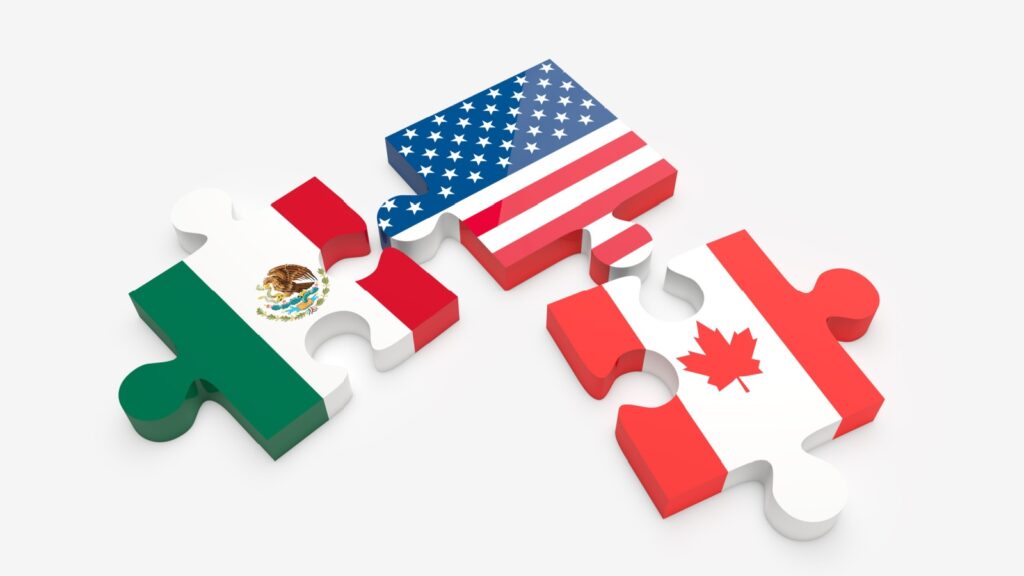
Mexico and Canada entered the latest phase of North America’s trade confrontation facing the same U.S. administration but increasingly different negotiating realities. Mexican President Claudia Sheinbaum says discussions with President Donald Trump are advancing toward a trade agreement, with officials trying to settle major disputes over automobiles, steel and aluminum. Canada, meanwhile, remains locked in a much more confrontational phase with Washington after negotiations broke down and reciprocal tariffs took effect.
The contrast does not mean Mexico has secured favourable terms, nor that the trilateral trading system has disappeared. The USMCA remains in force, and enormous amounts of commerce continue crossing all three borders. What has changed is the negotiating environment: Washington is increasingly dealing with its two neighbours on separate tracks, creating new uncertainty for companies built around an integrated North American economy.
Mexico Says Negotiations Are Moving Forward
Sheinbaum said on September 18 that Mexico was working toward a trade agreement with the United States after another conversation with Trump. Reuters reported that Mexican officials described the negotiations as progressing, although neither government has announced a completed agreement or published final terms. Mexico and Washington are trying to make headway before the U.S. midterm elections on November 3, giving negotiators a relatively short political window in which to resolve some of their largest disagreements.
That progress follows months of structured talks rather than a sudden breakthrough. U.S. and Mexican negotiators have held several bilateral rounds connected with the USMCA review, beginning with formal negotiations in May. Their agenda has included automotive rules of origin, steel and aluminum, agriculture, labour, economic security and supply chains. A July joint statement from U.S. Trade Representative Jamieson Greer and Mexican Economy Minister Marcelo Ebrard described continued engagement and scheduled another negotiating round in Washington for September.
Mexico Has Kept a Separate Negotiating Channel Open
The U.S.-Mexico discussions have increasingly developed as their own negotiating track. Washington and Mexico announced bilateral preparations for the USMCA review in March, then held rounds in Mexico City and Washington throughout the spring and summer. The two governments have repeatedly emphasized regional manufacturing, supply-chain security and efforts to prevent companies from countries outside North America from using Mexico as an indirect route into the U.S. market.
That process matters because it gives Mexico something Canada currently lacks: an active channel producing publicly acknowledged negotiating progress. It does not guarantee Mexico will obtain its preferred outcome. U.S. officials are seeking significant changes, while Mexico has its own industrial interests to protect. Still, the July negotiations ended with both governments publicly describing their engagement as constructive. By September, Sheinbaum was again telling reporters that discussions were advancing, creating a noticeably different picture from the suspended Canada-U.S. talks.
Autos, Steel and Aluminum Remain Mexico’s Biggest Tests
Mexico is seeking relief from U.S. tariffs affecting important exports, particularly steel, aluminum and automobiles. Those sectors have repeatedly appeared on the negotiating agenda. They are especially important because Mexico’s manufacturing economy is deeply connected to U.S. factories: engines, transmissions, electronics and other components can cross the border several times before a finished vehicle reaches a dealership. Mexican officials have argued that this integration makes North American vehicles fundamentally different from imports produced almost entirely outside the region.
Automotive rules may be among the hardest issues to settle. Existing USMCA rules generally require 75% regional value content for passenger vehicles and light trucks seeking preferential treatment, up from 62.5% under NAFTA. Reuters reported in May that the Trump administration proposed increasing North American content requirements to 82% and requiring at least half of vehicle content to originate specifically in the United States. Those were negotiating proposals rather than agreed rules, illustrating how substantial the remaining differences can be even while both governments describe progress.
Canada’s Negotiations Have Turned Into a Tariff Fight
Canada has moved in the opposite direction. After negotiations failed to produce an agreement, the Canadian government announced counter-tariffs covering C$27.6 billion of U.S. imports. The measures took effect September 8 at rates of 15%, 25% and 50%, depending on the product, and targeted sectors including steel, dairy, appliances, agricultural equipment, pulp and paper, plastics and electronics. Ottawa said the measures were designed to match U.S. tariffs dollar for dollar.
Washington subsequently escalated the dispute further. Reuters reported that the United States announced restrictions targeting Canadian alcoholic beverages, motorcycles and dairy products, with those measures scheduled to take effect September 29. The escalation followed earlier U.S. tariffs on C$27.6 billion of Canadian goods. As of September 19, Prime Minister Mark Carney was publicly defending the suspension of negotiations rather than describing an imminent return to bargaining. The result is a Canada-U.S. relationship currently defined more by active trade measures than by visible negotiating progress.
The USMCA Is Still Alive, but Its Long-Term Future Is Unsettled
The widening difference between Mexico’s and Canada’s experiences is happening inside a larger dispute over the USMCA itself. On July 1, the Trump administration declined to extend the agreement for another 16-year term in its current form. That decision did not terminate the USMCA immediately. Instead, the agreement remains in force and enters annual reviews while the three countries continue negotiating possible changes.
The distinction is important. Under Article 34.7 of the agreement, failure to agree on an extension during the six-year review triggers annual reviews for the remainder of the pact’s existing term. The countries can still agree later to extend it. Reuters described the July decision as beginning a 10-year countdown toward possible expiration rather than an immediate end to North American free trade. Washington is pressing for tighter rules of origin, stronger regional production requirements and measures aimed at limiting outside-country participation in North American supply chains.
The Trade Numbers Explain Why the Stakes Are So High
Despite the political confrontation, the economic relationship remains enormous. U.S. Census Bureau figures show that during the first seven months of 2026, the United States imported about US$358.7 billion in goods from Mexico and exported roughly US$229.8 billion there. Over the same period, U.S. goods imports from Canada totaled approximately US$233.7 billion, while U.S. exports to Canada were about US$205.5 billion. Together, the two neighbours represented more than US$1 trillion in two-way U.S. merchandise trade in only seven months.
Dependence also runs strongly in the other direction. Mexico’s Economy Ministry reported that the United States accounted for 83.3% of Mexican exports in its available 2026 data. Statistics Canada reported that Canada exported C$50.5 billion of goods to the United States in July alone, representing roughly two-thirds of Canadian merchandise exports that month. Such numbers explain why tariff disputes quickly reach factories, farms, trucking companies and household supply chains far beyond negotiating rooms in Washington, Ottawa or Mexico City.
Canada and Mexico Are Also Building Alternatives
Neither country is relying exclusively on Washington. Mexico signed an expanded trade agreement with the European Union in May covering areas such as services, digital trade, investment, government procurement and agricultural products. The agreement was explicitly framed partly as a way to reduce Mexico’s overwhelming dependence on the U.S. market. Even while Sheinbaum pushes for an accommodation with Trump, Mexico is therefore developing additional commercial outlets.
Canada is pursuing a similar diversification objective, although under more confrontational circumstances. Carney has sought deeper economic cooperation with Europe in critical minerals, defence, artificial intelligence, energy and digital trade, while his government has set a goal of doubling non-U.S. trade over roughly a decade. Canada is also trying to complete a comprehensive trade agreement with India by the end of 2026. Trade Minister Maninder Sidhu said on September 19 that he was optimistic negotiations could be completed in the coming months, with energy and critical minerals among the areas attracting investment interest.
The Next Deadlines Could Clarify North America’s New Trade Order
Mexico’s immediate objective is relatively clear: negotiators are trying to make enough progress for an agreement before the November 3 U.S. midterm elections. Reuters reported that officials on both sides were working toward that timetable, although difficult questions involving metals, automobiles and trade rules remained unresolved. Any agreement announced before then would still need to be examined carefully to determine which tariffs disappear, which remain and how new rules affect manufacturers operating across North America.
Canada faces a less predictable timetable because negotiations remain suspended while retaliatory measures are already operating. Meanwhile, U.S. Trade Representative Jamieson Greer said in July that Washington hoped to reach interim arrangements with both Canada and Mexico by the end of 2026, with more complicated USMCA negotiations potentially stretching into 2027. Mexico’s current momentum therefore represents progress, not closure. The larger question remains whether Washington ultimately restores a coordinated three-country negotiating process or continues resolving its biggest disputes with Canada and Mexico separately.
