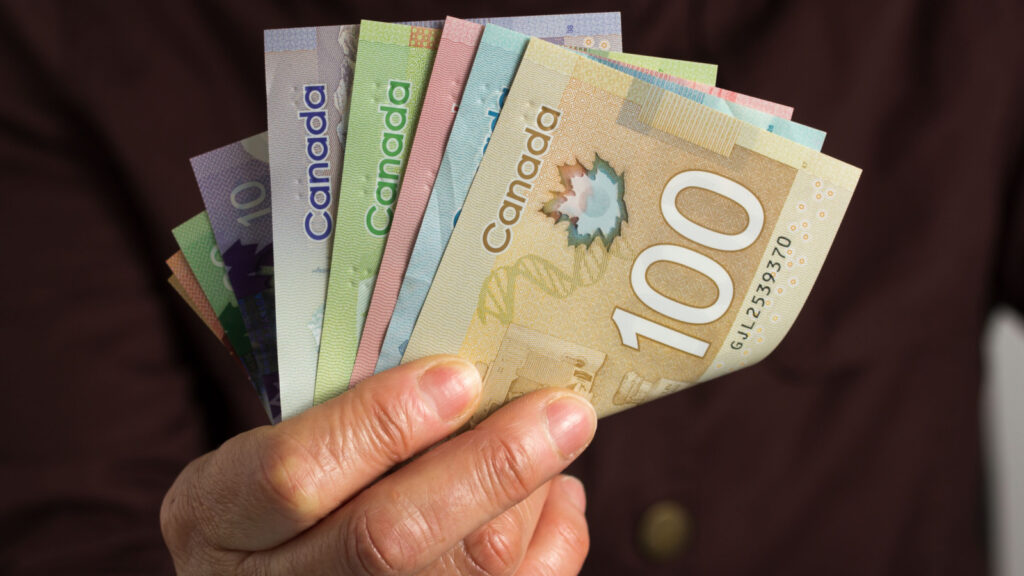
The Canadian dollar has endured a steady September slide, weakening for eight consecutive trading sessions as investors respond to an increasingly important difference between monetary policy in Canada and the United States. By September 18, the Bank of Canada’s daily exchange rate showed one U.S. dollar buying C$1.4002, while the loonie was worth roughly 71.4 U.S. cents.
The pressure intensified after the U.S. Federal Reserve raised interest rates on September 16, while the Bank of Canada had kept its own policy rate unchanged earlier in the month. That divergence has widened the advantage offered by some U.S. fixed-income investments and pushed the Canada-U.S. two-year yield spread to its widest level since late July. For households, businesses and currency markets, an apparently small difference in rates is beginning to have noticeably larger consequences.
Eight Trading Sessions Have Turned Into a Persistent Slide
The decline has been notable less for any single dramatic selloff than for its persistence. Bank of Canada exchange-rate data show the U.S. dollar at C$1.3784 on September 8. From there, the rate climbed on every subsequent Canadian trading day: C$1.3798 on September 9, C$1.3822 on September 10 and C$1.3866 on September 11. The progression continued after the weekend, reaching C$1.3909 on September 14, C$1.3917 on September 15, C$1.3947 on September 16, C$1.3988 on September 17 and C$1.4002 on September 18. Because a higher USD/CAD quotation means more Canadian dollars are required to buy one U.S. dollar, the sequence represents eight straight sessions of loonie weakness.
Reuters reported that the currency traded as weak as roughly C$1.40144 during Friday’s session, its weakest intraday level since August 7. The Canadian dollar was also down about 1% for the week. The move remains relatively modest compared with the extreme currency swings seen during financial crises, but eight uninterrupted daily declines can alter market psychology. Currency traders increasingly start watching whether each small rebound will be sold rather than assuming the previous range will quickly reassert itself.
The Federal Reserve Has Changed the Interest-Rate Equation
The most important new development arrived in Washington on September 16. The Federal Reserve raised its federal funds target range by a quarter percentage point to 3.75%–4.00%. The Federal Open Market Committee said U.S. economic activity was expanding at a solid pace, domestic spending remained resilient and inflation was still elevated. The decision passed unanimously. With the Bank of Canada’s overnight target sitting at 2.25%, the U.S. policy range is now 1.5 to 1.75 percentage points above Canada’s benchmark rate, although policy rates and market bond yields should not be treated as identical measures.
The Fed’s updated projections reinforced the message that U.S. rates could remain relatively high. The median projection among FOMC participants placed the federal funds rate at 4.1% at the end of 2026, compared with 3.8% in the Fed’s June projections. Policymakers also projected median U.S. real GDP growth of 2.3% for 2026 and PCE inflation of 3.7%. Those figures do not guarantee another rate increase, but they tell currency markets that the September hike may not represent an immediate end to U.S. tightening. That matters enormously when investors are comparing Canadian-dollar and U.S.-dollar assets.
The Bank of Canada Is Facing a Different Set of Trade-Offs
Canada’s central bank has not been standing still because inflation has vanished. On September 2, the Bank of Canada maintained its overnight rate at 2.25%, saying economic growth and inflation were developing broadly in line with its previous forecasts while risks around the outlook remained elevated. Statistics Canada subsequently reported that headline CPI inflation was 3.0% year over year in August, unchanged from July. Gasoline prices were 22.8% higher than a year earlier, however, and inflation excluding gasoline was a considerably cooler 2.4%.
The Canadian economy has also been recovering from a weak start to the year. Statistics Canada reported that real GDP increased 0.8% in the second quarter of 2026 after edging up 0.1% in the first quarter. Household spending, exports and business capital investment all contributed to the second-quarter increase. That leaves the Bank of Canada in an uncomfortable position: economic activity has improved and headline inflation is above the 2% target, yet a large portion of the inflation pressure has been associated with energy while economic uncertainty remains significant. The result has been a Canadian rate path that, at least for now, sits well below the one investors see in the United States.
The Two-Year Yield Gap Helps Explain Why the Loonie Is Under Pressure
Foreign-exchange markets rarely respond only to the rate announced by a central bank. Investors also watch government bond yields, particularly shorter maturities that are heavily influenced by expectations about where policy rates will go next. On September 18, Canada’s two-year government bond yield was roughly 142 basis points below the comparable U.S. yield, according to Reuters. That represented the widest Canada-U.S. two-year gap since July 28. Scotiabank strategists Shaun Osborne and Eric Theoret told Reuters that wider front-end yield spreads accounted for much of the Canadian dollar’s recent decline according to their correlation analysis.
The mechanism is intuitive. If comparable U.S.-dollar securities offer meaningfully higher yields, investors receive more compensation for holding U.S.-dollar assets, other things being equal. Bank of Canada research has demonstrated the relationship using a simple example: when a Canadian short-term interest rate falls one percentage point below its U.S. equivalent, the Canadian dollar would ordinarily need to depreciate to help balance expected investment returns. That relationship is not mechanical—risk sentiment, commodity prices, economic growth and other forces also matter—but the widening yield gap provides a clear explanation for why the loonie has struggled despite relatively resilient Canadian economic data.
A Stronger U.S. Dollar Is Adding to Canada’s Problem
Not every part of the loonie’s decline is uniquely Canadian. The Federal Reserve’s shift toward tighter policy has strengthened the U.S. dollar’s appeal across global markets. The U.S. Dollar Index reached a seven-week high during September 18 trading before giving back much of its advance later in the session. The Japanese yen also weakened even after the Bank of Japan raised its own policy rate, illustrating how powerful the market response to the U.S. outlook has become. Currency markets are effectively comparing the entire expected path of rates rather than simply counting which central banks raised rates during a particular week.
That distinction matters for interpreting the Canadian dollar’s eight-day run. Bank of Canada research has repeatedly found that interest-rate differences are only one component of exchange-rate movements. Global U.S.-dollar demand and currency risk premiums can amplify or sometimes overwhelm domestic influences. Research published by the central bank has found that systematic factors—including exposure to broad U.S. dollar movements, cross-country interest-rate differences and oil prices—can collectively account for a large share of Canadian exchange-rate variation. In other words, the loonie is being squeezed by both a specifically Canadian-U.S. rate gap and a broader environment that has recently favoured the greenback.
Oil Above US$100 Has Not Been Enough to Rescue the Loonie
Historically, rising oil prices have often supported Canada’s currency because energy represents an important share of Canadian exports. The relationship remains economically important. Statistics Canada reported that energy-product exports reached a record $60.6 billion in the second quarter of 2026, including a record $44.8 billion in exports of crude oil and bitumen. Crude-oil exports by volume were also 6.4% higher year over year in June. With international oil prices remaining above US$100 a barrel during the latest currency decline, the energy backdrop would normally be expected to provide at least some support to the Canadian dollar.
Yet the loonie still fell. That contrast is one reason the interest-rate story has received so much attention. Oil is only one of several forces acting on Canada’s currency, and its influence can be overshadowed when bond-market incentives are moving sharply in the opposite direction. Energy exports also softened in the most recent monthly merchandise-trade data: Statistics Canada reported energy-product exports fell 4.4% in July, including a 5.6% decline in crude-oil exports. The picture is therefore more complicated than the traditional assumption that expensive oil automatically produces a stronger Canadian dollar. At the moment, rate differentials appear to be carrying more weight.
Canadians and Businesses Can Feel the Currency Move in Different Ways
An exchange-rate move that looks small on a financial chart can become easier to appreciate when converted into everyday spending. Using Bank of Canada daily rates, purchasing US$1,000 would have required about C$1,378.40 on September 8 before transaction fees or exchange spreads. At the September 18 daily rate, the same US$1,000 would cost roughly C$1,400.20—about C$21.80 more. Larger U.S.-dollar purchases, business invoices, vacations or tuition payments multiply that difference. Bank of Canada research and its monetary-policy projections also note that Canadian-dollar depreciation tends to increase import prices, although the degree and timing of that pass-through vary considerably.
The effect can run in the opposite direction for some Canadian companies. Exporters receiving revenue in U.S. dollars may obtain more Canadian dollars when those earnings are converted, while Canadian products can become cheaper from the perspective of foreign customers. Still, it would be misleading to assume that every exporter automatically benefits. Bank of Canada research examining Canadian trade found that export performance depends heavily on why the exchange rate changed in the first place. U.S. economic growth and demand can matter more than the currency’s direct price effect. A weaker loonie therefore creates winners and losers rather than delivering a straightforward benefit or cost to the entire economy.
The Next Few Weeks Could Decide Whether the Streak Becomes a Trend
Attention now turns to what central bankers say and do next. Bank of Canada Governor Tiff Macklem is scheduled to speak about economic developments in Halifax on September 21, giving markets an early opportunity to assess how the Bank interprets the latest inflation data, currency weakness and shifting global rate environment. The Bank’s next scheduled policy announcement arrives on October 28, when it will also publish a new Monetary Policy Report. Reuters reported on September 18 that markets were assigning roughly a 60% probability to a Bank of Canada rate increase at that meeting, although market-implied probabilities can change quickly as economic data arrive.
The Federal Reserve will also meet on October 27–28. Its September projections suggest policymakers currently expect a higher year-end federal funds rate than they anticipated only three months earlier, but those projections are neither commitments nor guarantees. For the Canadian dollar, the critical issue is therefore not simply whether Canada or the United States raises rates next. What matters is how expectations for the entire Canadian rate path change relative to expectations in the United States. After eight consecutive trading sessions of weakness, even modest shifts in that gap could determine whether the loonie stabilizes near C$1.40 per U.S. dollar or enters another period of sustained pressure.
