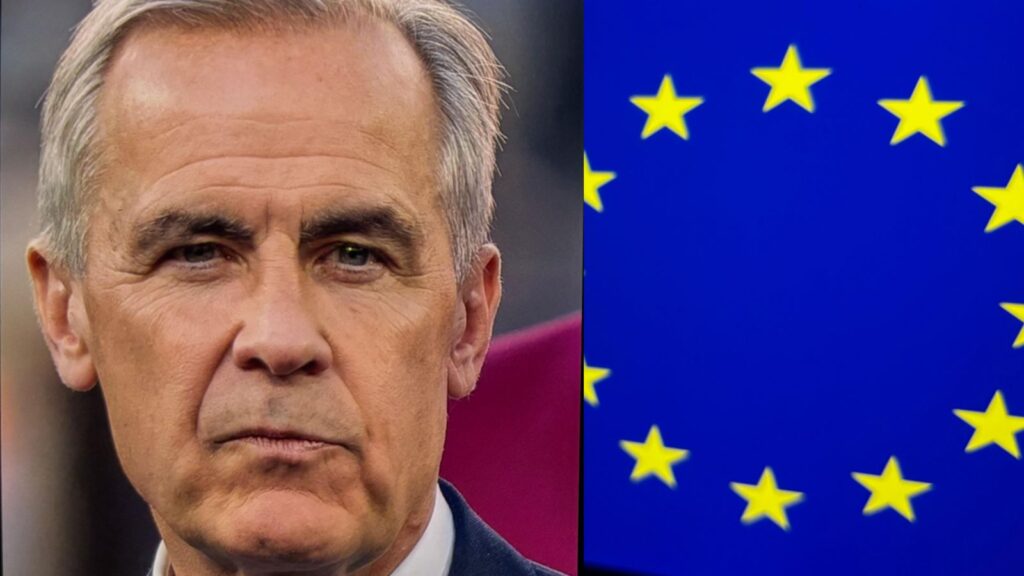
Mark Carney’s meeting with French President Emmanuel Macron in Saint-Pierre-et-Miquelon lands at an unusually consequential moment for Canada’s foreign policy. Ottawa is trying to deepen economic and security ties with Europe while trade relations with Washington remain strained by tariffs, suspended negotiations and sharper political rhetoric.
France offers Canada something increasingly valuable: a major European partner with overlapping interests in energy security, defence production, critical minerals, aerospace and advanced technology. For Paris, Canada brings large-scale resources, industrial capacity and a strategic position across the Atlantic and Arctic. The September 20 meeting therefore carries weight well beyond the small French archipelago off Newfoundland. It is another sign that Canada is building alternatives to overreliance on the United States without pretending that its geography, trade flows or security relationship with its southern neighbour can simply be replaced.
Saint-Pierre-et-Miquelon Turns Geography Into a Political Message
Saint-Pierre-et-Miquelon is a tiny place for a meeting about very large strategic questions. The French overseas collectivity sits roughly 25 kilometres off Newfoundland and Labrador, giving France a permanent North American presence beside Canada. Macron’s trip is the first by a French president since François Hollande visited in 2014. French officials have emphasized the territory’s position in the North Atlantic, close to the United States and Arctic approaches, while Ottawa has framed Carney’s visit around energy, defence, aerospace, critical minerals and advanced technology.
The symbolism has become sharper because Donald Trump recently posted an image depicting Saint-Pierre-et-Miquelon under the American flag. France responded by stressing that the islands are French territory, while Carney’s appearance alongside Macron demonstrates close Canada-France coordination. That does not make the meeting an anti-American alliance. It does, however, place sovereignty and strategic autonomy at the centre of a gathering that might once have looked mostly ceremonial.
Energy Security Gives the Meeting Immediate Stakes
Energy is one of the most immediate reasons France wants a deeper Canadian relationship. Macron said on September 18 that he planned to use the meeting with Carney to strengthen trade in petroleum products and liquefied natural gas. France and other European economies are again confronting supply risks as conflict in the Middle East disrupts shipping and pushes fuel costs higher. Traffic through the Strait of Hormuz has fallen sharply below recent norms, intensifying concerns about oil, refined products and gas supplies ahead of winter.
Canada fits that problem differently from traditional Middle Eastern suppliers. It is a politically stable producer with expanding LNG capacity, major oil and gas reserves and long-term potential for hydrogen and other lower-emissions fuels. Carney has explicitly told European leaders that Canada could supply LNG and hydrogen at scale if new infrastructure is developed. For households facing higher fuel bills in France, that turns an abstract diplomatic partnership into a question of physical supply, ports, contracts and investment.
Defence Cooperation Is Moving From Diplomacy to Procurement
The defence side of the relationship has also moved beyond broad statements of friendship. In June, Canada and France signed a General Security of Information Agreement designed to allow classified information to be exchanged and protected securely. Ottawa says the framework can make it easier for Canadian companies to pursue French defence, aerospace, space, cybersecurity and advanced-technology contracts that require access to sensitive information. It is the kind of technical agreement that can determine whether political cooperation actually becomes industrial business.
The two countries have since added another layer. At the NATO summit in July, Canadian and French defence ministers signed a technical arrangement for the Franco-Canadian Defence Cooperation Council, building on their 2024 security partnership and a 2026 roadmap. The framework covers interoperability, military cooperation, science and technology and capability development. Canada is also participating in the European Union’s SAFE defence procurement initiative. Together, those steps give Carney and Macron an existing structure to deepen rather than starting from scratch.
France Fits Carney’s Much Wider European Strategy
France is important partly because Carney’s strategy is larger than France itself. Days before the Saint-Pierre-et-Miquelon meeting, he addressed the European Parliament in Strasbourg and argued for a much deeper Canada-EU partnership spanning critical minerals, defence industrial capacity, energy security, artificial intelligence, space, financial services and research. European Commission President Ursula von der Leyen went further, proposing that Canada become the European Union’s first “associate member,” an unprecedented status whose legal meaning still has to be worked out.
The economic base is already significant. Canada-France merchandise trade totalled C$15.2 billion in 2025, and Ottawa identifies France as Canada’s third-largest export market inside the EU. The broader European Union accounted for roughly C$178 billion in Canadian goods-and-services trade that year. France therefore offers both a substantial bilateral market and political influence inside Europe. Its large aerospace, defence, nuclear-energy and technology industries also align unusually well with the sectors Carney wants Canada to develop.
U.S. Tariff Pressure Has Changed Ottawa’s Risk Calculation
The push toward Europe is unfolding against a much harsher Canada-U.S. trade environment than Ottawa faced only a few years ago. Canada suspended negotiations with Washington in August after talks failed to produce a mutually acceptable arrangement. The Canadian government says the United States imposed 50 per cent tariffs on C$27.6 billion of Canadian goods, prompting Ottawa to apply matching counter-tariffs on selected U.S. products beginning September 8. Washington has separately announced import restrictions on certain Canadian products beginning September 29, while presenting its actions as responses to what the Trump administration calls discriminatory Canadian trade policies.
Those disputes change the value of diversification. A European contract for defence equipment, minerals or energy is not simply an extra export opportunity when access to the U.S. market is less predictable; it can also reduce the economic cost of future disruptions. Carney has indicated that Canada remains prepared to negotiate with Washington when conditions are appropriate, but Ottawa’s strategy now pairs that position with an increasingly deliberate effort to build alternative commercial relationships.
Diversification Does Not Mean Decoupling From the United States
Even a rapid European pivot cannot erase the scale of Canada’s economic integration with the United States. Statistics Canada reported that 71.7 per cent of Canadian merchandise exports still went to the U.S. in 2025, even after that share fell from 75.9 per cent in 2024. Supply chains in autos, energy, agriculture, machinery and other sectors cross the border repeatedly, while North American defence and continental security remain deeply interconnected. Europe can diversify that exposure, but it cannot quickly reproduce a market located directly beside Canada.
The more realistic objective is to reduce vulnerability at the margin. Statistics Canada also found that exports to non-U.S. countries rose 17.2 per cent in 2025 and that total merchandise trade with non-U.S. partners increased 14.3 per cent. Those figures help explain Carney’s emphasis on collective resilience rather than economic self-sufficiency. If European demand absorbs more Canadian energy, minerals, technology and defence output, Ottawa gains options even while the United States remains its dominant customer and an indispensable security partner.
Critical Minerals and Aerospace Add Commercial Weight
The Canada-France relationship already has commercial examples that fit Carney’s diversification strategy. France recently purchased two additional DHC-515 water bombers manufactured by De Havilland Aircraft of Canada in Calgary, adding to its existing fleet. Ottawa has highlighted the deal as evidence that Canadian aerospace manufacturing can serve European public-safety and emergency-response requirements. The two governments have also established sector-focused work involving critical minerals, aerospace, nuclear energy and digital technologies, while signing a joint statement on quantum science and technology cooperation.
Critical minerals may be especially important. At the June G7 summit in Évian, Canada and France declared their intent to explore supplying French companies or institutions from Canada’s strategic critical-minerals stockpile, beginning with graphite, while considering co-investment in projects in Canada, France and third countries. That creates a practical exchange: Europe wants reliable inputs for batteries, clean technology and defence; Canada wants more processing, investment and long-term customers rather than remaining primarily a supplier of raw materials.
The North Atlantic and Arctic Are Becoming Central
The location of the Carney-Macron meeting also points toward a wider North Atlantic and Arctic agenda. French officials describe Saint-Pierre-et-Miquelon as strategically significant because of its position near the United States and Arctic approaches. Canada, meanwhile, has committed more than C$40 billion to a broad plan to defend, build and transform its North, including military infrastructure, radar, transportation corridors and projects intended to connect critical-mineral deposits to global markets. Ottawa increasingly treats northern infrastructure as both economic development and national security.
Europe is moving in the same direction. Twelve EU member states, including France, recently called for a more strategic European role in the Arctic, while von der Leyen has proposed making the region a flagship part of the deeper Canada-EU partnership. Canada and France are already NATO allies, and both have emphasized sovereignty and cooperation in northern security. Energy routes, satellites, maritime awareness, ports, communications networks and defence planning can consequently become parts of the same strategic conversation.
CETA Provides a Foundation, but Deeper Integration Will Be Harder
The existing Canada-EU trade agreement gives this new strategy a useful foundation, but it also illustrates how difficult deeper integration can be. CETA has been provisionally applied since 2017, eliminating duties on most tariff lines. The European Commission says bilateral goods-and-services trade reached €130 billion in 2025, roughly 80 per cent above its 2016 level. Yet the agreement still has not completed national ratification across the European Union. France is among the member states whose national ratification process remains unfinished.
That gap matters because “associate membership” is even less defined than CETA. No such status currently exists in EU treaties, so transforming the proposal into a functioning framework will require substantial political and legal work. Canada would also encounter sensitive questions involving regulation, agriculture, telecommunications and the extent of any market access. France can become an influential advocate for closer ties, but it cannot settle every EU concern alone. The diplomatic momentum is substantial; the institutional architecture remains under construction.
The October Summit Will Test Whether Momentum Becomes Structure
The next major test comes quickly. Canada is scheduled to host the Canada-EU summit in Montréal on October 29 and 30, where leaders will have an opportunity to give more substance to the proposed “Alliance for the Future.” Ottawa and Brussels are already working on defence cooperation, digital trade, energy security, critical minerals and research. The more consequential question is which ambitions can move from speeches into procurement agreements, infrastructure investment, industrial partnerships and expanded market access. France’s position will matter as those discussions move deeper into the European system.
Carney’s broader schedule also shows that Europe is being approached as a network rather than a single substitute for Washington. After Saint-Pierre-et-Miquelon, he is scheduled to meet Norway’s prime minister in Ottawa, following recent engagements with EU institutions and the United Kingdom. The pattern is consistent: Canada is trying to build more options among trusted partners. The success of that strategy will ultimately be measured less by diplomatic symbolism than by whether new flows of trade, capital, technology, energy and defence production actually materialize.
