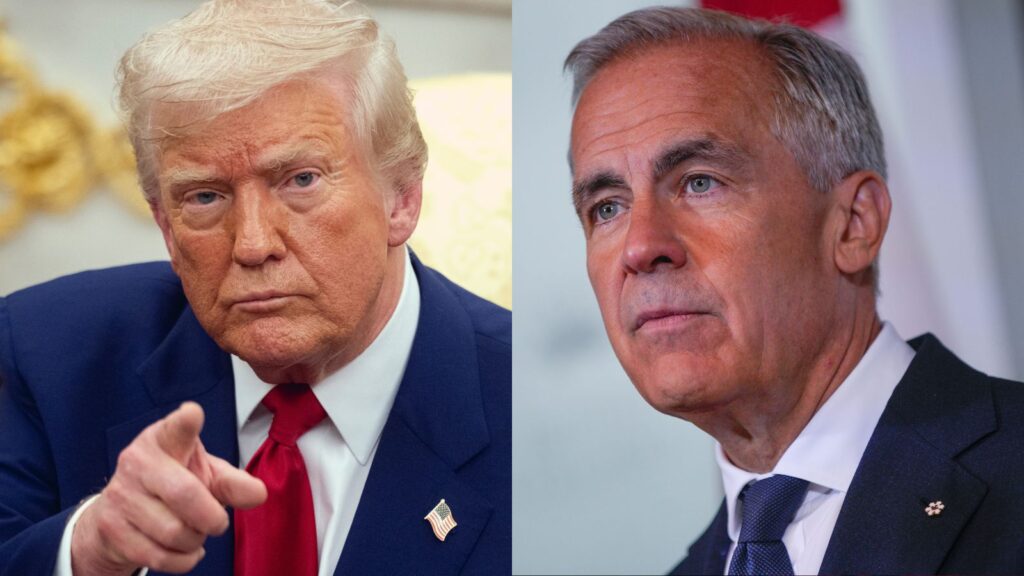
Prime Minister Mark Carney arrived in New York with no shortage of diplomatic business, but one meeting is conspicuously absent from his publicly released schedule. His September 22 itinerary lists four meetings with foreign officials — representing Chile, Angola, the United Arab Emirates and Jordan — alongside the opening of the United Nations General Assembly and other events. There is no scheduled bilateral with U.S. President Donald Trump.
That omission comes roughly a month after Canada suspended trade negotiations with Washington and responded to new U.S. tariffs with countermeasures of its own. It does not mean the two leaders cannot speak in New York; Carney’s schedule is explicitly subject to change. Still, with both leaders in the same city and the enormous Canada-U.S. economic relationship facing renewed uncertainty, the absence of a formal meeting puts an unusual spotlight on everything else Carney is doing.
Carney’s Published Schedule Has Four Foreign Meetings — None With Trump
Carney’s September 22 schedule starts at 9 a.m. with the opening of the High-Level General Debate at the 81st Session of the United Nations General Assembly. His first listed bilateral engagement comes at 11:30 a.m. with Chilean President José Antonio Kast. That is followed by a 12:05 p.m. meeting with Angolan President João Lourenço. At 1:15 p.m., Carney is scheduled to meet Sultan bin Ahmed Al Jaber, the United Arab Emirates’ Minister of Industry and Advanced Technology. At 2:05 p.m., he is due to sit down with Jordan’s King Abdullah II. Carney then has a media availability scheduled for 3:55 p.m. and is expected to deliver remarks at a leader-level event on the two-state solution later in the afternoon.
What is not on that schedule is just as closely watched. There is no announced bilateral with Trump, even though the U.S. president is also spending September 22 in New York conducting a packed series of diplomatic meetings. Reuters reported that Trump was expected to interact with at least 11 foreign leaders in bilateral or group settings, including leaders from Britain, Ukraine, Denmark, Greenland, Venezuela and Gulf states. That makes the lack of a publicly scheduled Canada-U.S. bilateral noticeable, although it should not automatically be interpreted as a diplomatic rejection. The Prime Minister’s Office states that Carney’s itinerary is subject to change, while Reuters similarly noted that additions to Trump’s schedule remained possible. At an event as fluid as UN High-Level Week, an unplanned conversation or brief pull-aside remains possible without becoming a full formal bilateral.
The Missing Meeting Comes After Canada-U.S. Trade Talks Broke Down
The timing gives the scheduling question considerably more weight. On August 21, Carney announced that Canada was suspending its trade negotiations with the United States after weeks of discussions failed to produce an agreement Ottawa considered acceptable. The Canadian government said negotiations had made progress but that last-minute changes to the American proposal were unfair and economically damaging. U.S. officials disputed Canada’s account of how the talks fell apart. The breakdown was followed by Washington imposing 50 per cent tariffs on roughly C$27.6 billion of Canadian goods, according to the Canadian government, creating another layer of uncertainty for companies already navigating sector-specific trade restrictions.
Ottawa answered with counter-tariffs covering an equivalent C$27.6 billion in U.S. products. Those measures took effect September 8, with tariff rates of 15, 25 or 50 per cent depending on the product. Steel, appliances, agricultural equipment, pulp and paper, electronics and other categories were among the sectors targeted. The dispute has therefore moved well beyond sharp political rhetoric: importers, manufacturers and exporters are now dealing with actual additional costs and altered supply-chain decisions. Carney nevertheless has stopped short of saying negotiations are permanently finished. Speaking at the Canada Investment Summit on September 15, he said a mutually beneficial arrangement with the United States remained possible and that Canada would be ready when the time was right. Against that backdrop, New York offered an obvious physical opportunity for leader-level contact, but neither government had placed a bilateral on the published schedule as the day began.
The Four Meetings Fit Canada’s Wider Push to Build Relationships Beyond Washington
Carney’s choice of meetings also reflects the broader diversification strategy Ottawa has emphasized as its relationship with Washington has become more unpredictable. Chile is already an established Canadian commercial partner. Bilateral merchandise trade reached C$2.9 billion in 2024, while Canadian direct investment in Chile stood at C$27.9 billion. The countries are linked through both the Canada-Chile Free Trade Agreement and the Comprehensive and Progressive Agreement for Trans-Pacific Partnership. Angola represents a much smaller commercial relationship — two-way merchandise trade totalled C$57.7 million in 2023 — but Global Affairs Canada identifies opportunities there in natural resources, infrastructure, clean technology, aerospace and vocational education.
The UAE connection has developed particularly quickly. Canada and the Emirates concluded negotiations on a Comprehensive Economic Partnership Agreement in July 2026 after what Ottawa described as a record 47-day negotiating process. The Canadian government says two-way trade with the UAE has been growing by roughly 10 per cent annually and has highlighted opportunities spanning energy, infrastructure, critical minerals, technology and artificial intelligence. Jordan occupies a different place in Canadian foreign policy. It became the first Arab country to implement a free-trade agreement with Canada, and bilateral merchandise trade exceeded C$273 million in 2025. Jordan is also an important Canadian partner on regional security, refugee support and Middle East diplomacy. Carney’s later participation in a UN event dealing with a two-state solution gives additional context to Jordan’s presence on the day’s schedule, although Ottawa had not publicly disclosed the specific agenda for the bilateral itself.
No Trump Bilateral Does Not Mean Canada Can Simply Move Past the U.S.
Canada may be diversifying, but the numbers show why the American relationship cannot be replaced by a handful of new partnerships. The United States remained Canada’s largest trading partner in 2025. Global Affairs Canada reported that 72.5 per cent of Canadian merchandise exports still went to the U.S. that year, although that was down from 76.3 per cent in 2024. Broader goods-and-services data show the same direction of travel: the American share of Canadian exports declined further as shipments to other markets expanded. That shift helps explain why Carney’s government is putting so much diplomatic energy into Europe, the Indo-Pacific, the Middle East and other regions, but diversification is a long-term adjustment rather than a quick substitute for the integrated North American economy.
That is why the most important takeaway from the New York schedule may be its uncertainty rather than the absence of one name. Trump has his own crowded diplomatic program, while Carney has meetings spread across several regions and a public schedule that can still change. A formal bilateral would be politically and economically significant, but its absence on September 22 does not establish that communication between Ottawa and Washington has stopped or that negotiations cannot restart. Carney has publicly left the door open to another agreement under conditions Canada considers acceptable. For businesses on both sides of the border, however, the immediate reality remains unchanged: the new tariffs are in force, the negotiating process that collapsed in August has not produced a replacement agreement, and Canada’s largest trading relationship remains one of the biggest unresolved files hanging over Carney’s New York diplomacy.
