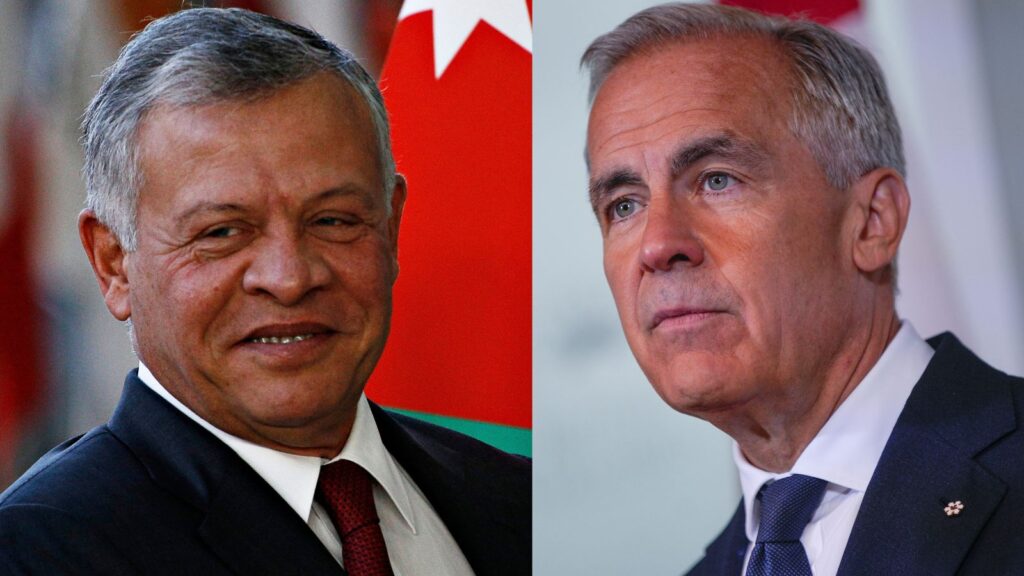
Prime Minister Mark Carney’s meeting with Jordan’s King Abdullah II in New York came at a moment when Middle East security was consuming much of the diplomatic oxygen at the United Nations. On the margins of the 81st UN General Assembly, the two leaders discussed the U.S.–Iran conflict, Gaza, growing tensions in the West Bank and the wider risk of regional escalation. They also agreed to deepen defence collaboration between Canada and Jordan. The announcement was brief, but it landed against a much larger backdrop: a nearly seven-month conflict involving Washington and Tehran, pressure on critical shipping routes, rising energy costs and renewed diplomatic efforts to prevent another escalation. For Canada and Jordan, closer defence ties therefore connect a longstanding bilateral relationship with an increasingly unstable regional security environment.
The Defence Agreement Was the Clearest Bilateral Outcome
The Canadian government’s account of the September 22 meeting was concise but significant. Carney and Abdullah discussed several of the Middle East’s overlapping crises before agreeing to deepen defence collaboration. Ottawa did not announce a new treaty, troop deployment, weapons purchase or dollar figure alongside that commitment. That distinction matters: the public announcement signals an intention to expand cooperation, while leaving the practical details for later discussions between governments and defence officials. The two leaders also agreed to remain in close contact as regional events continue to develop.
Defence was only one part of their conversation. Canada’s readout said the leaders discussed the U.S.–Iran conflict, the humanitarian crisis in Gaza, settlement expansion and rising violence in the West Bank, as well as broader instability across the Middle East. They emphasized civilian protection, preventing further escalation and maintaining regional stability. That combination gives the defence pledge a wider context: Ottawa and Amman are treating security cooperation as part of a relationship that also encompasses diplomacy, humanitarian assistance and efforts to manage regional crises rather than as a stand-alone military initiative.
Canada and Jordan Already Have a Defence Framework
Closer military cooperation would not start from zero. Canada and Jordan signed a memorandum of understanding on defence cooperation in 2012, reinforcing ties between the Canadian Armed Forces and Jordanian Armed Forces. A further memorandum on security and stabilization cooperation followed in 2016. Global Affairs Canada describes Jordan as an important Middle Eastern partner in areas including counterterrorism, transnational crime, border security and protection against chemical, biological, radiological and nuclear threats.
Canadian military personnel are already involved in capacity-building activity in Jordan. Under Operation AMARNA, the Canadian Armed Forces conduct defence diplomacy, exercises and regional partnership activities while continuing capacity-building work in Jordan and Lebanon. Canada also maintains a Canadian Armed Forces Training Assistance Team in Jordan. Those existing programs provide several established channels through which deeper cooperation could potentially be developed, although neither government has yet publicly specified which areas will be expanded after the New York meeting. That makes the September agreement an extension of more than a decade of institutional defence ties rather than an abrupt change in Canadian policy.
Recent Canadian Funding Has Put Border Security in Focus
The defence relationship had already received a notable boost before the UN meeting. During King Abdullah’s July 2025 visit to Ottawa, Carney announced $28.4 million for security and development initiatives in Jordan. Of that package, $13.4 million was allocated through Canada’s Counter-Terrorism Capacity Building Program. The initiative included $8 million for work with the International Organization for Migration to build and repair more than 17 kilometres of secured road along the Jordan–Syria border.
That investment built on approximately 70 kilometres of border-road construction previously supported by Canada in 2021. Ottawa said the projects were intended to improve threat detection and operational response in remote border areas while helping Jordan combat terrorism and transnational crime. Such projects show what Canada–Jordan security cooperation can look like in practice: infrastructure, training, surveillance capacity and border-management assistance rather than only conventional military deployments. With Jordan facing pressures from conflicts and armed groups across several neighbouring areas, border security has become closely connected to the broader question of regional stability discussed by Carney and Abdullah in New York.
The U.S.–Iran War Was a Major Backdrop to the UN Gathering
The bilateral meeting unfolded during a UN General Assembly increasingly preoccupied with wars across the Middle East. Reuters reported that the U.S.–Iran conflict had lasted nearly seven months by September 22 and had killed thousands, increased oil prices and drawn neighbouring states into the crisis. The conflict was prominent in President Donald Trump’s UN address, while American and Iranian representatives were simultaneously involved in diplomatic contacts through mediators in New York.
Those negotiations highlighted the unusual mixture of military confrontation and diplomacy surrounding the gathering. U.S. envoy Steve Witkoff said mediators had shuttled between American and Iranian delegations, while Trump said he believed an agreement remained possible. Reuters also reported that Tehran had proposed conditions under which the Strait of Hormuz could reopen more fully to shipping. The waterway carried roughly one-fifth of global oil and gas shipments before the war, making its disruption a problem extending far beyond the region. AP similarly described the Iran conflict, Yemen fighting and the wars involving Israel as major subjects on the General Assembly agenda.
Jordan Has Experienced the Conflict as a Direct Security Issue
For Jordan, the Iran conflict is not simply a distant diplomatic problem. Earlier in 2026, Canada condemned Iranian missile and drone attacks on Jordan and expressed support for Jordanian sovereignty and security. During a July 31 call, Carney and Abdullah discussed those attacks along with the broader U.S.–Iran confrontation, Gaza and instability elsewhere in the region. Canada has also joined G7 statements condemning Iranian attacks on civilian infrastructure in Jordan and several Gulf states.
King Abdullah used his September 22 UN address to emphasize how quickly Middle Eastern instability can spill into economies and societies elsewhere. He argued that the Iran war had demonstrated the ability of regional conflict to disrupt trade, investment and daily life well outside the Middle East. He also described threats to Jordan’s northern border and water security as matters of national security and said the kingdom was developing its own defences while confronting terrorism and narcotics trafficking. Those statements help explain why defence cooperation featured alongside humanitarian and diplomatic issues in Abdullah’s meeting with Carney.
Canada Is Supporting Regional Security Without Joining U.S. Offensive Operations
Canada’s position on the U.S.–Iran war contains several distinct elements. Carney said in March that Canada supported preventing Iran from obtaining a nuclear weapon and condemned Iranian attacks on civilians and civilian infrastructure. At the same time, he said the United States and Israel had launched military action without consulting Canada or engaging the United Nations and called for rapid de-escalation, protection of civilians and renewed diplomatic engagement.
Ottawa later stated explicitly that Canada had not participated and had no plans to participate in U.S. and Israeli offensive operations against Iran. Canada has nevertheless supported regional partners, sanctions on Iran, efforts to protect freedom of navigation and diplomatic initiatives aimed at ending the conflict. In September, the government said it continued to support international efforts to reopen the Strait of Hormuz while maintaining pressure on Tehran over its nuclear activities, support for armed groups and threats to shipping. The result is a policy that combines alignment with partners on Iranian security threats with a stated preference for diplomacy and de-escalation rather than Canadian participation in offensive strikes.
Gaza and the West Bank Remained Central to the Meeting
Despite the attention commanded by the Iran war, Carney and Abdullah also devoted significant attention to Palestinians in Gaza and the West Bank. The Canadian readout said the two leaders discussed Gaza’s humanitarian crisis, settlement expansion and increasing violence in the West Bank. Carney reiterated Canadian support for a negotiated two-state solution and pointed to Canada’s humanitarian contributions for Palestinians. Ottawa said more than three million people in Palestine urgently require assistance.
King Abdullah’s UN speech placed even greater emphasis on the Palestinian issue. He argued that the international community had spent decades managing rather than resolving the Israeli–Palestinian conflict and sharply criticized Israeli government policies in Gaza and the West Bank. Those were Jordan’s stated positions; Israel disputes many international accusations concerning its conduct and says its military and security actions are necessary to protect Israelis and confront armed groups. AP reported that Abdullah’s address described developments in Gaza and the West Bank as threatening the possibility of a Palestinian state. The difference in rhetoric between governments does not change the central point of the Carney meeting: Palestinian security and humanitarian conditions remained inseparable from the broader discussion of regional stability.
Jordan’s Humanitarian Role Gives the Partnership Another Dimension
Security cooperation sits alongside a substantial Canadian development and humanitarian relationship with Jordan. Global Affairs Canada says Canada contributed more than $757 million to support Jordan’s stability and resilience between 2016 and 2025 through its Middle East Engagement Strategy. Jordan has absorbed the effects of conflicts in neighbouring countries while supporting large refugee populations and serving as an important channel for humanitarian activity in the region.
UNHCR recorded 379,323 registered refugees in Jordan at the end of July 2026, including more than 356,000 Syrians. Canada continued adding assistance during 2026: International Development Secretary of State Randeep Sarai announced almost $80 million for Lebanon and Jordan in August, covering humanitarian needs, human rights, economic opportunity and food security. In the September meeting, Carney specifically thanked Abdullah for Jordan’s role in regional stability and the delivery of humanitarian assistance to Gaza. These overlapping roles help explain why Canada’s relationship with Jordan moves repeatedly between military security, refugee support, development programs and diplomacy. For Ottawa, Jordan is simultaneously a defence partner and an important humanitarian actor in a region where those issues increasingly overlap.
What “Deepening” Defence Ties Means Is Still to Be Defined
The most important unanswered question is what the new commitment will produce in concrete terms. Neither the Canadian readout nor Jordan’s account of Abdullah’s UN meetings announced a new military deployment, procurement program, permanent Canadian base, defence treaty or funding package on September 22. Jordan’s state news agency said Abdullah’s meetings with Carney and several other leaders focused on strengthening cooperation, regional escalation and restoring stability. Canada’s statement went further by specifically confirming an agreement with Jordan to deepen defence collaboration.
Existing cooperation suggests several areas that could provide a foundation for future initiatives—training, border protection, counterterrorism capacity, defence diplomacy, exercises and protection against unconventional security threats—but any specific expansion will depend on later announcements. What is already clear is the political context in which that work will occur. The UN Secretary-General opened the General Debate warning that global geopolitical divisions were widening and appealed for greater de-escalation and dialogue across Middle Eastern conflicts. Against that setting, Carney and Abdullah’s defence pledge reflects an established Canada–Jordan relationship being tested and potentially expanded during one of the region’s most unsettled periods in years.
