A corporate sale has changed the name above the door at one of Canada’s major steel and pipe businesses, but Washington is moving toward keeping its U.S. trade treatment largely unchanged.
The U.S. Department of Commerce has preliminarily determined that Interpro Pipe & Steel Inc. is the successor to Evraz Inc. NA Canada for purposes of an American anti-dumping order covering large-diameter welded pipe. The decision follows Atlas Holdings’ 2025 acquisition of Evraz North America and the subsequent reorganization of the Canadian business under the Interpro name. Rather than treating Interpro as an entirely new exporter, Commerce found that the underlying business remained similar enough to inherit Evraz’s existing treatment. That distinction matters for Canadian producers, U.S. importers and customers buying pipe for major energy and infrastructure projects.
Commerce Says Interpro Is Essentially the Same Business
The September 22 preliminary decision is the latest step in a changed-circumstances review opened specifically to determine whether Interpro should legally inherit Evraz’s position under the anti-dumping order. Interpro requested the review on January 26, 2026, several months after the ownership change. Commerce formally began the proceeding on March 19 and later sent the company a supplemental questionnaire on August 20. Interpro submitted its response on August 31.
Commerce’s preliminary answer is yes. The department found that Interpro operates as essentially the same business entity as Evraz for purposes of the covered merchandise. That means the ownership change and new corporate name, by themselves, do not create a clean break from Evraz’s history in the trade case. If that conclusion survives the final stage, Interpro will receive the same anti-dumping cash-deposit treatment that applies to its predecessor rather than being treated as a completely new company.
A Name Change Alone Does Not Reset a Trade Case
Successor-in-interest reviews are designed to look beyond a company’s branding. Commerce considers several characteristics when deciding whether a reorganized or acquired business remains substantially the same exporter or producer. Those factors include ownership and management, production facilities, relationships with suppliers and the company’s customer base. No single factor automatically decides the case; officials examine the overall continuity of the operation.
That approach is important in industries where factories, machinery and customer relationships may remain intact even after a corporate transaction. In Interpro’s case, Commerce found that some officers and directors changed after the acquisition, but the company’s production facilities, supplier relationships and customer base remained substantially the same. In practical terms, the pipes leaving the Canadian operation are being produced through an industrial network that Commerce views as materially continuous with the Evraz business. That continuity is why the department is proposing to transfer Evraz’s existing treatment to Interpro.
Atlas Bought Evraz North America in July 2025
The corporate change behind the review dates to July 31, 2025, when Atlas Holdings completed its acquisition of Evraz Inc. NA, Evraz Inc. NA Canada and their subsidiaries. Atlas simultaneously announced the creation of Orion Steel Companies, an umbrella organization containing several established North American steel businesses. The Canadian operation emerged under the Interpro Pipe and Steel name, alongside Oregon Steel Mills and Rocky Mountain Steel Mills within the Orion group.
For employees and customers, the transaction was much bigger than simply changing a logo. Interpro operates steel and pipe facilities in Western Canada, with locations including Regina, Calgary, Camrose and Red Deer. The company says its Canadian operations employ approximately 1,800 people and have annual electric-arc-furnace-based steelmaking capacity of about 1.2 million tons. Those operations serve energy and industrial markets, including oil and gas infrastructure, carbon-capture projects and other pipeline applications. Maintaining predictable trade treatment is therefore commercially significant well beyond the corporate headquarters.
The U.S. Order Covers Very Large Welded Pipe
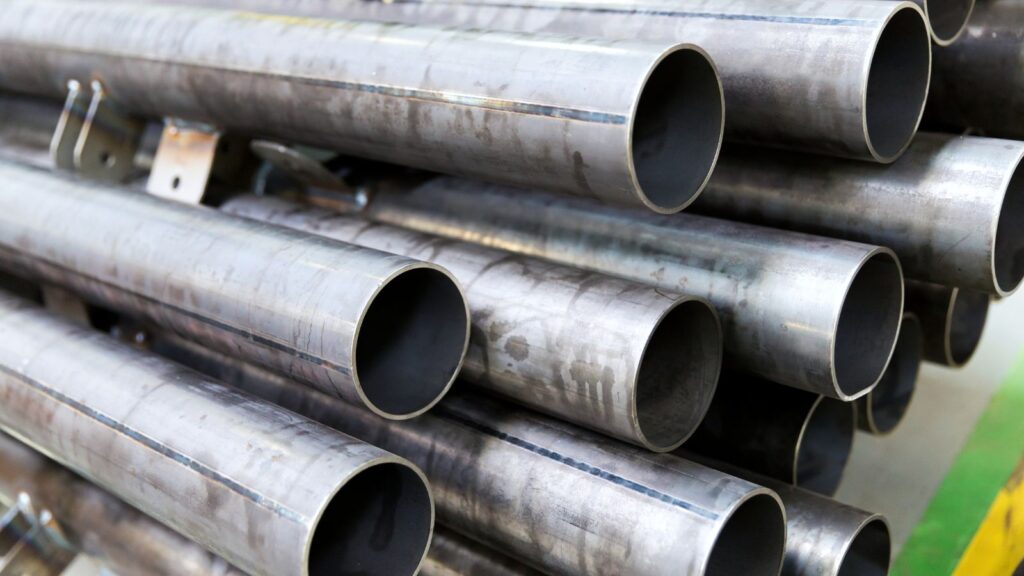
The trade case at the centre of the dispute covers large-diameter welded pipe from Canada. Under Commerce’s original scope, the merchandise includes welded carbon and alloy steel pipe, including stainless steel pipe, with a nominal outside diameter greater than 406.4 millimetres, or 16 inches. The coverage applies regardless of characteristics such as wall thickness, length, surface finish, grade or end finish, although specified water and sewage pipe meeting certain American Water Works Association standards is excluded.
This is not an obscure consumer product. Large welded pipe can be used to move oil, natural gas, steam, slurry and other fluids, and it can also be used structurally, including for piling. That helps explain why trade disputes involving pipe manufacturers can attract close attention from both producers and infrastructure customers. When a pipeline, industrial plant or large construction project needs hundreds or thousands of metres of pipe, even relatively small changes in trade treatment can affect sourcing decisions, import paperwork and ultimately project costs.
The Anti-Dumping Case Dates Back to 2019
Commerce originally imposed the Canadian large-diameter welded-pipe anti-dumping order in 2019 after determining that the investigated merchandise was being sold in the United States at less than fair value. In its final investigation, Commerce calculated an estimated weighted-average dumping margin of 12.32% for Evraz, which was also used as the all-others rate. The U.S. International Trade Commission separately made the injury determination required for the order to take effect.
The market involved was already substantial. USITC data for 2017 identified 15 U.S. producers employing 2,372 production and related workers. Those producers reported roughly $1.28 billion in U.S. shipments, while apparent U.S. consumption was about $2.25 billion. Canada was also identified among the leading foreign sources of the merchandise. Those figures help put the case into perspective: the proceeding concerns an industrial product bought in large volumes by major infrastructure and energy customers, not a niche shipment whose commercial significance disappeared after the original investigation.
Evraz’s Actual Duty History Has Changed Considerably
The existence of an anti-dumping order does not mean the same percentage necessarily applies forever. Administrative reviews can recalculate company-specific dumping margins as sales and costs change. Evraz’s results illustrate that clearly. Commerce calculated a 15.29% margin for the 2018–2020 review period and later an amended 26.15% margin for the May 2020 through April 2021 period.
The picture then changed sharply. In January 2024, Commerce corrected a ministerial error in its review covering May 2021 through April 2022 and amended Evraz’s weighted-average dumping margin from 9.17% to 0.00%. More recent Commerce proceedings did not establish a replacement Evraz rate: in the review covering 2023–2024 entries, the department concluded that Evraz had no reviewable shipments. Commerce also reiterated that companies not receiving a new rate continue using the company-specific rate from their most recently completed segment. That history is crucial for understanding what Interpro may inherit.
“Existing Treatment” Does Not Mean a New Tariff Increase
The September decision can sound more punitive than it actually is if it is described simply as keeping a Canadian company under an anti-dumping order. Commerce is not announcing a newly calculated dumping margin against Interpro in this preliminary successor proceeding. Instead, it is deciding whether Interpro should step into Evraz’s existing position in the case. The department specifically said that a final successor finding would give Interpro the same cash-deposit rate assigned to Evraz.
Based on the most recent completed segment establishing an Evraz company-specific rate, that treatment is currently tied to the 0.00% result published in January 2024. The distinction matters. A zero cash-deposit rate does not remove the company or its merchandise from the underlying anti-dumping order. It means the estimated deposit currently attached to that company-specific treatment is zero. Future administrative reviews can still examine later sales and potentially produce a different dumping margin if circumstances change.
The Broader U.S. Order Is Still Very Much Alive
While Evraz obtained a zero margin in one administrative review, the overall Canadian anti-dumping order did not disappear. The United States conducted its first five-year, or “sunset,” review of the large-diameter welded-pipe measures beginning in 2024. In April 2025, the USITC determined that revoking the relevant orders would likely lead to the continuation or recurrence of material injury to the American industry within a reasonably foreseeable period.
Commerce subsequently continued the orders, with the continuation applicable from May 2, 2025. That keeps the legal framework surrounding Canadian large-diameter welded pipe in place even when an individual producer may temporarily carry a zero deposit rate. Evraz also sought review of the USITC’s five-year determination under the Canada-U.S.-Mexico Agreement process, filing a request for a binational panel review in May 2025. The combination shows how multiple legal tracks can operate simultaneously: the underlying order, company-specific reviews and challenges to broader injury findings can all move on separate timelines.
The Ruling Matters for Importers as Well as the Canadian Mill
For U.S. buyers, the successor determination affects more than the name written on an invoice. The United States operates a retrospective anti-dumping system. Importers generally make estimated cash deposits when goods enter the country, while final duty liability can later be determined through an administrative review. A company’s applicable rate therefore influences both near-term cash requirements and the compliance assumptions companies use when arranging cross-border purchases.
That makes continuity valuable even when the inherited cash-deposit rate is zero. If Commerce instead concluded that Interpro was not Evraz’s successor, importers could face uncertainty about which rate should apply to its merchandise. The preliminary finding provides a clearer path: covered Interpro merchandise would continue under Evraz’s established company-specific treatment once the decision becomes final. For businesses purchasing large quantities of pipeline or structural pipe, certainty around customs treatment can matter when pricing contracts, financing inventory and estimating the landed cost of material months before delivery.
The Decision Is Preliminary and Comments Can Still Change the Outcome
Commerce has not yet closed the case. Interested parties have 14 days from publication of the September 22 notice to submit case briefs challenging or supporting the preliminary determination. Rebuttal briefs may follow five days after the case-brief deadline. Parties seeking a hearing also have a 14-day window to file a request, meaning the record can still be contested before officials make the successor determination final.
Under the timetable cited by Commerce, final results are expected no later than 270 days after the changed-circumstances review was initiated, which points to December 14, 2026. The process can move faster if all parties accept the preliminary finding, in which case Commerce says final results may be issued within 45 days. Until then, the important word is “preliminary.” Washington has signalled that the sale of Evraz’s Canadian business did not materially transform the operation for anti-dumping purposes, but the formal transfer of Evraz’s treatment to Interpro depends on the final determination.
