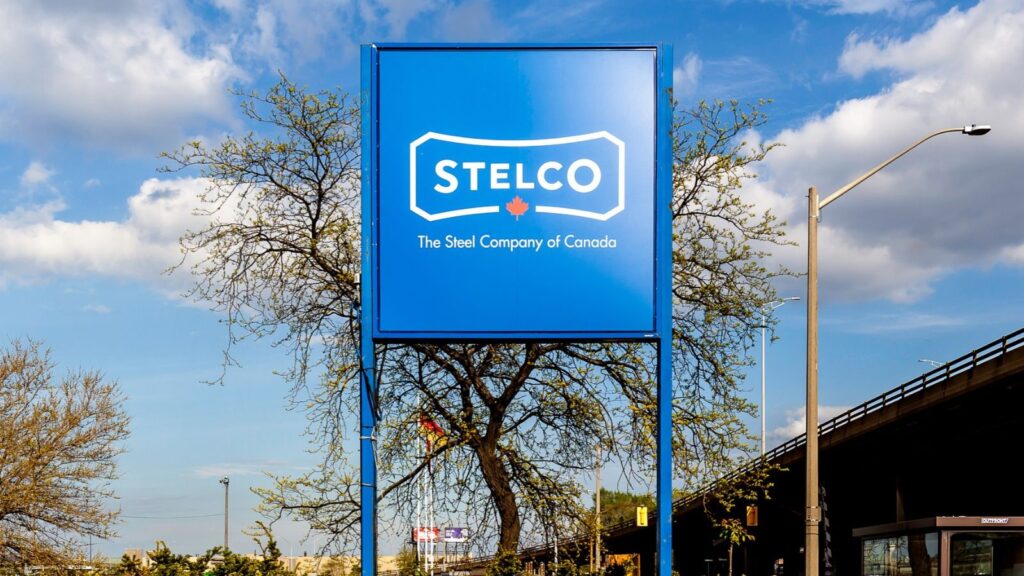
A Canadian steelmaking giant is at the centre of an escalating confrontation between Ottawa and its American owner, with hundreds of jobs at risk and the possibility of government intervention growing.
Industry Minister Mélanie Joly has raised the prospect of nationalizing Stelco or forcing its U.S. parent company, Cleveland-Cliffs, to sell Canadian assets after the steelmaker announced plans to lay off up to 500 workers in Ontario.
The dispute has intensified because Cleveland-Cliffs made legally binding employment commitments when it acquired Stelco in 2024. Now, American tariffs, shrinking steel demand and conflicting interpretations of those commitments are threatening the company’s future.
For workers in Hamilton and Nanticoke, the question is no longer simply who owns Stelco. It is whether Ottawa can prevent further job losses while preserving a critical part of Canada’s manufacturing economy.
Ottawa Considers Nationalization as Joly Warns Stelco’s American Owner
Canada’s federal government is examining unusually aggressive options to protect domestic steelmaking jobs, including the possibility of public ownership. Speaking in Toronto on October 16, Industry Minister Mélanie Joly said Ottawa was exploring all available measures under the Investment Canada Act after accusing Cleveland-Cliffs of failing to honour commitments made during its acquisition of Stelco. Reuters characterized her comments as opening the door to nationalization, a significant development in the dispute between the Canadian government and the American steel producer.
However, Joly did not announce a government takeover or explicitly commit Ottawa to purchasing Stelco. The Canadian Press reported that she discussed possible federal equity investments in strategically important industries while separately warning that Cleveland-Cliffs could be compelled to sell its Canadian operations. These are different possibilities. Nationalization would involve government ownership, while a court-ordered divestiture could transfer the business to another private investor. For now, Ottawa is considering its options rather than implementing a change in ownership.
Up to 500 Workers Face Layoffs as Stelco Reduces Operations in Ontario
The confrontation began after Stelco announced on September 28 that it would indefinitely idle cold-rolling and coated-steel operations at Hamilton Works. The company said the restructuring could affect up to 500 employees across its Hamilton facility and Lake Erie Works in Nanticoke. Stelco attributed the decision to weakening demand, persistent import competition and disruptions caused by the Canada–U.S. trade conflict. The planned shutdown affects important finishing operations that transform steel into products used by manufacturers and industrial customers.
Layoff notices began arriving in early October. United Steelworkers Local 1005 president Ron Wells said approximately 90 employees were expected to receive notices during the first week, with cuts continuing over roughly three weeks. Around 330 to 350 Hamilton workers were expected to be affected, alongside additional employees at Lake Erie Works. Some workers could potentially transfer to Nanticoke, although union representatives questioned whether sufficient openings existed. The figure of 500 represents the maximum announced impact, not a verified total of completed layoffs.
Cleveland-Cliffs Paid $3.4 Billion for Stelco and Promised to Preserve Jobs
The controversy is particularly serious because the Canadian government approved Cleveland-Cliffs’ acquisition of Stelco subject to specific employment and operating commitments. Announced in July 2024, the transaction valued the Canadian steelmaker at approximately US$2.5 billion, or C$3.4 billion. Cleveland-Cliffs described the acquisition as strengthening its North American steelmaking operations and adding approximately 1,800 unionized employees to its workforce. Ottawa approved the investment in October 2024 after reviewing whether the transaction would benefit the Canadian economy.
The approval included binding undertakings lasting five years. Cleveland-Cliffs agreed to maintain at least the same number of unionized employees and the vast majority of non-unionized employees as existed when the transaction was announced. Other commitments included keeping Stelco’s headquarters in Hamilton, respecting collective agreements and pension obligations, making capital and research investments, and meeting specified environmental standards. The employment commitments remain central to Ottawa’s position. Less than two years after the acquisition, a planned reduction involving hundreds of workers has raised questions about whether those promises are being honoured.
Canada’s Investment Law Could Force a Sale or Impose Financial Penalties
The federal government’s strongest legal tool is the Investment Canada Act, which allows Ottawa to enforce commitments accepted by foreign investors. On October 5, Joly wrote to Stelco president Paul Simon demanding a plan explaining how Cleveland-Cliffs would comply with its obligations. The company was given five business days to respond. Joly subsequently indicated that Ottawa was reviewing the company’s explanation and considering enforcement action, including penalties or a court-ordered sale of its Canadian assets.
Section 40 of the legislation provides several possible remedies when an investor fails to comply with a ministerial demand. A superior court may order compliance with written undertakings, impose financial penalties or require an investor to divest control of a Canadian business. The currently operative provision permits penalties of up to $10,000 for each day of a violation. However, these outcomes are not automatic. Ottawa would need to establish the relevant legal grounds, and the company would have an opportunity to defend its conduct. A forced private sale would also not automatically amount to nationalization.
Stelco Says Trump’s Tariffs Have Made Canadian Steel Production Unsustainable
Cleveland-Cliffs maintains that difficult market conditions explain the restructuring. In an October 9 response to Ottawa, Stelco president Paul Simon argued that American tariffs had severely damaged demand for Canadian cold-rolled and coated steel. The company’s figures indicated that Canadian exports of these products to the United States fell approximately 58% from pre-trade-war levels. That represented a decline of about 226,000 tonnes during the second quarter of 2026 compared with the quarterly average in 2024.
The company argues that continuing to operate unprofitable finishing lines would threaten its long-term competitiveness. Cleveland-Cliffs chief executive Lourenco Goncalves defended the layoffs as a temporary business decision intended to concentrate production, saying he expected employees to return when conditions improved. In an October 15 interview with BNN Bloomberg, he criticized Ottawa’s approach as “bullying and harassment” and warned that aggressive intervention could discourage foreign investment. Stelco also disputes the government’s interpretation of its acquisition commitments, arguing that unexpected market developments must be considered when evaluating compliance. Whether that argument succeeds could become an important legal question.
Steelworkers Accuse Cleveland-Cliffs of Supporting the Tariffs Hurting Stelco
The United Steelworkers union has challenged the company’s explanation, pointing to a contradiction between Cleveland-Cliffs’ support for American trade restrictions and its decision to blame those restrictions for Canadian layoffs. In an October 1 joint statement, USW Locals 1005 and 8782 criticized Goncalves for publicly supporting the Trump administration’s 50% tariffs on imported steel. The union highlighted his previous statements suggesting that he had helped influence the tariff policy, arguing that Cleveland-Cliffs should not be able to characterize the consequences as entirely outside its control.
This disagreement matters because federal investment guidelines recognize that companies may be excused from certain commitments when non-compliance is clearly caused by circumstances beyond their control. The union argues that Cleveland-Cliffs’ support for the tariffs undermines such a defence. Ottawa has advanced a similar argument, while the company maintains that market conditions justify the changes. A court would need to evaluate the specific undertakings, economic evidence and applicable rules before determining whether the company violated its obligations. Public criticism alone does not establish a legal breach.
Families in Hamilton and Nanticoke Face Uncertainty Over Their Financial Futures
Behind the dispute over ownership and legislation are workers whose livelihoods depend on steel production. Hamilton’s industrial identity has been closely connected to Stelco for generations, and many employees have spent decades developing specialized skills at its facilities. In October, CHCH News interviewed employee Mike Watt, who had worked for Stelco for more than 20 years and was facing uncertainty about his future. His experience reflected a broader problem: experienced industrial workers may struggle to find comparable positions when a major local employer reduces operations.
The anxiety is particularly significant in Nanticoke, where employment opportunities are more limited. United Steelworkers Local 8782 president John McElroy told local reporters that only about 20 full-time production vacancies were available at Lake Erie Works, despite the company’s suggestion that some Hamilton employees could transfer there. Workers are concerned about mortgage payments, household expenses and losing long-established careers. USW Local 1005 helped publicize an October 14 information session providing employment, retraining and federal benefits guidance. Such assistance can help displaced workers navigate difficult transitions, but it cannot immediately replace the wages or security associated with a stable steelmaking job.
Political Leaders Disagree Over Whether Government Ownership Is the Answer
The Stelco crisis has generated competing proposals from Canada’s political parties. On October 13, federal NDP Leader Avi Lewis called for the nationalization of Stelco, arguing that public ownership would provide a faster way to protect jobs than lengthy litigation against Cleveland-Cliffs. Ontario NDP Leader Marit Stiles also supported government intervention, emphasizing the importance of maintaining domestic steel production for infrastructure and future investment. United Steelworkers representatives said they were open to nationalization if other approaches failed to preserve employment.
Conservative Leader Pierre Poilievre has advocated a different response. During an October 9 visit to Burlington, overlooking Hamilton’s steelmaking operations, he urged Ottawa to sue Cleveland-Cliffs and seek the reinstatement of workers or a forced sale to a Canadian buyer. His broader steel proposal includes stronger action against unfairly priced imports, faster energy infrastructure development and renewed efforts to eliminate American steel tariffs. These approaches reflect different priorities: public ownership, legal enforcement and market-oriented industrial recovery. They also reveal a shared concern across political lines that losing Canadian steelmaking capacity could weaken the country’s economic independence.
Trump’s 50% Steel Tariffs Are Reshaping Canada’s Manufacturing Industry
The Stelco dispute is unfolding during a broader transformation of Canada’s steel industry. In June 2025, the Trump administration increased U.S. tariffs on imported steel from 25% to 50%, sharply restricting Canadian producers’ access to their largest export market. According to the Canadian Steel Producers Association figures reported by Reuters, Canadian steel shipments to the United States declined approximately 60% in 2025. Before the disruption, roughly 90% of Canadian steel exports had gone to American customers.
Canadian producers are responding by trying to capture more domestic business. United Steelworkers analysis indicates that the share of steel consumed in Canada and supplied by domestic manufacturers increased from 41% in 2024 to 51% in 2025. Demand from energy projects, mining, infrastructure and data-centre construction has helped some producers adapt. However, the recovery remains uneven. Companies focused on products with limited domestic demand still face substantial pressure. Stelco’s challenges demonstrate that selling more Canadian steel within Canada is not a simple replacement for decades of integrated North American trade.
Ottawa’s Steel Support Programs May Help, but Stelco’s Future Remains Unresolved
The federal government has introduced financing and procurement measures intended to protect steelmaking and reduce dependence on American customers. In May 2026, Ottawa announced a C$1-billion Business Development Bank of Canada financing program for qualifying companies exposed to steel, aluminum and copper tariffs. Other initiatives include regional industrial assistance, limits on certain imported steel products and policies prioritizing Canadian materials in major publicly funded projects. These measures are designed to help domestic producers maintain operations while developing new markets.
Nevertheless, financial assistance alone cannot ensure that every steelmaking operation remains profitable. Stelco’s owners must determine whether demand can support its Hamilton finishing lines, while Ottawa must decide how aggressively to enforce the 2024 takeover conditions. As of October 18, no completed nationalization or court-ordered sale has been confirmed. A negotiated agreement, renewed production commitments, litigation or a change in ownership remain possible outcomes. For Canadian workers, the immediate priority is preserving employment. For the federal government, the wider challenge is demonstrating that foreign investors can be held accountable while ensuring Canada retains the industrial capacity needed to support its economic future.
