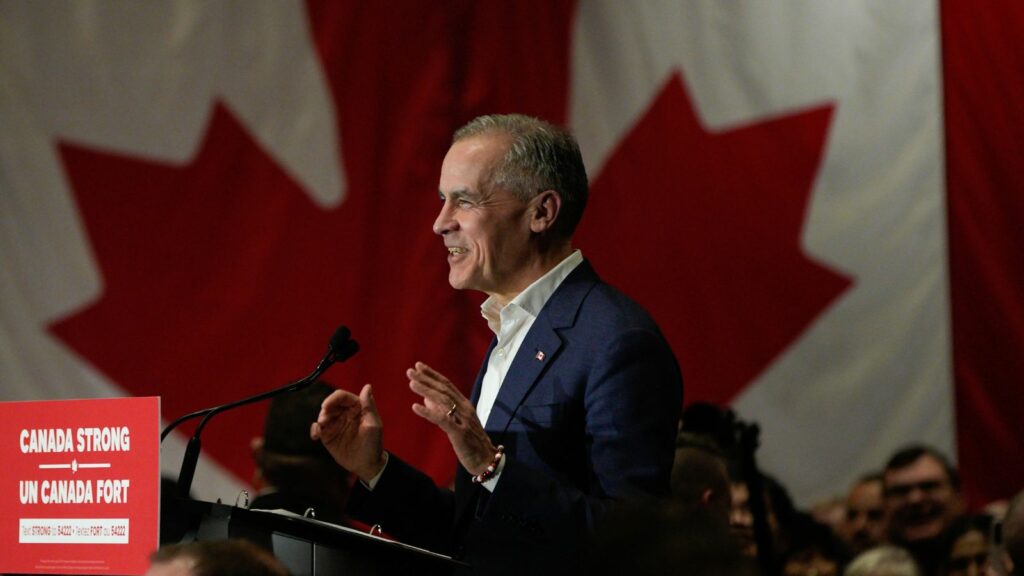
With Alberta preparing for a historic referendum on October 19, Prime Minister Mark Carney is warning that even taking the first step toward separation could create years of uncertainty for Canadians already facing pressure from Donald Trump’s trade policies.
Speaking at a national unity rally in Calgary on October 15, Carney described a vote against remaining in Canada as a “dangerous bluff,” arguing that the province cannot afford political instability during an increasingly unpredictable period in Canada–U.S. relations.
The referendum will not immediately separate Alberta from Canada. Instead, voters will decide whether the province should remain in Confederation or begin a legal process toward a possible future independence referendum.
Although recent polls show a clear majority favouring Canada, separatist supporters argue that Ottawa has repeatedly failed to respect Alberta’s economic interests. The result could shape federal-provincial relations long after Monday’s ballots are counted.
Alberta Faces a Historic Decision on October 19
For the first time, Albertans will vote in a provincewide referendum that explicitly addresses whether their province should pursue a path toward independence from Canada. The October 19 ballot contains ten questions covering immigration, provincial services, constitutional powers and Alberta’s future within Confederation. The final question presents two choices: remain a province of Canada or instruct the provincial government to begin the legal process required to hold a future binding referendum on separation. Unlike the other nine questions, voters must choose between two options rather than mark yes or no.
The distinction between initiating a process and actually separating is critical. Elections Alberta confirms that the October 19 question is nonbinding, meaning a vote for the second option would not automatically make Alberta independent. Additional legal and constitutional steps would be required. Nevertheless, the result could create substantial political pressure on Premier Danielle Smith’s government. For Albertans watching developments from Calgary, Edmonton or smaller energy-producing communities, the referendum raises immediate questions about political representation, economic stability and whether longstanding disagreements with Ottawa can be resolved without reopening the country’s constitutional foundations.
Carney Warns That Separation Could Become a Dangerous Political Gamble
Carney delivered his latest warning before a large pro-Canada crowd at the Forever Canadian rally in Calgary on October 15. The Prime Minister argued that Alberta’s referendum was arriving at an exceptionally difficult moment, when economic uncertainty and international tensions demanded cooperation rather than division. He rejected the suggestion that supporting a future independence referendum could simply strengthen Alberta’s negotiating position with Ottawa. Describing such an approach as a dangerous bluff, Carney warned that the consequences could extend far beyond the initial vote.
The warning echoes comments he made in May, when he compared the political risks to Britain’s decision to leave the European Union. Carney was governor of the Bank of England during the 2016 Brexit referendum and has repeatedly pointed to the uncertainty that followed that decision. His argument is that voters may intend to send a political warning without fully supporting the consequences of the process they authorize. However, supporters of Alberta independence reject the comparison, arguing that the province deserves a democratic opportunity to reconsider its constitutional relationship with Canada. The central disagreement concerns whether a referendum creates useful negotiating leverage or unnecessary instability.
Trump’s Trade War Makes Canada’s Internal Divisions More Consequential
The debate is unfolding while Canada faces considerable pressure from Washington. President Donald Trump’s tariffs, confrontational trade negotiations and repeated remarks about Canada becoming America’s 51st state have complicated relations between the two countries. Trump has also questioned whether the United States should renew the Canada–United States–Mexico Agreement, commonly known as CUSMA. The agreement’s scheduled 2026 review has therefore become a significant source of uncertainty for businesses dependent on cross-border supply chains, including Canadian energy producers, automakers and manufacturers.
Carney has used those tensions to argue that Canada needs greater national unity and economic independence. At the Calgary rally, he warned that unnamed forces outside Canada’s borders wanted to divide the country for their own advantage. Although the comments were made against the backdrop of Trump’s policies, they should not be interpreted as proof that Washington is directing Alberta’s separatist movement. The economic concern is more straightforward: a prolonged constitutional dispute could complicate investment decisions and Canada’s efforts to diversify trade. An independent Alberta would also have to address its own future trading arrangements, rather than simply assume that existing Canadian agreements would automatically continue unchanged.
Danielle Smith Opposes Separation Despite Calling the Referendum
One of the most unusual aspects of Alberta’s referendum is that Premier Danielle Smith supports remaining in Canada even though her government placed the separation question before voters. Smith says the decision was intended to settle a growing political dispute and allow Albertans to express their preferences directly. During advance voting, she confirmed that she selected the option to remain in Confederation. On October 16, she appeared alongside Carney at a Red Deer brewery, where the two political leaders shared a beer, sang the national anthem and urged Albertans to remain united.
The public display of cooperation followed months of tension over separatist petitions and federal-provincial relations. Elections Alberta verified approximately 222,600 signatures supporting an independence-related citizen initiative in July, while a separate pro-Canada petition had previously received approximately 404,300 verified signatures. Those figures came from different campaigns operating under different requirements and should not be treated as a referendum forecast. Smith also faces a divided political coalition. Some supporters of her United Conservative Party favour advancing the separation process, while others strongly oppose it. The referendum therefore tests not only national unity but also the premier’s ability to maintain cohesion within her own party.
Alberta’s Separatist Movement Is Driven by Longstanding Economic Grievances
Supporters of Alberta independence argue that the province’s relationship with Ottawa has been strained by decades of disputes over energy development, federal taxation, equalization and environmental regulation. Many believe governments in central Canada have benefited disproportionately from Alberta’s resource wealth while restricting its ability to develop and export oil and natural gas. Alberta’s government has frequently criticized federal emissions policies and regulatory requirements, arguing that they discourage investment and undermine provincial jurisdiction. These complaints help explain why calls for greater autonomy resonate even among Albertans who do not necessarily want complete independence.
The dissatisfaction predates the current referendum. In 2021, approximately 61.7% of Albertans voting in a provincial referendum supported removing the Constitution’s equalization commitment, although the result did not change federal law. More recently, separatist organizers have argued that federal policy changes under Carney remain insufficient. Their preferred solutions range from stronger provincial authority to establishing Alberta as an independent country. Opponents counter that separation would not automatically resolve disputes over market access, government revenue or regulation. Instead, it could introduce new negotiations involving trade, taxation, public debt and constitutional obligations. Both perspectives reflect genuine concerns about Alberta’s long-term economic position, but they offer sharply different approaches to addressing them.
Polls Show Most Albertans Want to Stay, but Many Still Want Ottawa to Listen
Recent public opinion research suggests the separatist movement faces an uphill battle. An Angus Reid Institute poll released October 16 found that 66% of Albertans supported remaining in Canada, compared with 34% favouring the option of pursuing a future binding separation referendum. The online poll surveyed 1,010 Alberta adults between October 13 and 15 and weighted the results to reflect provincial demographics. The findings indicate a substantial advantage for the remain campaign, although voting intentions are not the same as counted ballots.
Perhaps the most revealing result concerns why some Albertans support the second option. Among those favouring another referendum, 60% said their motivation was to send a message to Ottawa, while 37% identified separation itself as their motivation. This distinction strengthens Carney’s argument that some voters may be considering the referendum as a negotiating tactic rather than endorsing independence. Earlier Ipsos research found that only 14% of Albertans said they would vote to leave Canada in an actual independence referendum, a different question from Monday’s ballot. Angus Reid also found that 62% believe Alberta’s separatist movement will never disappear entirely, suggesting that even a decisive remain victory may not settle the underlying debate.
Alberta’s Energy Industry Is at the Centre of the Economic Debate
Alberta’s importance to the Canadian economy is closely tied to its oil and natural gas resources. According to the Canada Energy Regulator, Canada exported approximately 4.3 million barrels of crude oil per day in 2025, with about 90.1% going to the United States. Much of that production originates in Alberta, leaving the province deeply connected to American energy markets. The relationship supports Canadian producers and American refiners, but it also makes market diversification an important economic objective, particularly during periods of strained trade relations.
Carney and Smith have recently highlighted the proposed Pacific Link pipeline as evidence that federal and provincial cooperation can produce tangible benefits. On October 1, Ottawa designated the proposed West Coast oil pipeline a project of national interest. The plan envisions expanding access to Asian markets, with the federal government estimating that it could eventually accommodate an additional one million barrels of oil per day. The project remains in development and requires further consultation, planning and regulatory work. Its projected employment and economic benefits are government estimates, not outcomes already achieved. For separatist supporters, the initiative may demonstrate the value of pressuring Ottawa. For federalists, it provides an example of what Alberta can accomplish through cooperation within Canada.
Indigenous Treaty Rights Complicate Any Path Toward Independence
A potential Alberta separation would involve far more than negotiations between Edmonton and Ottawa. First Nations throughout the province hold treaty rights established through agreements with the Crown, many predating Alberta’s creation as a province in 1905. Indigenous leaders have warned that proposals to remove Alberta from Canada raise serious questions about those agreements, territorial rights and the obligations governments owe Indigenous peoples. Their concerns are particularly important because a provincewide referendum cannot, by itself, extinguish constitutionally protected treaty rights.
The legal significance became clear in May, when Alberta Court of King’s Bench Justice Shaina Leonard ruled against an earlier separatist petition process. The judge found that the province had failed to fulfill its duty to consult affected First Nations before permitting the initiative to proceed. Alberta challenged the decision, and Elections Alberta subsequently completed a separate signature-verification process following another judicial ruling. These developments show that procedural questions and Indigenous rights remain contested. Any serious movement toward independence would have to address these obligations directly. The debate cannot be resolved solely by counting votes among the broader provincial electorate while leaving the rights of treaty nations unanswered.
Canada’s Constitution Makes Separation Far More Complicated Than a Single Vote
Canadian constitutional law does not give a province the power to declare independence unilaterally. In its 1998 Reference re Secession of Quebec, the Supreme Court of Canada established that a clear expression of support for separation on a clear referendum question would create an obligation to negotiate, not an automatic right to depart. Those negotiations would have to respect federalism, democracy, constitutional law and minority rights. The subsequent federal Clarity Act gave the House of Commons responsibilities for evaluating whether a separation question and its result demonstrate a sufficiently clear democratic mandate.
That framework matters because Alberta’s October 19 question does not directly authorize independence. It asks whether the province should begin the process toward a possible future referendum. Even if that option receives majority support, the result would not satisfy every legal requirement for separation. A later process could involve disagreements about constitutional amendments, the division of government assets and liabilities, citizenship, borders and the protection of Indigenous rights. These questions are not necessarily impossible to negotiate, but their complexity explains why Carney has emphasized the risk of prolonged uncertainty. A provincial majority expressing dissatisfaction with Confederation would not, on its own, establish a new country.
Monday’s Results Could Reshape Alberta–Ottawa Relations for Years
Elections Alberta plans to count the separation-related question first after voting closes on October 19. Ballots will be counted manually, with unofficial results expected within 48 hours under the rules governing a referendum with ten questions. A strong vote to remain in Canada would reinforce the position taken by Carney, Smith and federal Conservative Leader Pierre Poilievre. It could also encourage renewed negotiations over energy development, provincial powers and economic diversification without opening a formal independence process. However, a remain victory would not necessarily eliminate the separatist movement or the concerns that helped sustain it.
A majority favouring the second option would create a different challenge. Smith has indicated that she would respect the result and begin the steps associated with pursuing a future binding referendum, although constitutional and legal limitations would still apply. Businesses, investors and governments would then face uncertainty about how far the process might advance. Neither outcome guarantees a lasting political settlement. The broader question is whether Alberta and Ottawa can rebuild confidence while Canada navigates a difficult relationship with the United States. As Carney’s warning makes clear, Monday’s referendum concerns more than Alberta’s political identity; it will also test how Canadians respond to internal divisions dur
