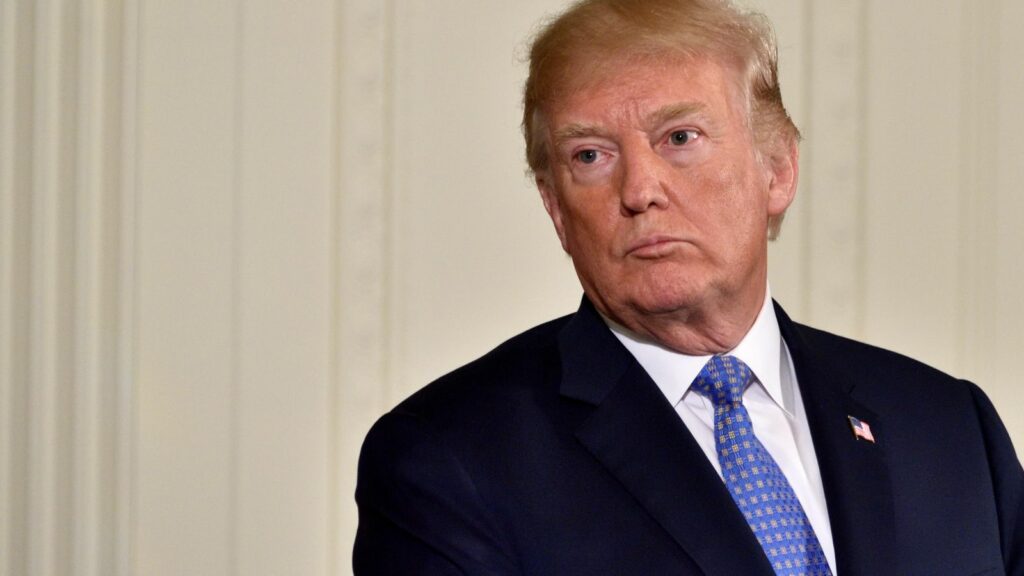
Donald Trump’s trade war with Canada is creating an unexpected problem for Republicans trying to hold onto Congress. With the November 3 midterm elections approaching, several candidates are publicly challenging the president’s tariffs, warning that the measures are increasing costs for American families and threatening businesses that depend on cross-border commerce.
The political shift is particularly visible in Michigan, Maine and New Hampshire, where Canadian trade supports manufacturers, farmers and local employers. Republican candidates who previously defended Trump’s economic agenda are now facing difficult questions about whether protecting American industries through tariffs is doing more harm than good.
The growing disagreement comes as U.S. inflation reaches 3.7%, Canada maintains retaliatory duties, and negotiations between Ottawa and Washington remain stalled. For Canadian businesses, the American election is becoming another important factor in an already uncertain trade relationship.
Michigan Republican Mike Rogers Breaks With Trump on Canadian Tariffs
Michigan Republican Senate candidate Mike Rogers made one of the clearest breaks with Donald Trump’s trade policy on October 7, releasing a campaign advertisement calling for an immediate end to the tariff dispute with Canada. Sitting in a neighbourhood bar with a bottle of Canadian-made Labatt Blue beer, the former congressman declared that Canada was not America’s enemy. Rogers said the escalating trade confrontation was hurting Michigan businesses and consumers, promising to work across party lines to reduce costs if elected to the Senate.
His position represents a notable reversal. Only weeks earlier, Rogers had defended Trump’s tariffs as necessary to advance the president’s America First agenda, although he acknowledged they were not appropriate for every situation. The timing has attracted attention because Rogers is competing against Democrat Abdul El-Sayed in one of the country’s most closely watched Senate races. Rogers argues that his relationship with Trump could help resolve the dispute, while his opponent accuses him of changing positions for political advantage. The disagreement has made Canadian trade an unusually prominent election issue.
Michigan’s Economic Dependence on Canada Makes the Tariffs Personal
Michigan has substantial economic reasons to question an escalating trade conflict with Canada. The state conducted more than US$66 billion in trade with its northern neighbour in 2025, according to figures cited by The Washington Post. Much of that commercial relationship involves industries that operate on both sides of the border, particularly automobile manufacturing. Components such as steering mechanisms, fasteners, steel products and other automotive parts regularly move between Ontario and Michigan before being incorporated into finished vehicles. Tariffs can raise costs at several points in that process.
The economic consequences are also influencing voters. A Washington Post–Schar School survey conducted September 10–14 found that more than 60% of likely Michigan voters opposed Trump’s 50% tariffs on specified Canadian goods. Among independents, opposition reached 68%, compared with 89% among Democrats. A majority of Republicans surveyed, 56%, supported the tariffs, illustrating the political divide. Cost of living was the leading concern for nearly half of respondents. For businesses making long-term manufacturing decisions, uncertainty about future trade restrictions can be as damaging as the immediate financial burden.
New Hampshire Republican John Sununu Says the Canada Trade War Must End
Former Republican senator John E. Sununu has also distanced himself from Trump’s tariff strategy while campaigning to return to the Senate. During an October 5 appearance before the Nashua Rotary Club, Sununu criticized the administration’s trade confrontation with Canada, arguing that tariffs on imported building materials were contributing to higher housing costs. His opposition is particularly significant because Trump endorsed Sununu in his race against Democratic Representative Chris Pappas. Rather than rejecting the president’s entire economic agenda, Sununu is emphasizing areas where he believes American consumers are paying an unnecessary price.
Housing affordability is a major concern in New Hampshire, where construction expenses and household budgets remain prominent election issues. Canadian lumber and other building materials are important to the regional economy, making tariffs relevant beyond manufacturing. Sununu has also called for greater access to Canadian hydroelectric power as one way to address energy costs. His campaign reflects the challenge of representing a state with close Canadian connections while maintaining support among Republican voters who approve of Trump’s broader policies. Sununu’s opposition illustrates how regional economic interests can produce disagreements within the same political party.
Susan Collins Warns Maine Families and Businesses Are Paying the Price
Republican Senator Susan Collins has been another outspoken critic of broad tariffs on Canadian products. In an August 22 statement, Collins warned that deteriorating negotiations were increasing costs and uncertainty for Maine businesses. She noted that Maine imports approximately US$2 billion in non-petroleum products from Canada annually, making the state particularly vulnerable to disruptions. Collins subsequently told federal officials that roughly US$170 million in Maine goods faced announced Canadian retaliatory tariffs, with forest products accounting for approximately 62% of the affected value.
The concerns extend to employers and municipal budgets. Collins reported that two Maine paper mills had warned her about substantial additional expenses, while the border community of Frenchville faced an estimated US$10,000 increase in road-salt costs. Canada removed seafood and lobster from an earlier retaliation proposal, preventing another potentially significant burden on Maine’s fishing industry. Collins, who is seeking re-election against Democrat Troy Jackson, has urged Washington and Ottawa to negotiate a settlement. Unlike some Republican candidates, her opposition is not a recent campaign reversal: she previously supported congressional efforts to restrict tariff powers and create exemptions for American small businesses.
Not Every Republican Is Turning Against Trump’s Trade Strategy
The emerging disagreements do not amount to a complete Republican rejection of tariffs. In Kansas, Republican Senator Roger Marshall has defended Trump’s trade approach despite complaints from farmers about higher costs and restricted export opportunities. His Democratic challenger, Adam Hamilton, has criticized the policy’s consequences for Kansas businesses, particularly those connected to Canadian aerospace manufacturing. Both candidates have opposed measures that could threaten Bombardier’s operations in Wichita, but they disagree over the broader value of tariffs. Their contest demonstrates how candidates can share concerns about particular industries while reaching different conclusions about trade policy.
Other Republicans remain firmly aligned with the White House. Wisconsin Representative Derrick Van Orden, campaigning for re-election in a competitive district, has supported Trump’s tougher position toward Canadian trade practices, particularly in dairy. Van Orden argues that American farmers deserve stronger protections against foreign policies they consider unfair. The administration similarly maintains that tariffs are intended to protect workers, encourage investment and create better negotiating conditions. Critics counter that businesses and consumers absorb much of the expense. The division is therefore not simply between supporters and opponents of free trade, but between competing assessments of how economic pressure should be used.
Inflation Reaches 3.7% as Tariffs Become an Affordability Issue
The latest inflation figures have intensified the political pressure. On October 14, the U.S. Bureau of Labor Statistics reported that consumer prices rose 3.7% over the 12 months ending in September, accelerating from 3.4% in August. Prices increased 0.6% during September alone, with gasoline climbing 9.1% and accounting for more than half of the monthly increase. Energy disruptions associated with the conflict involving Iran have played a major role, meaning tariffs cannot reasonably be blamed for the entire inflation increase.
Nevertheless, economic research shows that import duties contribute to consumer costs. A Federal Reserve Bank of New York study published in 2026 estimated that approximately 26% of the studied tariff increase passed through to consumer prices, including indirect effects on domestically manufactured goods. Businesses importing components can face higher expenses, while domestic competitors may increase prices when imported alternatives become more expensive. Such effects often emerge gradually rather than immediately. For Republican candidates promising affordability, explaining why additional trade barriers are necessary becomes more difficult when households are already struggling with fuel, housing and everyday expenses.
Voter Opposition Is Giving Democrats an Opening
Public dissatisfaction with Trump’s tariff policies extends beyond individual manufacturing states. An Associated Press report published in October cited polling showing that more than 64% of Americans believed the president had gone too far with his latest tariffs, compared with 58% in January. The findings indicate declining support for an economic policy Trump has repeatedly defended as central to his presidency. They do not establish how every respondent will vote, but they help explain why candidates in competitive races are emphasizing affordability.
Democrats are using the issue to challenge Republicans who previously supported the administration’s policies. In Michigan, Abdul El-Sayed criticized Mike Rogers after his October advertisement, arguing that the Republican’s sudden change of position reflected electoral concerns rather than a genuine policy shift. During their October 8 debate, Rogers said he had contacted the White House to encourage a settlement with Canada. The exchange highlighted a political vulnerability: candidates must explain not only their present position but also their earlier support for measures they now question. Voters are being asked to judge which candidate offers a credible approach to protecting jobs and lowering costs.
The Canada–U.S. Trade War Has Expanded Beyond Automobile Tariffs
The dispute involves several different tariff programs, creating confusion about which products are affected. On August 22, Washington imposed 50% duties on specified Canadian goods under Section 338 of the Tariff Act of 1930. Canadian government guidance identifies affected categories including plastics, furniture, electronics, paper products, industrial machinery and other manufactured goods. These measures differ from the existing 25% sectoral tariffs on automobiles and trucks. Under the automotive rules, qualifying vehicles receive an exemption for their U.S. content, while eligible automotive parts have separate exemptions.
Canada responded on September 8 with additional countertariffs covering approximately C$27.6 billion in American products. Depending on the category, duties range from 15% to 50%, affecting industries such as metals, dairy, agricultural equipment and manufactured goods. Washington subsequently modified some tariffs and implemented import prohibitions on specified Canadian products in late September. These measures have not eliminated the Canada–United States–Mexico Agreement, which remains in force. However, some newer duties apply even to products that otherwise meet CUSMA requirements. That distinction explains why a trade agreement and a costly tariff dispute can exist simultaneously.
Republican Candidates Face a Difficult Choice Between Trump and Local Voters
The tariff disagreement is part of a broader effort by vulnerable Republican candidates to establish independence from the president. An October 7 Reuters review of 62 competitive congressional contests found that Republican candidates in 41 races had either disagreed with Trump on particular policies or attempted to reduce their visible association with him. Those differences covered several subjects, including the Iran conflict and technology infrastructure, rather than tariffs alone. The findings nevertheless help explain why trade policy has become politically sensitive in states with substantial Canadian economic connections.
Trump remains influential within the Republican Party, and candidates cannot assume that criticizing his policies will automatically improve their electoral prospects. Supporters of tariffs argue that temporary economic pressure may ultimately encourage investment and secure more favourable trade terms. Opponents emphasize the immediate effects on supply chains and consumer prices. Political disagreements are complicated by mixed economic indicators: U.S. manufacturing output increased 0.3% in September, according to Federal Reserve data reported by Reuters, while motor vehicle and parts production declined 3%. Neither figure alone establishes the overall success or failure of tariffs. Candidates must balance competing evidence and voter expectations.
Canada’s Trade Future Could Be Influenced by the November Election
For Canada, the approaching November 3 midterm elections introduce another important variable into an already difficult relationship. Prime Minister Mark Carney suspended formal trade negotiations with Washington in August after rejecting proposed terms his government considered economically unacceptable. Ottawa has maintained retaliatory measures while pursuing greater economic diversification. At the same time, the United States declined to extend CUSMA during its July 2026 joint review. The agreement remains legally in force, with further review activity scheduled for 2027 and public submissions currently due January 12.
The election could influence Washington’s willingness to compromise, particularly if Republicans lose congressional seats in regions affected by Canadian tariffs. A change in congressional control could strengthen oversight of trade decisions or encourage legislative challenges to presidential tariff authority. However, election results would not automatically repeal existing duties or guarantee a new trade agreement. The president retains substantial authority under various trade laws, subject to legal and congressional constraints. For Canadian manufacturers and exporters, the immediate priority remains predictable market access. The growing willingness of American Republicans to criticize tariffs suggests that economic pressure is becoming harder to dismiss, but whether that political disagreement produces meaningful tariff relief remains uncertain.
