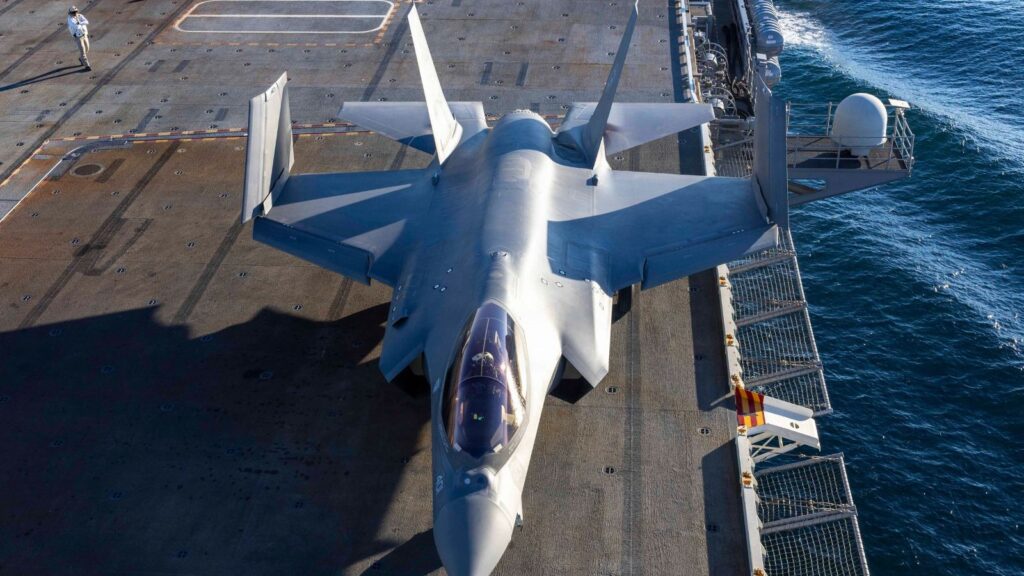
Canada’s multibillion-dollar fighter-jet decision has acquired a new transparency problem just as the first Canadian F-35s begin arriving. National Defence is refusing to say whether it has received a restricted U.S. government review examining F-35 production and modernization—information that could be directly relevant to Prime Minister Mark Carney’s still-unfinished reassessment of Canada’s planned 88-aircraft fleet.
The U.S. Government Accountability Office produced the congressionally mandated review in 2026, but the Pentagon determined that it contained Controlled Unclassified Information and prevented public release. That distinction matters: the report is restricted, but it is not formally classified “Secret.” With Ottawa weighing cost, capability, industrial benefits and alternatives, the unanswered question is not simply what Washington is withholding from the public. It is whether Canadian decision-makers have seen it themselves.
The Report Ottawa Won’t Discuss
The immediate controversy is unusually straightforward. On October 26, the Ottawa Citizen reported that National Defence would not say whether Canada had received the latest U.S. Government Accountability Office review of the F-35 program. GAO’s 2026 acquisition list confirms the report exists under the title “F-35 Joint Strike Fighter: Update on Production and Modernization Efforts,” with the identifier GAO-26-108728SU. Unlike the public annual F-35 assessments available in previous years, this one cannot be publicly scrutinized.
The Pentagon reviewed the document and determined that it contained Controlled Unclassified Information, according to reporting based on a GAO spokesperson. That label restricts distribution, but under U.S. rules it is distinct from classified national-security information. The practical result is still significant: authorized lawmakers can see the review, while the public cannot. For Canada, the missing piece is whether Ottawa obtained access while reconsidering a purchase worth tens of billions of dollars during an unusually consequential defence procurement review.
Why This GAO Review Matters to Canada
Congress did not order a ceremonial progress report. U.S. law requires GAO’s annual F-35 reviews to assess the program’s cost, scope and schedule, the status of modernization work, and other issues the watchdog considers important. Those categories overlap directly with Canada’s decision: how quickly aircraft can be delivered, what capabilities they will have, what modernization will cost and whether the program can support a growing international customer base.
The last public annual review showed why fresh information matters. GAO reported in September 2025 that Block 4 modernization was more than US$6 billion above its original estimate and at least five years behind the initial schedule. Lockheed Martin delivered 110 F-35s in 2024, all late by an average of 238 days, up from 61 days a year earlier. That does not prove the restricted 2026 review contains worse findings. It does show why Canada would have a strong interest in the newest assessment before making a difficult-to-reverse decision.
Carney’s Review Has Become a Decision Without a Deadline
Carney ordered a review of the planned F-35 acquisition on March 14, 2025, after the government had already selected the aircraft and finalized arrangements for an 88-jet fleet in 2023. Public Services and Procurement Canada says National Defence is leading the review with input from key stakeholders, while an independent defence-acquisition panel is providing separate advice. Ottawa says the process considers operational requirements, NORAD and NATO commitments, industrial benefits, strategic relationships and potential alternatives.
The reassessment has stretched well beyond its earlier timetable. Federal briefing material once anticipated completion by the end of September 2025, yet Defence Minister David McGuinty confirmed in April 2026 that the work was still underway and gave no deadline. Canada remains financially committed to the first 16 aircraft. That leaves a narrowing policy space: Ottawa can reconsider the balance of the fleet, but each delivery, training investment and infrastructure commitment makes a major change more complicated and potentially more expensive.
The First Canadian F-35s Have Already Arrived—In Arizona
The debate is no longer about aircraft that exist only in procurement documents. Canada accepted its first two CF-35A fighters at Luke Air Force Base in Arizona in October 2026 while the review of the full purchase remained unresolved. The jets are part of an initial group intended to support Canadian pilot and aircrew training in the United States before aircraft begin operating from Canadian bases. Their arrival gives the program a physical reality that was absent when Carney ordered the reassessment.
Canada’s transition plan calls for the first eight aircraft to support training at Luke, with the first F-35 scheduled to arrive in Canada in 2028. Initial operational capability is targeted for 2029, with full capability expected in the early 2030s. Two processes are therefore moving at once: the military is implementing the F-35 transition it was previously directed to execute, while the government is deciding whether the original 88-aircraft structure still makes strategic and economic sense.
Canada’s Price Tag Has Already Jumped Sharply
The financial picture changed substantially before the current review was completed. Canada’s Auditor General found that National Defence’s estimate for the Future Fighter Capability Project rose from C$19.0 billion in 2022 to C$27.7 billion in 2024, an increase of 46 per cent. Inflation, foreign-exchange movements and higher facility costs contributed. The audit also found that the 2022 estimate relied on older information and carried only a 50 per cent confidence level, leaving a substantial risk of higher eventual costs.
The C$27.7-billion figure does not capture every expense required for full operational capability. The Auditor General said essential infrastructure upgrades and advanced weapons excluded from the project estimate would add at least C$5.5 billion. Two new fighter squadron facilities were expected to be completed in 2031, more than three years later than planned, forcing an interim operating solution that will add further expense. In that context, access to the newest U.S. production and modernization data becomes part of responsible cost control.
Public U.S. Data Show a Serious Readiness Problem
Even without the restricted production review, public U.S. oversight has identified significant sustainment problems. In June, GAO reported that the F-35 fleet’s mission-capable rate fell from 67 per cent in fiscal 2021 to 44 per cent in fiscal 2025. The full-mission-capable rate—measuring whether an aircraft can perform all assigned missions—declined from 38 per cent to 25 per cent. GAO linked the difficulties to issues including spare-parts shortages, contractor dependence, technical-data limitations and constrained repair capacity.
The Joint Program Office has responded with a sustainment reset aimed at improving readiness by 2030, but GAO estimated it would require roughly US$13.7 billion more than previously planned through fiscal 2031. These are U.S. fleet figures, not a forecast of future Canadian availability. Canada will operate within the same multinational support ecosystem, however, making its health relevant. A sophisticated fighter is strategically useful only when enough aircraft can be maintained, updated, armed and flown when required.
Operational Sovereignty Is More Complicated Than a “Kill Switch”
Concerns about U.S. leverage over the F-35 are often reduced to claims about a remote “kill switch.” Canada’s own briefing material says there is no such switch and that Canada will own and operate its CF-35As and control how they are used. Ottawa also says partner nations participate in decisions about software upgrades, while Canada takes part in the Australia-Canada-United Kingdom Reprogramming Laboratory, which develops mission data needed to employ the aircraft in different environments.
That does not mean the fleet operates independently of the broader F-35 system. The aircraft relies on a multinational Global Support Solution in which participants share support sources such as spare parts, depot maintenance and training. Hardware and software modernization are coordinated across partner countries. The sovereignty question is therefore more practical than a hidden switch: how resilient are Canada’s access to parts, technical data, software updates and repair capacity during a political or military crisis? Current sustainment information is directly relevant to that assessment.
Gripen Offers Diversification, but Not a Simple Escape
Saab has used the extended review to revive its case for the Gripen E, emphasizing Canadian industrial participation. Reuters reported discussions with Ottawa and Bombardier about licensed Canadian production, including a Saab estimate of roughly 10,000 jobs. In 2026, Saab and CAE announced a conditional arrangement covering Canadian training, mission-systems engineering and sustainment if Gripen is selected. GE Aerospace and Magellan separately announced a conditional plan for Canadian maintenance of the GE F414 engine that powers the fighter.
Those proposals are not contracts, and their benefits depend on an order. The F-35 already has a Canadian supply-chain footprint: National Defence said in May that more than C$5.2 billion in contracts had gone to more than 110 Canadian companies, with 37 holding active work. Gripen could diversify Canada’s fighter relationship, but its F414 is also an American-made GE engine. The comparison is therefore not U.S. dependence versus complete independence, but different combinations of capability, industrial control, supply-chain exposure and cost.
The CF-18 Retirement Clock Is Still Running
Ottawa does not have unlimited time to debate the replacement. National Defence says Canada has exhausted available opportunities to extend the CF-18 fleet, which has already begun retiring and is scheduled to leave service completely in 2032. The department says the replacement fighter capability must be operational by then to avoid a gap in NORAD and NATO commitments. Under the current plan, F-35s begin arriving in Canada in 2028, with initial operational capability targeted for 2029 and full capability in 2033.
That schedule helps explain why a mixed fleet or late switch carries consequences beyond purchase price. Different aircraft can require separate training systems, maintenance pipelines and inventories, and Reuters reported that defence officials had warned such duplication could weaken the military and financial case for splitting the fleet. That does not settle the political choice. It makes the withheld U.S. review more relevant: Ottawa is nearing a decision point where delaying, changing course and proceeding all carry costs, while room for adjustment is shrinking.
