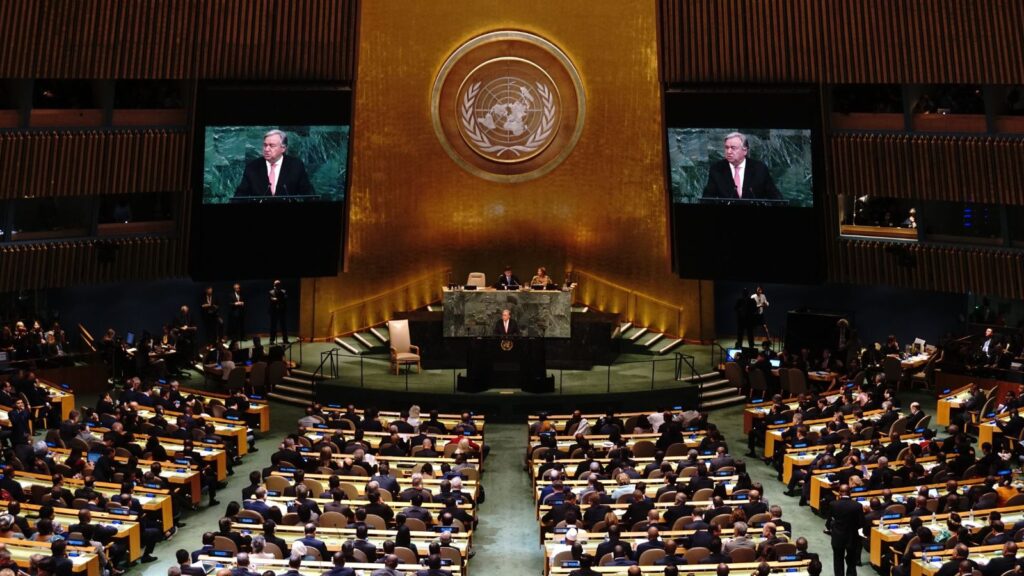
Canada has once again broken ranks with Washington over one of the United States’ longest-running foreign policy disputes, joining 129 other countries in a United Nations vote calling for an end to the American economic embargo on Cuba. The October 28, 2026, resolution passed with 130 votes in favour, 17 against and 25 abstentions, marking the 34th time the General Assembly has approved such a measure.
But behind that overwhelming majority lies a significant diplomatic shift. Support dropped sharply from 165 countries in 2025 as President Donald Trump’s administration intensified its campaign to persuade governments to change their positions. For Canada, the decision reinforced decades of diplomatic independence on Cuba, while exposing growing divisions over American sanctions, international trade and the humanitarian crisis facing millions of Cubans.
Canada’s Vote Reinforces a Decades-Old Diplomatic Position
Canada’s decision was not a sudden change in foreign policy. Ottawa has supported the UN call to end the embargo since the General Assembly began voting on the issue in 1992. Its relationship with Havana stretches further back: Canada opened its first Caribbean diplomatic mission in Cuba in 1945 and recognized the post-revolutionary government in 1959. Unlike most countries in the Americas, Canada kept diplomatic channels open after the Cuban Revolution, even when relations between Havana and Washington hardened.
That history gave this year’s vote extra significance. Days before the ballot, Cuban ambassador Rodrigo Malmierca Díaz publicly urged Canada to hold the line, while Global Affairs Canada said it was still considering its position. Ottawa had abstained on a separate July procedural motion to hold another debate, raising questions among supporters of its longstanding policy. By voting yes on October 28, Canada answered the immediate question without abandoning its parallel demand for political reform and human rights protections in Cuba.
The 130-Country Majority Hides a Major Diplomatic Shift
At first glance, the October 28 decision looks like another landslide against Washington. Of the 172 countries voting or formally abstaining, 130 supported ending the embargo. Only 17 opposed the measure, including the United States and Israel, while 25 abstained. Twenty-one of the UN’s 193 members did not record a vote. Yet the comparison with 2025 changes the story: support fell by 35 countries, opposition rose from seven to 17, and abstentions more than doubled from 12 to 25.
Some of the most consequential changes came from governments that had previously backed Cuba’s resolution. Germany, Italy, the Netherlands and South Korea abstained; Colombia and Trinidad and Tobago moved into the no column. The vote still showed that a clear majority of UN members reject the embargo. It also suggested Washington had succeeded in reducing the near-universal consensus that once surrounded the issue. A large victory for Havana, in other words, was also a warning about its shrinking diplomatic margin.
Trump’s Administration Finds Success in Changing Countries’ Votes
Washington did not treat this year’s vote as a ceremonial rebuke. U.S. Ambassador Mike Waltz urged delegations to reject Havana’s resolution, arguing that it masked repression by Cuba’s communist government. After the result, he openly welcomed shifts by countries including Germany and South Korea. The numerical change gave his team a talking point: 42 nations either opposed the measure or abstained, versus 19 in 2025, even though the resolution still passed comfortably.
Cuban Foreign Minister Bruno Rodríguez offered a much darker explanation for the movement. Before the vote, he alleged that U.S. officials had threatened governments with visa restrictions, trade penalties and other reprisals unless they changed their positions. Reuters reported the allegations; they were not independently established, and the State Department had not provided an immediate response when asked. Washington, meanwhile, publicly presented its lobbying as an effort to prevent Cuba’s leaders from using a UN vote to deflect criticism of their human-rights record. Both governments claimed a measure of success, but for different reasons.
Cuba Says the Embargo Is Deepening an Already Serious Humanitarian Crisis
For Cuban families, the dispute is more than an argument about diplomatic principles. Havana resident Luis Manuel Cepero told Reuters that the value of the vote lay in making outsiders understand the embargo’s effects on everyday life. In the island’s cities, fuel scarcity and prolonged electricity outages can mean spoiled food, unreliable transport and pumps that cannot deliver water. Those problems touch households long before they appear in an economic report.
At the General Assembly, Foreign Minister Bruno Rodríguez blamed the U.S. restrictions for shortages of medicines, food and other essentials, portraying the policy as collective punishment. Those are Cuba’s allegations, but independent United Nations humanitarian officials have documented severe disruption to healthcare and basic services. In May, UN officials reported more than 100,000 patients awaiting delayed surgery, including roughly 11,000 children. The numbers do not establish that sanctions alone caused every shortage; Cuba’s aging infrastructure and internal economic failures have also contributed. They do show why a diplomatic dispute can become intensely personal.
Washington Argues Cuba’s Government Is Responsible for Its Economic Problems
U.S. officials rejected Havana’s portrayal of the crisis, arguing that decades of state control, weak investment and political repression have driven Cubans’ hardships. During the UN debate, Ambassador Mike Waltz challenged the term “blockade,” saying American goods still reach the island. He cited more than US$876 million in U.S. exports to Cuba during the first eight months of 2026, including fuel permitted for eligible private businesses. His argument was that a commercial embargo is not the same as a complete physical cutoff.
U.S. regulations do contain humanitarian channels: the Commerce Department generally approves qualifying medicine and medical-device exports, and agricultural sales can be authorized under specific rules. Yet those exceptions do not erase practical obstacles involving payments, licensing, shipping and access to fuel. Nor do they resolve Cuba’s domestic governance problems. This is the central disagreement: Washington emphasizes the Cuban government’s responsibility for economic collapse, while Havana and many UN members argue that American restrictions make an already troubled economy harder to repair.
Fuel Shortages Collapse Transport and Threaten Essential Services
Fuel shortages are now shaping nearly every part of daily life. Cuba’s transportation minister said in October that daily interprovincial bus services from Havana had fallen from 419 to just 11 and projected a 75% decline in public-transport trips for 2026. That makes visiting relatives, commuting to work or reaching a hospital a complicated logistical task. The same shortage strains the electrical grid, which suffered another nationwide collapse in September, leaving homes and businesses struggling to keep lights and refrigeration running.
Trump’s January executive order created a mechanism to impose tariffs on countries supplying oil to Cuba. However, the administration ended the related tariff duties in February after a Supreme Court ruling; other U.S. sanctions and fuel-enforcement measures continued. In October, American authorities reported seizing 90 biodiesel shipments valued at nearly US$3 million that were headed to a sanctioned Cuban state company. The distinction matters because a withdrawn tariff threat did not mean the broader campaign had stopped. For households, fuel availability—not the legal machinery behind it—remains the immediate concern.
Why Cuba Remains Important to Canadian Travellers and Businesses
Canada’s vote also reflects a relationship measured in people and businesses, not just diplomacy. According to Global Affairs Canada, roughly 700,000 Canadians travelled to Cuba in 2025, and until 2026 Canada was the island’s largest source of tourists. For decades, Canadian winter visitors have filled Cuban resort towns while Canadian firms invested in mining, energy, agriculture and tourism. In 2025, Cuba was Canada’s largest merchandise-export market in the Caribbean and Central American subregion.
That familiarity has run up against rapidly deteriorating conditions. On February 11, 2026, Ottawa raised its nationwide travel advisory for Cuba to “avoid non-essential travel,” citing shortages of fuel, electricity, food, water and medicine—even at resorts. Canadian companies face tightening operating constraints, the federal government says. The UN vote cannot restore a cancelled flight, power a hotel or guarantee a shipment. It does, however, affirm Ottawa’s preference for maintaining trade and diplomatic engagement rather than adding another layer of isolation.
Canada’s Support for Ending Sanctions Is Not an Endorsement of Havana
Supporting the resolution does not mean Ottawa endorses Cuba’s one-party political system. Canada’s official bilateral policy calls for open dialogue, but it also presses Havana to respect human rights, release political prisoners and pursue economic and democratic reforms. Global Affairs Canada repeated those concerns in the days before the ballot. It is a position that distinguishes opposition to broad U.S. economic restrictions from approval of the Cuban government’s own decisions.
Canada has also backed that position with assistance. Ottawa says it announced C$13.5 million in support since February 2026 for food security, health services, emergency supplies and logistics, channelled through organizations with safeguards intended to keep aid directed to Cuban people. At home, Cuban diplomats, solidarity groups and the Bloc Québécois urged the government to maintain its vote. These competing pressures help explain why the decision mattered politically: Canada could oppose the embargo while insisting that Havana remains accountable for its treatment of citizens.
A Heated UN Confrontation Shows How Deep Tensions Have Become
Debate in New York turned unusually acrimonious before the ballots were cast. On October 27, Ambassador Waltz accused Cuba’s leaders of benefiting while ordinary citizens struggled, and Foreign Minister Rodríguez interrupted to challenge his statements. The exchange forced a brief suspension of the General Assembly meeting. It was a striking scene for an institution built on formal rules, with the foreign-policy argument suddenly unfolding as a confrontation on the assembly floor.
Tensions escalated over an encounter involving a Cuban diplomat and an American official who was filming. Waltz accused Richard Tur de la Concepción, a first secretary at Cuba’s UN mission, of assaulting an American diplomat and said he would be expelled from the United States. Cuba disputed the American account and lodged a complaint over the U.S. staffer’s conduct. The incident did not change the wording of the embargo resolution, but it illustrated just how little space remained for ordinary diplomacy between the governments. By voting day, each side was already accusing the other of intimidation.
The UN Vote Sends a Message but Cannot Lift the Embargo
Even a 130-country majority cannot force Washington to repeal the embargo. General Assembly resolutions of this kind are nonbinding, and much of the U.S. sanctions framework is written into congressional legislation, notably the 1996 Helms-Burton Act. Congress would need to act to end the broader statutory embargo, although presidents retain some room to adjust how restrictions are administered. Similar resolutions have passed every year since 1992, apart from the pandemic-related interruption in 2020, without achieving that result.
What the vote changes is the diplomatic record. Canada and most participating governments have again rejected the embargo, while Washington can point to a larger group of dissenters and abstainers. For policymakers, the immediate questions are practical: whether humanitarian shipments can move, whether Cuba can repair vital services, and whether either government is willing to restart meaningful dialogue. Until those issues move, the General Assembly’s message will remain powerful in symbolism but limited in its ability to change life on the island.
