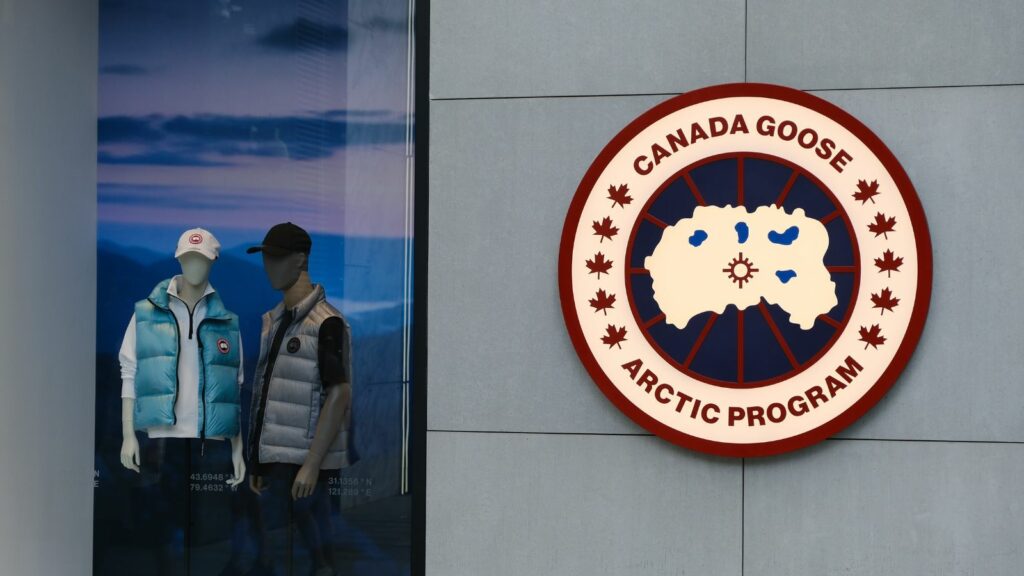
Canada Goose built its reputation on the promise that some of the world’s most recognizable winter jackets are made in Canada. That identity is now colliding with an increasingly difficult U.S. trade environment.
Washington’s 50% additional tariffs on specified Canadian imports, including apparel, threaten to raise the cost of reaching American customers at a time when luxury spending is uneven. UBS has lowered its price target for the Toronto-based outerwear maker by approximately 14%, maintaining a neutral stance ahead of its next quarterly results.
Behind the analyst revision lies a bigger challenge: preserving the craftsmanship and premium positioning that made Canada Goose famous while managing rising trade costs, weaker store traffic and conflicting signals from consumers around the world.
UBS Lowers Its Valuation as Investor Confidence Weakens
UBS has adopted a more cautious outlook for Canada Goose ahead of its fiscal second-quarter earnings announcement. The investment bank reduced its quoted price target from $10.50 to $9, representing a decline of approximately 14.3%, while maintaining its neutral rating. It also lowered earnings-per-share forecasts for fiscal 2027 through 2029 by between 3% and 4%. The changes reflect concern about future profitability, weaker luxury demand and additional expenses associated with U.S. tariffs.
The downgrade does not necessarily suggest that UBS expects a dramatic deterioration in Canada Goose’s immediate financial performance. The bank believes many of the company’s challenges are already reflected in its valuation, which it estimates at approximately 10 times earnings. However, the lower target indicates reduced confidence in the premium investors may be willing to pay for future profits. There is also an important currency distinction: some Canadian reporting describes the new target as C$9, while UBS’s historical research disclosures denominate its U.S.-listed price targets in U.S. dollars. That discrepancy matters when comparing the target with market prices.
Trump’s 50% Tariffs Create a New Cost Challenge
The trade environment changed significantly when the Trump administration announced additional duties on a range of Canadian products in July 2026. The measures, introduced under Section 338 of the Tariff Act of 1930, imposed a 50% additional tariff on specified Canadian-origin imports. Following a brief postponement, the duties took effect on August 22, affecting categories including clothing, textiles, furniture, machinery and electronics. Importantly, the measures also apply to covered Canadian goods that otherwise qualify for preferential treatment under the Canada-United States-Mexico Agreement.
For Canada Goose, the consequences depend on the classification and origin of individual products. A 50% import tariff does not automatically mean a jacket’s retail price must increase by 50%. Duties are calculated on the applicable customs value, which can differ substantially from the final selling price. Companies must decide whether to absorb additional costs, adjust wholesale arrangements or pass some expenses to consumers. Subsequent changes to the U.S. tariff schedules have also made classification more important. This uncertainty complicates decisions involving inventory, shipment schedules and pricing during the industry’s most important selling season.
Canadian Manufacturing Becomes Both an Advantage and a Vulnerability
Canada Goose’s Canadian identity has long distinguished it from competitors that rely primarily on overseas manufacturing. According to its fiscal 2026 annual report, nearly all its down-filled outerwear was manufactured in Canada, with more than 80% produced directly in company-operated facilities. As of March 2026, Canada Goose operated five manufacturing facilities in Canada and one in Romania. Across its owned and contracted manufacturing network, approximately 65% of units were produced in North America, 34% in Europe and 1% in Asia.
That commitment to domestic craftsmanship creates a difficult commercial tradeoff. Manufacturing in Canada supports the brand’s reputation for quality and authenticity, but it also exposes relevant exports to American import duties. Other product categories, including knitwear, footwear and rainwear, are manufactured through international partners, providing some flexibility. The American market is too important to overlook: Canada Goose generated approximately C$385.1 million in U.S. revenue during fiscal 2026, representing roughly one-quarter of companywide sales. Relocating production might reduce certain trade expenses, but doing so could weaken one of the company’s most recognizable brand attributes.
Recent Earnings Reveal a Business Moving in Two Directions
Canada Goose’s first-quarter fiscal 2027 financial results demonstrate why the company’s situation is more complicated than a straightforward sales decline. For the quarter ending June 28, 2026, revenue increased 10.3% year over year to C$118.9 million, exceeding analysts’ expectations. Gross margin improved to 62.4%, compared with 61.4% a year earlier, while wholesale revenue jumped 66.5% to C$29.8 million. However, the wholesale improvement partly reflected shipment timing and larger planned orders rather than an across-the-board recovery in consumer demand.
Regional figures revealed contrasting performance. U.S. revenue fell 19%, while Greater China recorded impressive growth of 44.2%. Direct-to-consumer comparable sales declined 3.2%, even though e-commerce experienced double-digit growth across all regions. The company also reported an adjusted loss of C$0.89 per share, improving from a C$0.91 loss a year earlier. These figures preceded the implementation of the new American tariffs, making them an imperfect indication of future performance. They nevertheless highlight an important reality: Canada Goose has demonstrated an ability to attract customers, but that demand remains inconsistent across markets and retail channels.
Higher Import Costs Could Squeeze Profit Margins
The financial consequences of tariffs extend beyond a company’s immediate customs payments. In July, Canada Goose chief financial officer Neil Bowden estimated that the proposed duties could reduce fiscal 2027 operating margin by less than 200 basis points, assuming the measures were implemented without mitigation. That represents a potential reduction of nearly two percentage points. Bank of America separately estimated that Canada Goose’s effective tariff rate on imports entering the United States could rise from 4.3% to approximately 41.4%. This was an analyst estimate of the company’s import exposure, not a uniform tax on every product sold.
By September, Bowden maintained that the full-year impact would depend on several factors, including U.S. revenue, inventory already inside the country and future shipment requirements. Canada Goose had positioned some merchandise in the American market before the tariffs took effect, helping limit immediate disruption. Management also indicated that significant U.S. price increases were not being considered for the current fiscal year. That approach helps protect customer relationships, but absorbing additional duties could weaken profitability. The company must therefore find savings in operations and distribution while preserving the quality and customer experience expected from a premium brand.
China’s Luxury Slowdown Adds Another Layer of Uncertainty
Tariffs are only one part of the challenge facing Canada Goose. UBS has also highlighted weaker luxury demand in China, where changes in affluent consumer spending can substantially influence international brands. Its research found that Canada Goose website traffic improved during August and September following a weaker July. Google search interest also increased by an average of 23% year over year, with particularly encouraging activity in the United States and United Kingdom. These indicators suggest that consumers remain interested in the brand, even when purchases do not immediately follow.
China’s performance presents a more complicated picture. Although Canada Goose reported 44.2% revenue growth in Greater China during its fiscal first quarter, the later industry data assessed by UBS indicated a substantial decline in Chinese gross merchandise value between July and September. These figures cover different periods and measurements, meaning they should not be interpreted as directly contradictory. Nevertheless, the weaker purchasing signals raise questions about the sustainability of demand in an important luxury market. For Canada Goose, slower overseas sales growth would make it harder to compensate for American tariff expenses, increasing the importance of maintaining customer loyalty across multiple regions.
Stronger Sales Have Not Always Translated Into Stronger Profits
Canada Goose entered the latest tariff dispute with growing revenue but a less comfortable profitability picture. During fiscal 2026, total revenue increased 13.3% to C$1.53 billion. However, adjusted earnings before interest and taxes declined from C$171.4 million to C$148 million, while the adjusted EBIT margin contracted from 12.7% to 9.7%. Net income attributable to shareholders also decreased sharply, from C$94.8 million to C$22.5 million. These changes reflected substantial increases in operating expenses, including investments in marketing, product development, retail operations and certain exceptional charges.
The company nevertheless demonstrated financial strengths. Direct-to-consumer revenue increased 15.9% to approximately C$1.16 billion, and comparable sales across that channel rose 8.4% for fiscal 2026. Net debt declined to C$383.2 million at the March year-end, although it subsequently climbed to C$627.8 million by June as cash balances decreased and seasonal working-capital requirements increased. These figures help explain why additional tariffs are concerning despite continued revenue growth. Canada Goose needs to convert more sales into sustainable earnings while managing inventory, supporting its retail network and maintaining the investment required to compete in the international luxury market.
Expanding Beyond Winter Jackets Could Help Protect Growth
Canada Goose has spent recent years reducing its dependence on traditional winter outerwear. Rather than relying exclusively on expensive down-filled parkas, the company has expanded into lightweight apparel, knitwear, rainwear, footwear and everyday clothing. During its September 2026 presentation at the Goldman Sachs Global Consumer and Retail Conference, management indicated that approximately half of product units sold were now non-down items. This represents an important transformation for a brand historically associated with extreme cold. Its June quarterly update also reported four net new store openings, bringing the permanent retail network to 92 locations.
Diversification offers several potential advantages. Customers who already own a Canada Goose parka may be interested in purchasing lighter jackets, sweaters or casual clothing throughout the year. A broader assortment could also support expansion in markets where severe winters are uncommon. However, this strategy introduces challenges involving product pricing, manufacturing expenses and brand positioning. Many non-down items are produced outside Canada, creating different trade and sourcing considerations. Canada Goose must balance accessibility with exclusivity, ensuring that expansion into everyday fashion strengthens its reputation rather than weakening the premium identity that distinguishes it from less expensive competitors.
November Earnings Will Test Canada Goose’s Ability to Adapt
Canada Goose’s next major financial checkpoint is scheduled for November 5, 2026, when the company plans to release second-quarter fiscal 2027 results. Management previously projected low-single-digit annual revenue growth and an adjusted EBIT margin between 11% and 12%. However, its July guidance assumed no material impact from the newly announced American duties, making tariff-related commentary particularly important. UBS expects the company to maintain its full-year outlook, partly because approximately 75% of annual revenue typically arrives during the second half of the fiscal year, when winter merchandise becomes more important.
Not every analyst shares that expectation. Williams Trading separately reduced its Canada Goose price target to C$9 from C$10 while maintaining a Sell rating, anticipating that tariff expenses and weaker store traffic could force a reduction in annual guidance. The differing forecasts highlight what investors will be watching: updated tariff exposure, operating margins, consumer demand in China, American retail performance and management’s ability to protect profitability without substantial price increases. The November announcement will not resolve the broader trade dispute, but it should provide a clearer picture of Canada Goose’s response. Ultimately, the company’s prospects depend on maintaining the desirability of its products while adapting to a trade environment that has made Canadian manufacturing more expensive for American customers.
