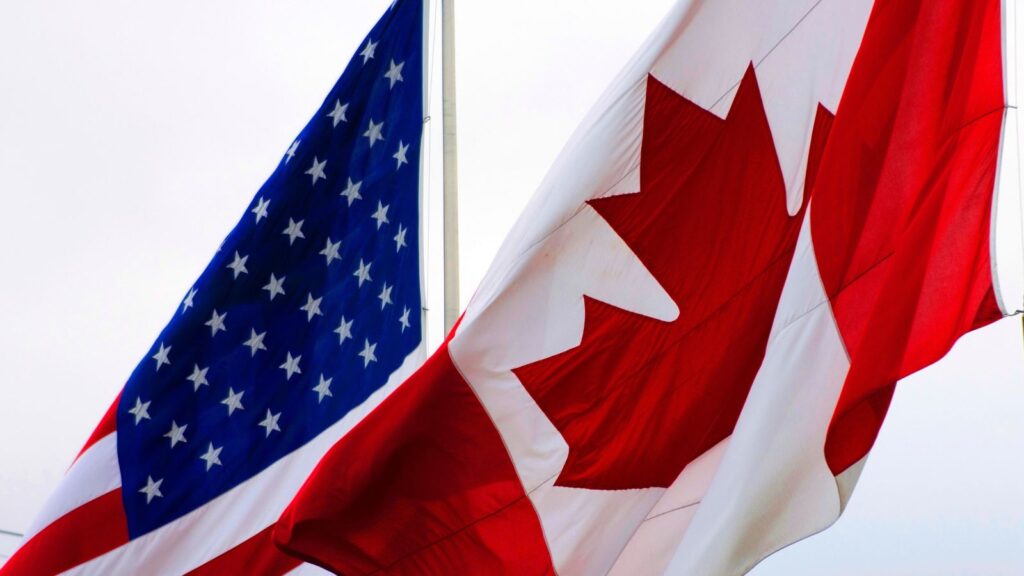
Canada’s growing determination to stand up to Washington is meeting a more personal calculation at the kitchen table: who pays the bill?
After months of tariff disputes and stalled negotiations, Canadians continue to favour a strong national response. However, recent research reveals an uncomfortable divide between defending Canada’s economic independence and accepting the financial consequences of a prolonged trade conflict.
Job security, household expenses and retirement savings are becoming important considerations, even as support for preserving North American trade remains substantial.
The emerging picture is not one of Canadians suddenly embracing American demands or abandoning efforts to diversify their economy. Instead, it reflects a country attempting to balance national sovereignty with financial stability, while discovering that reducing dependence on its largest trading partner is considerably more complicated than simply buying fewer American products.
Strong Support for Confronting Washington Comes With Conditions
Canadians remain overwhelmingly supportive of defending their country’s economic interests, but that support has important limits. A Build Canada poll conducted between August 31 and September 4, 2026, found that 75% of respondents favoured maintaining a firm negotiating position against the United States, even if economic costs persisted. Only 20% preferred making concessions to secure a quicker agreement. The findings suggest that frustration with American trade policies has not translated into widespread enthusiasm for compromise.
However, attitudes become more complicated when specific financial consequences enter the discussion. Many respondents who supported Canada’s negotiating position also expressed opposition to potential household job losses, higher taxes and reductions in retirement savings. This distinction is significant because supporting national economic independence does not necessarily mean accepting unlimited personal hardship. The research did not establish that individual respondents changed their minds after reviewing information. Rather, it revealed how support for a tough negotiating position coexists with resistance to particular economic sacrifices.
Job Security Emerges as One of the Biggest Concerns
The possibility of losing employment appears particularly troubling when Canadians consider the consequences of prolonged trade tensions. Build Canada’s research found that approximately 68% considered a noticeably increased risk of household job loss unacceptable. Among respondents, 46% described that possibility as completely unacceptable, while only about 21% considered the additional risk acceptable. These findings highlight the difference between supporting a national negotiating strategy and confronting uncertainty over a family’s next paycheque.
The concern is especially relevant to industries closely connected to American customers. Canadian automotive manufacturers, steel producers, aluminum facilities and lumber businesses have faced significant U.S. trade restrictions. For workers employed by suppliers serving American factories, losing access to established customers could affect production schedules, investment decisions and future employment opportunities. Finding replacement buyers overseas is rarely straightforward, particularly when products are designed for integrated North American supply chains. The findings suggest that maintaining public support for a prolonged dispute may depend partly on protecting employment in communities exposed to cross-border trade.
Higher Taxes and Retirement Losses Complicate the Debate
Canadians also appear reluctant to finance an extended trade confrontation through significant personal financial sacrifices. In the Build Canada research, respondents were presented with hypothetical annual household tax increases of $500, $1,000 and $2,500. Across the separate groups considering those amounts, approximately 56% to 60% rejected the increases. The results indicate that even relatively modest additional tax burdens can encounter resistance when associated with Canada’s response to American tariffs.
Retirement savings produced similarly strong reactions. When respondents considered potential investment or retirement savings losses of 5%, 10% and 20%, approximately 58% to 68% found those outcomes unacceptable, depending on the scenario. For households approaching retirement, an investment loss could mean adjusting spending plans or reconsidering when to stop working. These responses do not establish that such losses will occur, but they illustrate why economic policy becomes more complicated when hypothetical national benefits are weighed against potential household costs. Canadians may support economic independence while expecting policymakers to minimize the financial burden associated with pursuing it.
Workers and Retirees View Economic Sacrifice Differently
The willingness to accept higher costs varies significantly across age groups and employment circumstances. Build Canada’s findings showed that 54% of retirees would accept increased expenses indefinitely to maintain Canada’s negotiating position, compared with only 36% of full-time workers. Among Canadians aged 30 to 44, approximately 33% were unwilling to accept any additional costs, compared with just 14% of respondents aged 75 or older. These differences suggest that economic uncertainty is experienced differently depending on individual circumstances and financial responsibilities.
Occupational differences are equally revealing. Forty-four percent of blue-collar respondents said they would accept no higher costs, compared with 20% of white-collar respondents. Political preferences also shaped responses, with 96% of surveyed Liberal voters supporting a firm negotiating position, against 41% of Conservative voters. The research does not establish whether these differences result from political beliefs, financial circumstances or a combination of factors. Nevertheless, they illustrate why a national strategy built around economic sacrifice may face different reactions from factory workers, salaried professionals, retirees and younger families managing household expenses.
Most Canadians Still Believe the North American Trade Agreement Benefits Canada
Despite growing tensions with Washington, Canadians have not broadly rejected the economic benefits of North American trade. Research published by the Chicago Council on Global Affairs in June 2026, incorporating Canadian findings from Nanos Research, found that 81% considered the Canada-United States-Mexico Agreement beneficial to Canada’s economy. Furthermore, 52% wanted the agreement maintained under its existing terms, while another 24% preferred remaining in a renegotiated arrangement. Only 7% supported leaving the agreement altogether.
These preferences highlight an important distinction between opposing American trade demands and rejecting the underlying economic relationship. The same research found that 69% of Canadians preferred resisting U.S. pressure for concessions, even at the risk of worsening relations. Maintaining trade access while negotiating stronger protections is therefore consistent with prevailing public opinion. The agreement, commonly called CUSMA in Canada, also remains in force despite the United States declining to extend it at its scheduled 2026 review. Instead, the countries face annual reviews, creating additional uncertainty for companies planning investments and long-term production arrangements.
Canada’s Economic Dependence Goes Far Beyond the Border
In 2025, American customers purchased approximately C$683.3 billion in Canadian goods and services, representing 67.2% of the country’s total exports. Those figures, published by Global Affairs Canada, demonstrate why the United States remains so difficult to replace as a trading partner. The relationship also extends well beyond products sitting on store shelves. At the Blue Water Bridge connecting Sarnia, Ontario, and Port Huron, Michigan, more than 2.1 million commercial trucks cross annually, carrying goods through one of North America’s major trade corridors.
The deeper complication is how closely Canadian and American production systems are connected. According to the Bank of Canada, American-sourced components account for roughly one-fifth of the value of Canada’s exports to the United States. In 2024, approximately one-quarter of Canadian imports originating outside the United States also travelled through American territory before entering Canada. Changing these arrangements can require different transportation routes, suppliers and business relationships. Consequently, cutting American trade ties could disrupt Canadian manufacturers as well as their U.S. customers.
Economic Forecasts Reveal the Potential Cost of Prolonged Tariffs
The consequences of prolonged trade restrictions extend beyond individual businesses. In an assessment released October 20, 2026, Canada’s Parliamentary Budget Officer estimated that recent American trade measures had increased the effective U.S. tariff rate on Canadian imports from 5.3% in June to 7.7%. Canada’s corresponding tariff rate on American imports rose from 1.6% to 3.0%. These changes make cross-border commerce more expensive, potentially affecting investment decisions, business profitability and consumer prices.
The budget watchdog estimated that trade measures introduced since early 2025 could leave Canada’s inflation-adjusted economy 1.4% smaller after five years than it would have been under a pre-tariff baseline. If those measures remained permanent, employment could be as much as 185,000 jobs lower than the baseline. Importantly, these are modelled economic impacts, not confirmed job losses or predictions that every outcome will occur. Actual results will depend on policy changes, business adjustments and global economic conditions. Nevertheless, the estimates illustrate why Canadians concerned about household finances may hesitate to endorse an unrestricted economic confrontation.
Export Diversification Is Advancing, but Replacement Markets Take Time
Canada has made measurable progress in finding customers beyond the United States. Global Affairs Canada reported that exports of goods and services to non-American markets increased 11.1% in 2025, adding approximately C$33.3 billion in sales. Meanwhile, exports to the United States declined 3.7%. The share of Canadian exports destined for countries outside America reached 32.8%, its highest level since 1981. That represents an important shift for a country historically dependent on its southern neighbour.
However, the composition of that growth matters. A substantial portion came from gold shipments, particularly to the United Kingdom, alongside increased crude oil exports to Europe and the Indo-Pacific. Those opportunities are not necessarily available to every Canadian manufacturer. More recent data from the Parliamentary Budget Officer showed that nominal merchandise exports to non-U.S. destinations in August 2026 were 51% above their 2024 monthly average, although price changes also influence such comparisons. The Bank of Canada has emphasized that developing new customers and supply chains requires time and investment. Diversification is underway, but it cannot immediately replace decades of North American commercial integration.
Canadians Are Seeking Economic Independence Without Abandoning Trade
For many Canadians, the desire for greater independence has already influenced everyday purchasing decisions. Build Canada’s September research found that 69% of respondents reported choosing Canadian products despite higher prices during the previous 12 months. Another 57% said they had cancelled or avoided American travel, while 55% reported stopping purchases from particular U.S. brands. These self-reported behaviours illustrate public willingness to make certain financial sacrifices, even as majorities rejected the hypothetical prospect of substantial taxes, retirement losses or increased unemployment risks.
The longer-term challenge is turning that determination into an economically sustainable strategy. An October 2026 report from the Institute for Research on Public Policy recommended expanding trade partnerships, diversifying critical supply chains, developing higher-value exports and strengthening investment relationships beyond the United States. Ottawa has also established a goal of doubling non-U.S. exports by 2035. Together, these approaches suggest that Canada’s strongest option may not be abandoning American trade, but reducing the risks of depending too heavily on it. The central question is no longer whether Canadians want greater economic independence. It is how much that independence should cost, and how carefully the transition can be managed.
