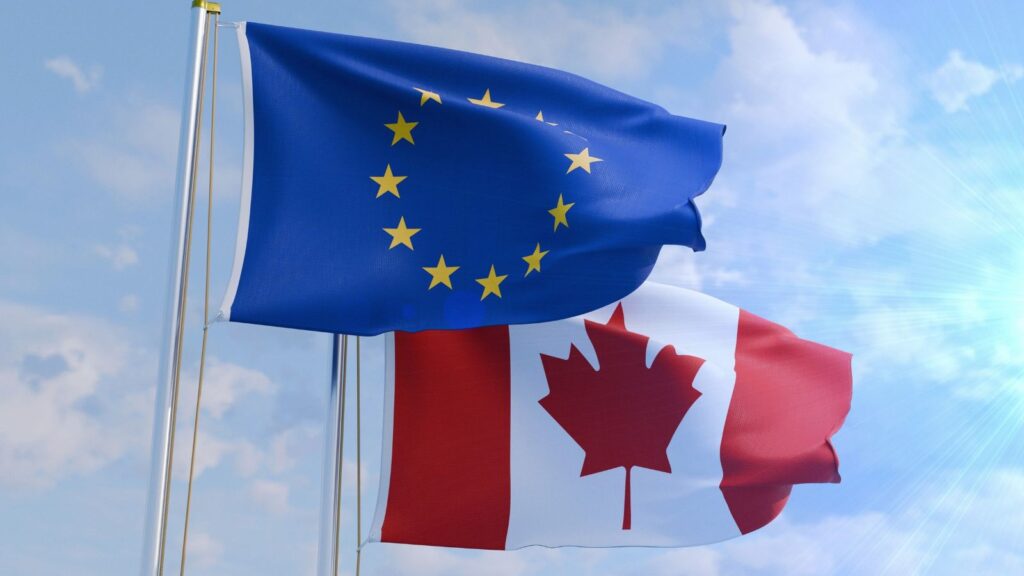
Canada’s relationship with Europe is entering a new chapter, with Prime Minister Mark Carney pursuing a closer international alliance as President Donald Trump’s trade policies continue to reshape Canada’s economic priorities.
At a high-profile summit in Montréal on October 29 and 30, 2026, Carney is meeting European Commission President Ursula von der Leyen and European Council President António Costa to advance an ambitious partnership covering trade, defence, technology, energy and economic security.
The proposed “Alliance for the Future” reflects a growing determination to reduce dependence on the United States while strengthening relationships with reliable international partners. However, disagreements within Europe over Canada’s proposed special status show that the transformation will not be straightforward.
For Canadian businesses, workers and consumers, the stakes extend far beyond diplomatic symbolism. The outcome could influence where Canadian products are sold, how investment flows across the Atlantic and how the country protects its economic independence.
A New Alliance Takes Shape in Montréal
The 21st Canada–European Union summit represents one of the most ambitious efforts in decades to strengthen Canada’s relationship with Europe. Carney is hosting von der Leyen and Costa with the goal of developing an Alliance for the Future, a proposed framework designed to bring both economies closer together. Unlike a traditional trade agreement focused primarily on tariffs and market access, the initiative would expand cooperation into defence, advanced technology, critical minerals, research and economic security. European officials have described the plan as a major step toward a more integrated political and economic relationship.
The summit began with business-focused discussions on October 29, ahead of formal leaders’ talks scheduled for October 30. At the Canada–EU Business Forum, Costa emphasized the importance of aligning standards, improving labour mobility and strengthening investment in strategic industries. Those priorities could have practical consequences for Canadian companies seeking European customers. A manufacturer facing different certification requirements across two markets, for example, could benefit from greater regulatory coordination. The summit is expected to establish the direction of the partnership, although its long-term structure remains subject to further negotiations.
Trump’s Trade Pressure Is Accelerating Canada’s European Strategy
Canada’s renewed focus on Europe comes against the backdrop of a deeply unsettled trading relationship with the United States. Trump’s tariffs and increasingly confrontational approach to international trade have encouraged Ottawa to reconsider the risks of concentrating so much economic activity in one market. In September, Trump warned that Canada’s proposed closer association with the EU could be viewed as a hostile act, threatening additional tariffs on Europe if he believed the arrangement was directed against American interests. Canadian officials have maintained that closer European cooperation is not intended to undermine Washington.
The economic challenge remains enormous. According to Statistics Canada, 71.7% of Canadian merchandise exports went to the United States in 2025, compared with 75.9% in 2024. Although exports to other destinations increased by 17.2%, deeply integrated manufacturing networks and longstanding commercial relationships make rapid diversification difficult. Automotive suppliers, energy producers and manufacturers cannot simply replace American customers with European buyers overnight. Carney’s strategy is therefore less about abandoning Canada’s largest trading partner and more about creating additional options that could reduce the country’s vulnerability to future trade disputes.
Europe Is Already One of Canada’s Most Important Trading Partners
Europe is far from an unfamiliar destination for Canadian businesses. The European Union was Canada’s second-largest trading partner for goods and services in 2025, with two-way commerce valued at approximately C$178.6 billion. European data place bilateral trade at roughly €130 billion, representing an increase of more than 80% compared with 2016. Much of that expansion has taken place under the Comprehensive Economic and Trade Agreement, commonly known as CETA, which began provisional application in September 2017. The agreement eliminated tariffs on 98% of tariff lines at the outset, helping businesses trade across the Atlantic with fewer financial barriers.
Despite that progress, the relationship still has room to develop. Nine EU member states have not completed their national ratification procedures for CETA, meaning certain provisions remain outside full implementation. Smaller businesses can also encounter unfamiliar regulations, administrative expenses and the challenge of establishing reliable distribution networks. Nevertheless, momentum has continued. The Canadian government reported that merchandise exports to the EU increased by almost 21% during the first eight months of 2026. For Ottawa, that growth suggests the European market could play a meaningful role in reducing Canada’s dependence on American demand.
Canada’s Proposed EU Membership Status Is Facing Resistance
One of the most politically sensitive questions surrounding the summit involves von der Leyen’s suggestion that Canada could become the European Union’s first “associate member.” The European Commission president has described her vision as a form of association without formal accession, potentially allowing Canada to participate more closely in selected European programmes and institutions. However, such a designation is not currently defined under EU treaties, and Canada is not seeking full membership in the 27-country bloc. Carney has emphasized that the practical benefits of cooperation matter more than the terminology used to describe the relationship.
Several European governments, including Germany and France, have raised concerns about creating a new membership category without clearly established legal responsibilities. According to reporting by Reuters, the proposed designation was removed from a draft summit declaration, replaced by language supporting an increasingly close association. Von der Leyen continued advocating the concept in Montréal, but no formal associate-member status has been granted. The disagreement highlights an important political obstacle: even when Canada and the European Commission share ambitious goals, the governments of individual EU countries must be brought into agreement. Negotiations will therefore need to establish what closer cooperation means in practice, including its financial and institutional implications.
Defence Cooperation Is Already Producing Opportunities for Canadian Companies
Defence has emerged as one of the strongest areas of cooperation between Canada and Europe. During their June 2025 summit, the two sides signed a Security and Defence Partnership designed to strengthen military cooperation and industrial collaboration. Canada subsequently became the first non-European country to participate in the EU’s Security Action for Europe initiative, known as SAFE. The programme provides up to €150 billion in loans to EU member states to support defence investment through procurement. Under a separate agreement that entered into force on August 1, 2026, eligible Canadian manufacturers and products can participate in procurement supported by the initiative.
The arrangement has already produced a tangible Canadian example. Ottawa announced in June that Montréal-based Marconi Technologies would manufacture Canadian-made ORION tactical radios for Poland’s Cyber Command, describing it as Canada’s first procurement secured through SAFE. For domestic defence suppliers, European demand could create opportunities to expand production, hire specialized workers and develop longer-term international partnerships. However, participation remains subject to procurement requirements, and SAFE financing is directed toward European member governments rather than automatically provided to Canadian manufacturers. Even with those limitations, the agreement demonstrates how closer international cooperation can generate real business opportunities before a broader political alliance is finalized.
Critical Minerals and Energy Could Become Major Economic Priorities
Canada’s natural resources give the country another potential advantage in its expanding relationship with Europe. European manufacturers need reliable access to minerals used in electric-vehicle batteries, renewable-energy equipment, electronics and other advanced technologies. Canada possesses significant mineral resources, making it an attractive potential supplier as European governments seek more diversified industrial supply chains. The relationship already has a foundation: Canada and the EU established a strategic raw-materials partnership in 2021, focusing on investment, supply-chain integration, innovation and sustainability. The Montréal summit is intended to deepen that cooperation and encourage greater commercial investment.
Financing could become particularly important. Canada’s Department of Finance announced plans for Finance Minister François-Philippe Champagne and European Investment Bank Vice-President Nicola Beer to sign a framework agreement on October 30, aimed at facilitating investment in sectors including critical minerals. Energy security is another discussion point, with both sides examining opportunities involving Canadian liquefied natural gas. A feasibility study on potential long-term LNG exports to Europe has been contemplated, although it would not constitute a supply agreement. For resource-producing Canadian regions, the central question is whether European interest eventually translates into financed projects, processing facilities, transportation infrastructure and sustained employment. Those results will depend on commercial demand, regulatory approvals and significant investment.
Artificial Intelligence and Research Are Becoming Central to the Partnership
Technology cooperation could become one of the most consequential elements of the proposed alliance. Canada already participates in Pillar II of Horizon Europe, the EU’s major collaborative research programme, under an association agreement signed in July 2024. That arrangement gives eligible Canadian researchers and institutions opportunities to participate in and lead research projects with European counterparts. The two sides also launched a digital partnership in 2023. Their latest discussions are expected to explore stronger cooperation involving artificial intelligence, digital trade, computing infrastructure and technological security, reflecting concerns about excessive dependence on a small number of international technology providers.
Carney reinforced the importance of domestic technological capacity on October 29 by announcing a planned federal equity investment of up to C$1.6 billion in Toronto-founded artificial intelligence company Cohere. Under the arrangement, Cohere has committed to investing at least C$1.7 billion in additional Canadian computing infrastructure by 2030 while maintaining its Canadian headquarters. Its relationship with German AI developer Aleph Alpha provides a separate example of transatlantic technology cooperation. The federal investment is not itself an EU funding commitment, but it illustrates Ottawa’s broader strategy: building Canadian-owned technological capabilities while creating stronger international partnerships that can support innovation, research and access to global markets.
Students and Workers Could See More Opportunities Across the Atlantic
Beyond major investments and trade negotiations, the proposed partnership could eventually affect how Canadians study, work and build careers abroad. Officials have discussed expanding educational exchanges and exploring Canada’s participation in additional European initiatives, including Erasmus+, the EU programme supporting international education and academic mobility. Carney has identified greater opportunities for young Canadians to live, work and study in Europe as an important objective. For university students, researchers and early-career professionals, easier access to international programmes could provide valuable training and professional connections that extend well beyond the classroom.
Labour mobility is another priority. At the October 29 business forum, Costa highlighted the need to improve professional recognition, licensing procedures and the movement of workers between Canada and Europe. There is already a practical example of progress: an agreement providing for mutual recognition of architects’ professional qualifications entered into force in December 2025. Expanding such arrangements could eventually help employers recruit specialized talent while reducing unnecessary administrative barriers for qualified professionals. However, broader mobility rights have not yet been established, and Canadian participation in additional European programmes may carry specific financial obligations. The eventual benefits will depend on the rules governments negotiate and how accessible those opportunities become.
Canada and Europe Want a Stronger Voice in the International Order
The proposed alliance extends beyond economic diversification into a broader effort to strengthen international cooperation. In September 2026, Canada and the EU joined Australia, Barbados, Brazil, India and Kenya as initial co-sponsors of the Partners for Multilateralism initiative during the United Nations General Assembly. The coalition seeks stronger respect for international law, more effective international institutions and cooperation against economic coercion. Its diverse membership reflects an approach in which countries with different regional interests can work together on shared priorities without depending exclusively on any single global power.
Canada and Europe already coordinate on several important foreign-policy issues. Both support Ukraine against Russia’s invasion and have worked with G7 partners on sanctions, export controls and other responses. The Montréal summit also includes discussions involving the Arctic, the Middle East and broader international security. Those topics demonstrate how commercial relationships and geopolitical priorities are becoming increasingly connected. Nevertheless, shared principles do not guarantee agreement on every decision. European countries and Canada retain their own economic interests, domestic political pressures and national security priorities. The challenge will be translating common positions into practical actions that strengthen stability while respecting the independence of each participating government.
The Real Test Will Be Turning Diplomatic Promises Into Results
The importance of the Montréal summit will ultimately depend on what happens after the leaders depart. European Council President Costa made the practical challenge clear during the October 29 business forum, calling for more compatible regulations, stronger investment links and easier recognition of professional qualifications. Such changes may lack the visibility of a major political announcement, but they directly affect whether businesses can expand internationally. A smaller Canadian manufacturer considering European exports needs reliable standards, affordable shipping options and predictable rules. Similarly, prospective investors need confidence that ambitious agreements will be supported by consistent policies.
The summit is expected to conclude on October 30 with a joint statement outlining the next phase of cooperation. Officials have indicated that negotiations defining the deeper Canada–EU relationship could continue through the next bilateral summit in 2027. That timeline underscores an important distinction: the Alliance for the Future is an ambitious political project whose final structure has not yet been settled. Its success will be measured by new investments, export opportunities, operational agreements and benefits that reach Canadian businesses and households. Europe cannot quickly replace the United States as Canada’s largest trading partner. It can, however, offer Canada greater economic flexibility and additional strategic options in an increasingly unpredictable world.
