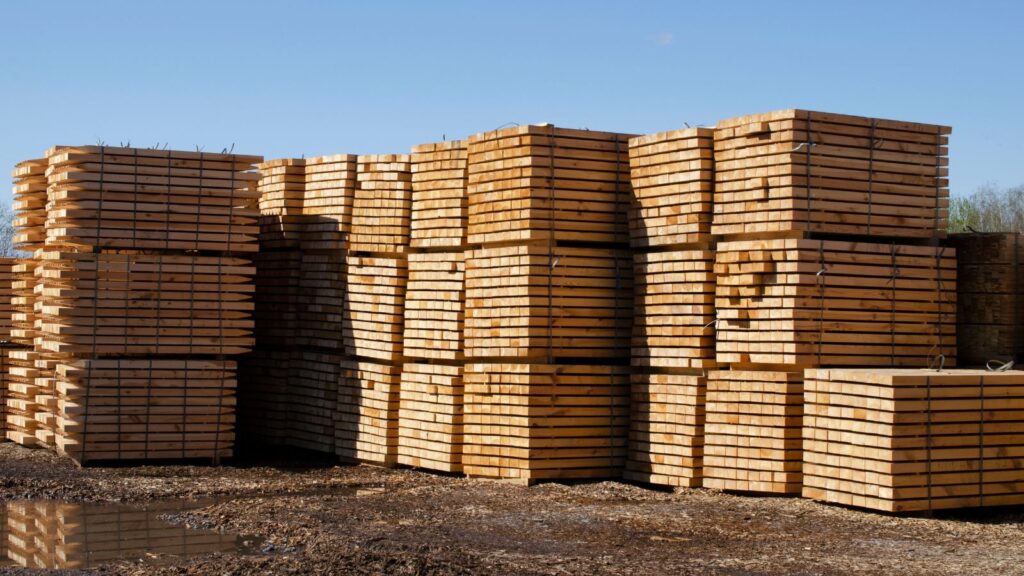
Canada’s long-running softwood lumber dispute with the United States has entered another legal battle, with Ottawa and five provincial governments challenging American trade duties that continue to weigh on Canadian forestry businesses.
Requests filed on November 18, 2026, and published in the U.S. Federal Register on November 23 seek binational reviews of American countervailing and anti-dumping duty decisions. Alberta, British Columbia, New Brunswick, Ontario and Quebec are participating in the countervailing duty challenge, while four of those provinces are also named in the separate anti-dumping case.
The developments come as President Donald Trump’s broader tariff policies add uncertainty to an already strained trading relationship. For Canadian lumber producers, the dispute reaches far beyond government negotiations. It affects export costs, sawmill competitiveness and the economic security of communities that depend on the forest industry.
Ottawa and Five Provinces Launch a Coordinated Legal Challenge
The federal government and five provincial governments have joined Canadian forestry businesses in challenging the U.S. Department of Commerce’s countervailing duty findings for softwood lumber. The formal requests for panel review were submitted on November 18, 2026, under Article 10.12 of the Canada-United States-Mexico Agreement (CUSMA). Alongside Ottawa, the governments of Alberta, British Columbia, New Brunswick, Ontario and Quebec are named in the proceeding. Major industry participants, including Canfor, Interfor, J.D. Irving, Tolko and West Fraser, are also among the parties requesting a review. A separate request in the same proceeding involves Resolute FP Canada, the Quebec Forest Industry Council and the Ontario Forest Industries Association, among others. The participation of governments, producers and industry organizations demonstrates how broadly the dispute reaches across Canada’s forestry sector.
A parallel challenge targets the United States’ anti-dumping duty findings for the same 2024 review period. That proceeding identifies the federal government and four provinces—Alberta, British Columbia, Ontario and Quebec—rather than all five. New Brunswick is specifically named in the countervailing duty challenge but not among the provincial governments in the anti-dumping filing. The distinction is important because the two proceedings address different legal findings, even though both involve Canadian lumber exports. The U.S. authorities published the notices on November 23, formally recording the requests and establishing the next procedural deadlines. Neither challenge represents an immediate cancellation of duties. Instead, both initiate a process in which binational panels can examine whether American trade authorities made errors of fact or law in reaching their decisions.
Two Different U.S. Lumber Duties Are at the Centre of the Dispute
The legal battle centres on two forms of American trade protection that have affected Canadian lumber exports for years. Countervailing duties are intended to offset subsidies that U.S. authorities determine give foreign producers an unfair advantage. Anti-dumping duties, meanwhile, address imported products that American investigators determine are being sold below their normal value. The United States applies both measures to certain Canadian softwood lumber products, while Ottawa maintains that the duties are unjustified. The latest challenges concern the U.S. Department of Commerce’s administrative reviews of shipments made during 2024. Although the underlying transactions occurred two years ago, the findings also influence the cash deposits required on current exports. That makes the dispute especially important for companies managing operating expenses, negotiating supply contracts and deciding how much lumber to send across the border.
The financial implications became clearer after the Commerce Department corrected a calculation error in November 2026. Its original October results assigned a 14.11% countervailing duty rate to non-selected companies. However, an amended determination published on November 19 reduced that rate to 14.08% and lowered Resolute’s individual countervailing rate from 12.42% to 12.35%. When combined with the 10.64% anti-dumping rate applicable to non-selected companies, the revised countervailing figure produces a combined rate of 24.72% for exporters subject to both rates. Other producers face different assessments. West Fraser’s combined anti-dumping and countervailing rate is 20.02%, while Canfor’s applicable reviewed rates total 31.08%. Even relatively small adjustments can matter when exporters are dealing with substantial shipment volumes. The continuing challenges also mean companies must manage financial uncertainty while the legal process unfolds.
Five Provinces Face Different Economic Pressures From the Lumber Fight
The decision by five provinces to participate reflects how deeply forestry is connected to regional economies across Canada. According to Natural Resources Canada’s 2025 annual report, the forest sector directly employed approximately 194,040 Canadians in 2024 and exported $37.2 billion worth of forest products. Those figures cover the broader forest industry, not just softwood lumber, but they illustrate the economic importance of the sector. Quebec accounted for approximately 30% of national forest sector employment, followed by British Columbia at 25%, Ontario at 20% and Alberta at 10%. Atlantic Canada collectively represented another 10%. The United States received approximately 76% of Canada’s forest product exports by value, underlining the industry’s reliance on the American market. For provinces with major sawmilling operations, prolonged trade barriers can complicate business planning and make international competition more difficult.
The consequences extend beyond the companies named in the legal filings. Sawmills support logging contractors, transportation businesses, equipment suppliers and other employers whose livelihoods are closely tied to wood production. Natural Resources Canada reports that more than 40% of forest sector workers live in rural and remote communities, where alternative employment opportunities may be limited. A reduction in mill operations can therefore affect businesses that have no direct involvement in international trade. The federal government’s 2026 budget recognizes these pressures by proposing additional forestry support, including loan programs, changes to the Softwood Lumber Guarantee Program and regional funding to help companies adapt. For affected communities, those measures may provide financial breathing room. However, temporary assistance cannot fully replace the stability that comes from predictable access to export markets, particularly for businesses making long-term investment decisions.
Trump’s Additional Tariffs Create Another Layer of Costs
The challenges are unfolding alongside a separate set of U.S. tariffs introduced under President Trump’s trade policies. In October 2025, the United States implemented a 10% tariff on certain softwood lumber imports under Section 232 of the Trade Expansion Act, a measure based on national security authority. That tariff applies in addition to existing anti-dumping and countervailing duties when products fall within the scope of both measures. Using the amended November 2026 figures, a Canadian lumber shipment subject to the 24.72% combined non-selected trade-remedy rate and the additional 10% Section 232 tariff would face a total nominal tariff burden of approximately 34.72%. The precise cost varies by producer and product classification. Separate American measures imposing 50% tariffs also affect certain Canadian wood, paper and engineered-wood products, but those additional duties should not be assumed to apply to every softwood lumber shipment.
American homebuilders have also expressed concern about the economic effects of escalating trade restrictions. The National Association of Home Builders warned in August 2026 that building-material tariffs increase supply-chain uncertainty and put additional pressure on construction costs during an already difficult period for housing affordability. The relationship is complicated by the United States’ continued demand for imported lumber. Global Affairs Canada states that American domestic mills cannot fully satisfy demand, making Canadian supply an important part of the market. A U.S. construction company purchasing lumber for a residential development must consider material costs when preparing its budget, while Canadian exporters must decide how much of the additional trade expense they can absorb. The latest legal proceedings specifically target the anti-dumping and countervailing duty determinations, meaning a successful challenge would not automatically eliminate Trump’s separate Section 232 tariff.
The Next Legal Deadlines Could Shape Canada’s Lumber Trade Outlook
The newly opened proceedings now move toward formal complaints and the establishment of binational panels. Under the published CUSMA procedures, parties wishing to challenge the American determinations must file their complaints by December 18, 2026. Other interested participants who intend to take part without filing a complaint have until January 4, 2027, to submit notices of appearance. The countervailing duty proceeding has been assigned case number USA-CDA-2026-10.12-01, while the anti-dumping proceeding carries number USA-CDA-2026-10.12-02. The panels will examine allegations involving errors of fact or law and ultimately issue binding decisions. Their role is to review the challenged trade-remedy determinations, rather than negotiate a new trade agreement or settle every aspect of the broader Canada-U.S. tariff dispute. Consequently, the filings represent an important legal step, but not a guarantee that the existing duties will disappear.
History suggests that reaching a lasting settlement may require more than another round of legal challenges. Canada and the United States signed a Softwood Lumber Agreement in 2006, resolving an earlier dispute and facilitating the return of more than $5 billion in duty deposits to Canadian companies. That agreement expired on October 12, 2015, and new American investigations eventually led to duties being imposed again in 2017. The dispute has since continued through multiple reviews, appeals and trade proceedings. Some older NAFTA panel challenges concluded in 2026, even as the latest CUSMA cases were being initiated. Ottawa continues to seek a negotiated solution, but the current legal filings demonstrate how difficult it has been to achieve lasting certainty. For Canadian forestry businesses and the communities that depend on them, the central question remains whether sustained legal and diplomatic pressure can eventually produce a more predictable trading relationship.
